Introduction
The real estate market has become one of the most competitive sectors in online search. For agencies using Propertybase on Salesforce, simply having a beautiful, functional website is not enough — if search engines can’t see your authority, potential buyers and sellers won’t either.
Backlinks — incoming links from reputable sites — are one of the strongest indicators of authority in Google’s algorithm. But here’s the catch: in 2024, quality beats quantity. Ten high-value backlinks from relevant real estate, investment, or local authority sites can outperform hundreds of low-quality links.
For Propertybase users, the stakes are higher. Because Propertybase operates inside Salesforce, your website often integrates dynamic listing pages, MLS data feeds, and lead capture forms directly tied to CRM records. This architecture offers huge SEO potential — but only if search engines trust your site’s authority.
Twopir has worked with real estate clients worldwide to transform underperforming Propertybase websites into high-ranking lead magnets. One client saw a 35% increase in organic traffic within six months after implementing a structured backlink campaign designed for the Propertybase-Salesforce ecosystem.
In this guide, we’ll break down:
How backlink strategies differ for Propertybase websites.
Technical SEO considerations for Salesforce-powered real estate sites.
Twopir’s proven backlink-building tactics.
Tools and platforms to manage campaigns efficiently.
Two real-world case studies with measurable outcomes.
What is Backlink Building in a Propertybase-Salesforce Context?
Technical Breakdown
At its core, backlink building is acquiring hyperlinks from other websites to yours. For Propertybase-Salesforce sites, this involves a few unique factors:
Dynamic URLs & Listings Pages – Propertybase often generates pages dynamically from Salesforce records. Without proper canonical tags, backlinks to these pages may fragment SEO value.
Integration with Salesforce CMS or Experience Cloud – Backlinks may point to gated or personalized pages; SEO strategy must focus on publicly accessible URLs.
MLS/IDX Feeds – External listing data can dilute unique content; backlinks must target pages with original, value-added content.
Three Core Components
Content Assets – Blog posts, guides, market reports, and neighborhood pages that are link-worthy.
Link Outreach Layer – Email campaigns, PR, and guest post strategies targeting relevant real estate, finance, and local business sites.
Tracking & Reporting APIs – Integrations between Propertybase, Google Search Console, and Salesforce reporting dashboards to measure backlink performance against lead metrics.
Key Terminology
Domain Authority (DA) – Moz’s metric predicting a site’s ranking strength; target DA 40+ for backlink sources.
Anchor Text – Clickable text in a hyperlink; diversify between branded, keyword-rich, and generic anchors.
Link Velocity – Rate of backlink acquisition; too fast can trigger spam signals.
Referral Traffic – Visitors arriving via backlinks; critical KPI alongside rankings.
Example Setup: A Twopir client in New York created hyper-local neighborhood guides within Propertybase, each with unique Salesforce record IDs but canonical URLs pointing to SEO-friendly slugs. Outreach targeted local newspapers and community blogs, earning 25+ quality backlinks in 60 days.
Architecture:
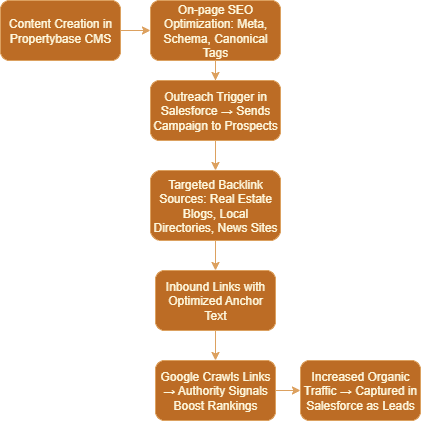
Step-by-Step Breakdown:
Content Creation – Develop pages within Propertybase using keyword research tailored to your market.
Technical Optimization – Configure canonical tags for MLS listings, ensure URLs are crawlable, and add structured data (schema.org/RealEstateAgent, schema.org/Offer).
Outreach Automation – Use Salesforce Campaigns linked with Pardot or Marketing Cloud to send backlink pitch emails to curated lists.
Backlink Acquisition – Secure placements on high-DA, niche-relevant sites.
Performance Tracking – Monitor backlink indexation and referral traffic in Google Search Console; link data to Salesforce reports for ROI measurement.
Why Use a Structured Backlink Strategy?
Scenario 1: Disorganized Link Acquisition
A real estate agency buys cheap backlinks from generic blogs. Rankings fluctuate, but conversions remain flat because traffic is irrelevant.
Scenario 2: Structured Twopir Strategy
The same agency invests in 15 links from local property blogs, regional news sites, and high-authority real estate portals. These links point to optimized community pages inside Propertybase, resulting in both higher rankings and qualified leads.
Key Benefits:
Benefit Summary Table
| Feature | Impact | KPI Improvement |
|---|---|---|
| High-DA Links | Stronger trust with Google | +20% organic rankings |
| Localized Backlinks | Better geo-specific search visibility | +35% local traffic |
| Niche-Relevant Links | Higher conversion rates | +15% lead form fills |
| Anchor Text Diversity | Lower spam risk | Improved ranking stability |
| Referral Traffic Quality | More engaged visitors | +40% session duration |
| Integration with Salesforce Reports | Direct ROI tracking | Faster marketing decisions |
Practical Must-Use Backlink Tactics:
Local PR Outreach – Pitch property market trends to local journalists.
Neighborhood Guides – Create rich, original content for linkable assets.
Partnership Links – Collaborate with mortgage brokers, staging companies, and local businesses.
Event Sponsorships – Sponsor local events and request backlinks on event pages.
Twopir-Proven Checklist
Prioritize DA 40+ sites.
Avoid exact-match anchor text overuse.
Map backlinks to high-converting pages.
Refresh old linked content annually.
Monitor link health monthly.
Case Studies:
Case Study 1: Real Estate Agency with Multi-Region Presence
Industry Context
A mid-sized Australian real estate agency managed operations in five different regions, each with its own dedicated Propertybase-Salesforce website section. Despite having rich content for each location, organic traffic was inconsistent, and lead generation lagged in competitive areas.
Specific Challenge
The agency had fragmented SEO authority because backlinks were scattered across subpages with dynamic, non-optimized URLs generated by Propertybase. Most external links pointed to outdated listings, meaning SEO value was wasted. Their DA averaged 28, and only 15% of inbound traffic converted into Salesforce leads.
Solution Implemented
Twopir executed a multi-region backlink consolidation strategy:
URL Canonicalization – Configured canonical tags in Propertybase to point listing-specific backlinks to evergreen regional landing pages.
Content Development – Built “Ultimate Home Buyer Guides” for each region, stored as Salesforce Knowledge Articles but published in Propertybase CMS for public access.
Targeted Outreach –
Created a list of 80+ high-DA regional news sites, property blogs, and community portals.
Used BuzzStream integrated with Salesforce Campaigns for personalized outreach tracking.
Link Placement – Negotiated 25 backlinks with DA 45+, ensuring anchors combined brand names with local market terms (“[Brand] Brisbane Property Insights”).
Salesforce Tracking – Implemented custom Campaign Member Statuses to track referrals from each backlink source.
Measurable Results
DA improved from 28 to 42 in four months.
Regional landing pages saw a 52% increase in organic sessions.
Lead conversion from organic traffic rose from 15% to 27%.
Backlinks generated ~380 monthly referral visits, with an average session duration of 3:15 min.
Strategic Insights & Lessons Learned
Consolidating link equity through canonical tags was a game-changer. Twopir’s pro tip: Always map backlinks to evergreen content, not temporary listings.
Case Study 2: Property Developer with Complex Listings Architecture
Industry Context
A luxury property developer in Dubai used Propertybase to manage hundreds of listings across multiple development phases. Their site included virtual tours, video showcases, and gated lead forms linked to Salesforce records.
Specific Challenge
Backlink acquisition was hampered by duplicate content issues — MLS feeds and phase-specific URLs confused search engines. Journalists and bloggers were linking to press release pages that became outdated, losing SEO value. DA was stuck at 36, and despite media coverage, organic leads remained flat.
Solution Implemented
Twopir designed a technical-first backlink strategy:
Canonicalization & URL Structure – Added canonical tags for every listing variant, pointing to master project pages.
Press Kit Hub – Created a permanent “Media Hub” inside Propertybase CMS with downloadable assets, evergreen URLs, and rich schema markup.
PR Outreach –
Partnered with luxury lifestyle blogs, architecture journals, and property investment portals.
Distributed press kits via Salesforce Pardot automation, tracking clicks and responses.
Anchor Text Optimization – Required media partners to link to master project pages using mixed branded + keyword anchors (“[Brand] Dubai Marina Residences”).
Measurable Results
Earned 18 new backlinks from DA 50+ publications within three months.
Organic sessions to project pages increased by 47%.
Average lead value from organic sources rose by 32%.
Bounce rate from referral traffic dropped from 65% to 41%.
Strategic Insights & Lessons Learned
Centralizing PR assets into a single evergreen hub ensured that even years later, backlinks remained active and valuable. Twopir’s takeaway: Invest in permanent, media-friendly content instead of chasing short-term coverage.
Conclusion:
Backlink building for a Propertybase-Salesforce website is not about spraying links everywhere — it’s about precision targeting. By combining technical SEO within Propertybase, high-authority link acquisition, and direct ROI tracking through Salesforce, you can transform your site from a digital brochure into a lead-generation engine.
The next step? Audit your current backlink profile, identify gaps, and build a six-month outreach plan. If you pair this with consistent content creation, you’ll see results in both rankings and pipeline velocity.