Introduction
In today’s fast-evolving digital landscape, nonprofit organizations need more than just donor tracking—they need a comprehensive, scalable platform that enables impact-driven operations. Salesforce’s Nonprofit Success Pack (NPSP) has long served as a powerful foundation for nonprofits, offering basic CRM capabilities and fundraising tools. But as missions grow more complex and service delivery becomes more data-intensive, many organizations are discovering the limitations of NPSP. Enter Salesforce Nonprofit Cloud, the next-generation solution tailored to address modern nonprofit challenges head-on.
According to a 2023 Salesforce.org report, over 70% of nonprofits struggle with fragmented data, while 64% lack tools to measure mission impact effectively. These gaps can stifle growth, hurt donor confidence, and make it harder to demonstrate outcomes to stakeholders. That’s where Nonprofit Cloud excels. With native support for program management, case tracking, and outcome measurement, this purpose-built platform goes far beyond fundraising—enabling nonprofits to operate with precision, transparency, and agility.
At Twopir Consulting, we’ve helped multiple organizations successfully migrate from NPSP to Nonprofit Cloud, unlocking new levels of efficiency and impact. Whether you’re a small nonprofit scaling up services or an enterprise NGO managing thousands of cases globally, transitioning to Nonprofit Cloud equips you with the future-ready tools to deliver on your mission—faster and smarter.
What is Salesforce Nonprofit Cloud?
Salesforce Nonprofit Cloud is a purpose-built suite of industry solutions embedded directly within Salesforce Industries. Unlike NPSP, which relies on custom configurations and managed packages, Nonprofit Cloud leverages Salesforce’s metadata-driven architecture for scalability, automation, and deep analytics.
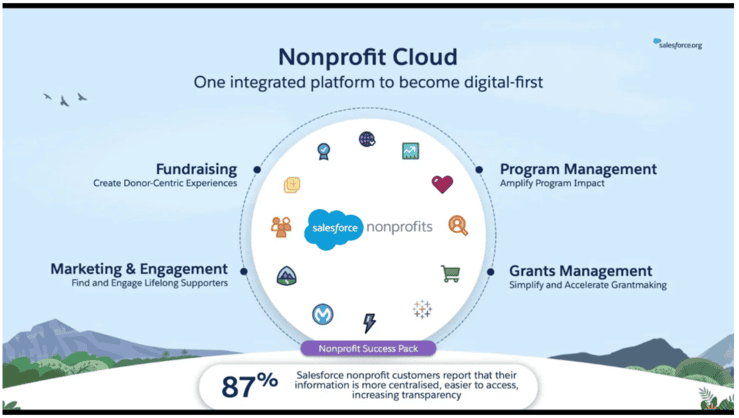
Three Core Components:
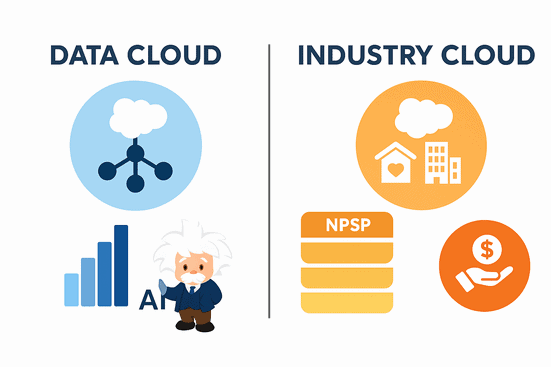
1. Data Cloud and Industry Data Model:
Nonprofit Cloud introduces a new data model based on Salesforce Industries. It replaces traditional objects like Donation or Household with industry-aligned objects such as Fund, Engagement, Program, and Outcome. These objects are natively related and optimized for real-time data operations.
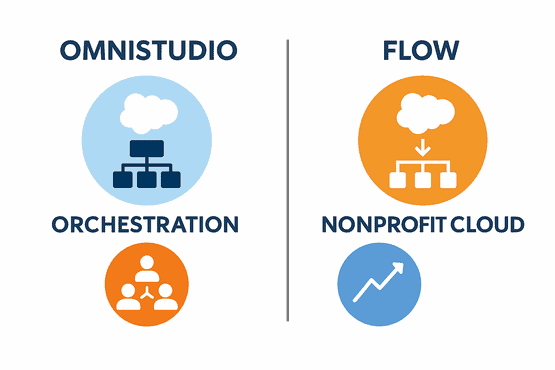
2. OmniStudio and Flow Orchestration:
Instead of customizing Apex or installing unmanaged packages, Nonprofit Cloud leverages OmniStudio and Flow Orchestration for low-code automation. For example, a user intake process that once required multiple Apex triggers can now be orchestrated in OmniStudio via declarative drag-and-drop steps.
3. Program Management and Outcome Measurement:
Salesforce Nonprofit Cloud includes pre-configured components for program planning, delivery tracking, and outcome reporting. Whether you’re running a food bank or a mentorship program, these tools enable you to measure the tangible impact of every effort.

NPSP vs Nonprofit Cloud: Data transformation
Moving from Salesforce NPSP to Nonprofit Cloud isn’t just a system upgrade. It’s a fundamental shift in how your data is structured and utilized. Some of the key differences to address include:

Contacts to Person Accounts: In NPSP, Contacts are standalone, but in NPC, they transform into Person Accounts—a unique blend of Contacts and Accounts. This change calls for a careful migration strategy to ensure all contact data is effectively converted into Person Accounts. While this shift may require some adjustment, it ultimately streamlines data management and enhances user experience.
Redefining opportunities: NPC reimagines how gift information is stored. While Opportunities remain a feature and may be practical for major gifts, NPC introduces objects like Gift Commitments and Gift Transactions for more nuanced donation handling. Migrating Opportunities from NPSP into NPC’s new structures requires a strategic approach, considering constraints like the non-acceptance of $0 gift transactions in NPC.
Gift and transaction information: NPC consolidates gift and transactional data into a single Object, differing from NPSP’s separate treatment. This consolidation demands a thoughtful combination of data from two distinct sources during migration.
Tribute information: NPC separates tribute information into its own record, which is linked to gift transactions, unlike its integration within opportunity records in NPSP. This split requires a precise division of existing data.
Key Benefits of Transitioning from NPSP to Nonprofit Cloud
Migrating from Salesforce NPSP to Nonprofit Cloud unlocks a suite of powerful, enterprise-ready benefits. Below, we outline the most impactful advantages—each paired with technical insights, business value, and real-world examples—to help you understand why this transition is worth your investment.
1. Modern Data Model for Scalability and Flexibility: Nonprofit Cloud introduces a standardized industry data model built on the Salesforce Industry Common Objects (ICOs). This enables better alignment with Salesforce’s long-term roadmap, supporting more scalable and flexible system designs.
2. Advanced Program Management Capabilities: With the Program Management Module (PMM) built into Nonprofit Cloud, organizations can track services, enroll constituents, and measure outcomes—all through standard objects and flows.
3. Outcome Management for Real-Time Impact Tracking: Nonprofit Cloud includes Outcome Management objects that allow you to define indicators, associate them with goals, and track performance in real time—tied directly to program enrollments and service deliveries.
4. OmniStudio for Declarative Process Automation: OmniStudio enables admins to create sophisticated, multi-step forms and guided interactions without writing code. It replaces many Apex-heavy use cases with drag-and-drop tools.
5. Enhanced Security and Compliance Support: Built-in support for Salesforce Shield, field-level tracking, and advanced role hierarchies makes compliance with HIPAA, GDPR, and other regulations easier.
6. Built-in Integration with Experience Cloud and Tableau: Nonprofit Cloud seamlessly integrates with Experience Cloud for self-service portals and Tableau for real-time analytics, enabling robust data storytelling and external engagement.
7. Future-Proof Architecture and Long-Term Support: Salesforce is prioritizing Nonprofit Cloud over NPSP in future releases, with ongoing investment in industry-specific features via the Industries architecture.
Why Use Nonprofit Cloud?
1. Case: Food Security Nonprofit:
Challenge: A regional food bank using NPSP struggled to track which families had received monthly food deliveries.
Solution: By moving to Nonprofit Cloud and enabling Program Cohorts with Outcome Metrics, each household’s delivery schedule was tracked automatically. This cut manual spreadsheet usage by 95% and improved service accuracy.
2. Case: Youth Mentorship Program:
Challenge: The NPSP model couldn’t support mentor-mentee pairing at scale or track program outcomes effectively.
Solution: Nonprofit Cloud introduced a relationship mapping model between mentors and cohorts. The program team leveraged Flow Orchestration to auto-match mentors to mentees based on skills and availability.
Key Benefits of Salesforce Nonprofit Cloud
1. Unified, Person-Centric Data Model:
- Simplifies data across programs, services, and cases.
- Eliminates complex household structures from NPSP.
- Enables a 360-degree view of each constituent or client.
2. Built-In Program and Case Management:
- Native tools to track client services, cases, and referrals.
- Use Action Plans and Assessments to standardize delivery.
- Reduces reliance on third-party apps or custom objects.
3. Outcome Management Capabilities:
- Measure progress toward mission-aligned goals natively.
- Define KPIs, collect results, and visualize impact.
- Greatly improves transparency with funders and boards.
4. Scalable Architecture for Growth:
- Designed for larger or expanding organizations.
- Supports multi-program, multi-site, or global structures.
- Aligns with Salesforce’s industry cloud strategy.
5. Low-Code Automation with OmniStudio:
- Powerful tools for guided processes, like client intake.
- Reduces admin workload and increases operational consistency.
- Enables integration across external systems more easily.
6. Enhanced User Experience:
- Industry-specific UI improves user adoption.
- Embedded flows simplify complex data entry.
- Experience Cloud portals empower clients and partners.
7. Embedded Analytics and Impact Dashboards:
- Native Tableau integration for real-time dashboards.
- Pre-built KPIs for service delivery, outcomes, and engagement.
- Moves nonprofits from reactive to data-driven decision-making.
Conclusion
Transitioning from NPSP to Salesforce Nonprofit Cloud is a strategic move for nonprofits ready to modernize their operations, scale their programs, and measure impact with greater precision. With its native industry architecture, built-in automation tools like OmniStudio, and robust program and outcome management features, Nonprofit Cloud offers a more flexible and sustainable foundation than NPSP.
This transition isn’t just about adopting new technology—it’s about aligning your organization with modern expectations around data transparency, constituent engagement, and impact reporting. Whether you’re looking to improve donor retention, streamline program delivery, or secure larger grants, Nonprofit Cloud equips you with the tools to succeed.