INTRODUCTION
In the realm of data analytics and customer relationship management, score decay management is a crucial but often overlooked aspect. Effective management of score decay can significantly impact the accuracy and utility of your scoring systems, ensuring that your data remains relevant and actionable. This article explores the nuances of score decay management, its implications, and strategies for optimal implementation.

Understanding Score Decay
Score decay refers to the gradual reduction in the value or relevance of a score over time. In many scoring models, especially those used in lead scoring, customer segmentation, or risk assessment, scores are assigned based on specific criteria or behaviors. However, as time progresses, the relevance of these scores may diminish. For instance, a lead’s initial interest might wane, or a customer’s engagement might change, leading to outdated or misleading scores.
Understanding score decay is essential for maintaining the integrity of your scoring models. It involves recognizing that a static score may no longer accurately reflect the current state or behavior of an individual or entity. Hence, score decay management ensures that scores remain dynamic and reflective of recent activities or changes.
The Impact of Score Decay on Data Accuracy
Score decay can have profound implications for data accuracy. When scores become obsolete, the decisions based on these scores can be flawed. For example, if a lead scoring model does not account for the decline in a lead’s engagement over time, the sales team might prioritize leads who are no longer interested, leading to wasted resources and missed opportunities.
Moreover, in customer segmentation, outdated scores can lead to misclassifications, affecting targeted marketing efforts and overall strategy. Effective score decay management helps mitigate these risks by ensuring that scores are updated to reflect the most current data, thereby enhancing decision-making accuracy and operational efficiency.

Strategies for Effective Score Decay Management
Implementing Time-Based Decay Functions
One of the most straightforward approaches to managing score decay is to incorporate time-based decay functions into your scoring models. These functions reduce the score value systematically based on the age of the data. For example, a lead’s score might decrease by a fixed percentage each week or month if no new interactions are recorded. This method ensures that scores naturally adjust over time, reflecting diminishing relevance.
Utilizing Activity-Based Adjustments
Another effective strategy involves adjusting scores based on recent activities or interactions. For instance, if a customer re-engages with your brand, their score can be recalibrated to reflect renewed interest. This approach ensures that scores are not only time-sensitive but also responsive to changes in behavior. By integrating activity-based adjustments, you maintain a dynamic and responsive scoring system.
Periodic Review and Recalibration
Regular reviews and recalibrations of your scoring models are vital for managing score decay. Periodically assessing the effectiveness of your scores and making necessary adjustments can prevent scores from becoming obsolete. This process involves analyzing historical data, evaluating the performance of your scoring model, and recalibrating scores to align with current trends and behaviors.
Incorporating Predictive Analytics
Predictive analytics can enhance score decay management by forecasting future trends and behaviors. By leveraging advanced algorithms and machine learning, you can anticipate changes in lead or customer behavior and adjust scores accordingly. Predictive models provide valuable insights into how scores should evolve over time, ensuring that they remain relevant and accurate.
Automation and Integration
Automating score decay management processes can streamline operations and reduce manual intervention. By integrating your scoring models with automation tools, you can ensure that score adjustments occur seamlessly and in real-time. Automation not only improves efficiency but also minimizes the risk of human error, leading to more accurate and reliable scores.
Half-Life and Decay
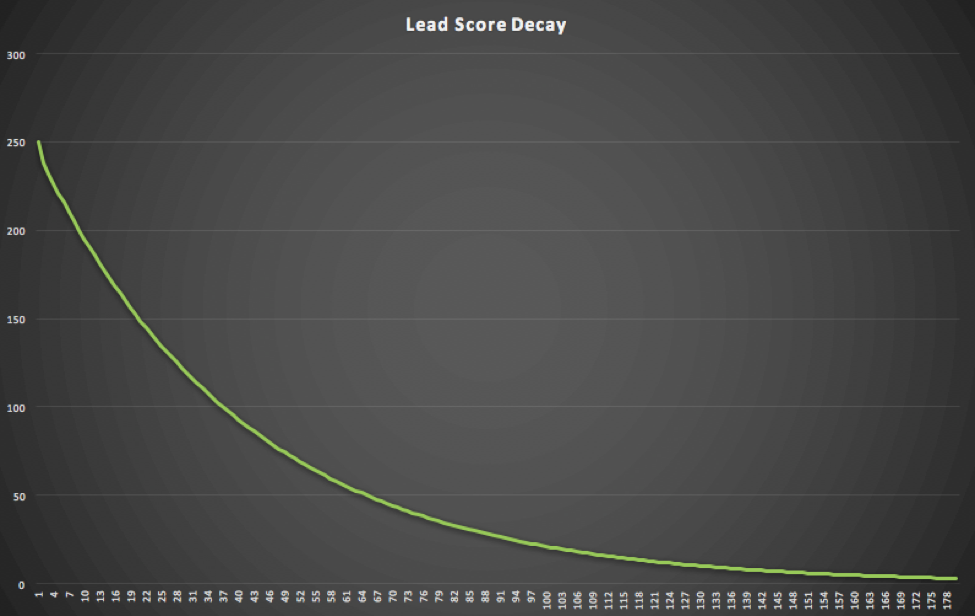
When a lead provides certain important information or takes part in an activity on a website, they will accumulate a lead score based on how you have configured lead scoring. A lead score half-life is the amount of time it will take for our lead’s score to be half as valuable as it was on the day of the lead’s last interaction. Lead score decay is effectively a half-life, and represents the amount of time it should take for a lead to be half as important as it used to be.
A lead score half-life ensures that leads are categorized appropriately based on their most recent activity history. If the half-life feature is not used, then lead scores will always increment (or remain static), even if the lead has not taken part in an activity in weeks. This can result in incorrect or problematic lead information. Utilizing lead score half-life allows a Sales team to have an accurate snapshot of the hottest leads at any time. The importance of a lead’s half-life will vary based on many factors, including industry, target audience, and the buying cycle. Identifying a half-life will likely take contributions from many different teams to get a key understanding of the desired timeframe.
It is important to note that decaying a lead’s score does not mean that you are giving up on that lead. Rather, it is allowing for you to use automation to segment leads based on where they are at in the buyer’s journey. This allows you to market to them more effectively.
Setting Lead Score Rates
When configuring lead scoring, take into account an estimated duration of time that, if a lead does not take part in any activity that increments their lead score, then the score value will decrease over such time.
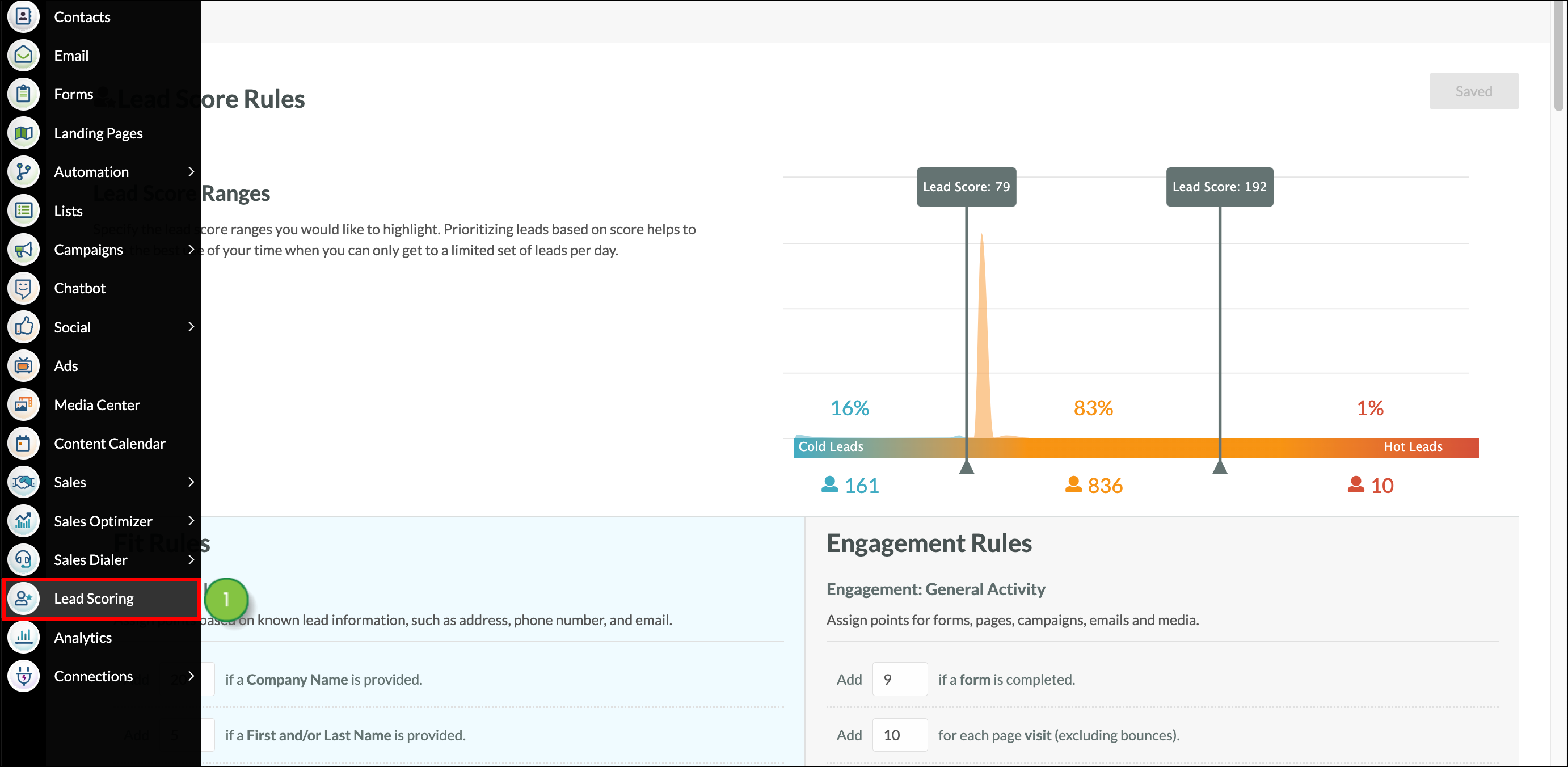
To set half-life and decay values, do the following:
- Click Lead Scoring in the left toolbar.

- Scroll to the Activity and Decay Timing section and select a time period from the Lead Activity Period drop-down menu.
- Click the toggle to On in the Turn Decay On/Off section.
- Set a time period in the Rate of Decay (Half-Life) section.
- Click Save.
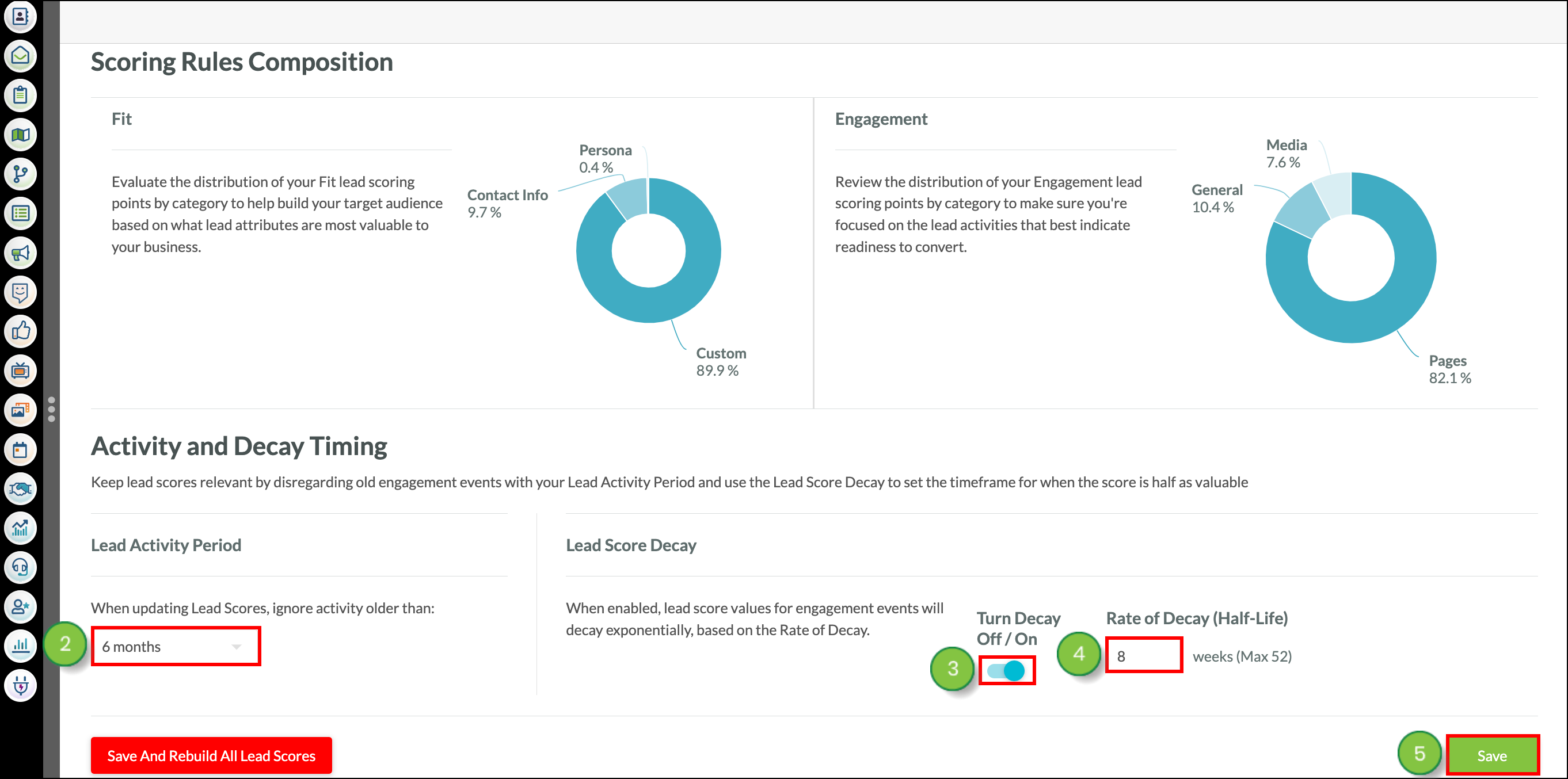
Note: To update current leads with new decay and half-life rates, click Save and Rebuild All Lead Scores.
Decay Calculations
Once you have set your lead score decay time period, all lead event activity will decay based on that timeframe. The decay will be calculated daily across the chosen time period. If the lead takes part in no further event activity during that time period, that the lead’s score will have decayed to be half the value of the initial score.
Lead scores will not decay if a lead:
- Fills out a form
- Visits a tracked page
- Clicks a link in an email
- Views a Media Center asset
Score Increments
Lead scores can be incremented by either an event activity a lead takes part in (such as a website visit or a form submission) or information the lead provides (information in fields like First Name, Last Name, or Email). It is important to note that activities will decay over time, while information does not.
To put this into perspective, if a lead submits a form with their name, email, and title, the value of that information will not change. However, the event of the form submission (and associated website visit) will decrease over time. If a lead has not been on a website over the course of a few weeks, that previous event is not as valuable due to the duration that has passed since the form submission or visit.
If a lead takes part in an event that would increase lead scoring during the decay period, their lead score will grow based on the specific event. For example, if a lead gets a certain amount of points for providing their email address (information) and another amount of points for visiting a website (event activity), their lead score will grow based on the lead score rules you have configured.
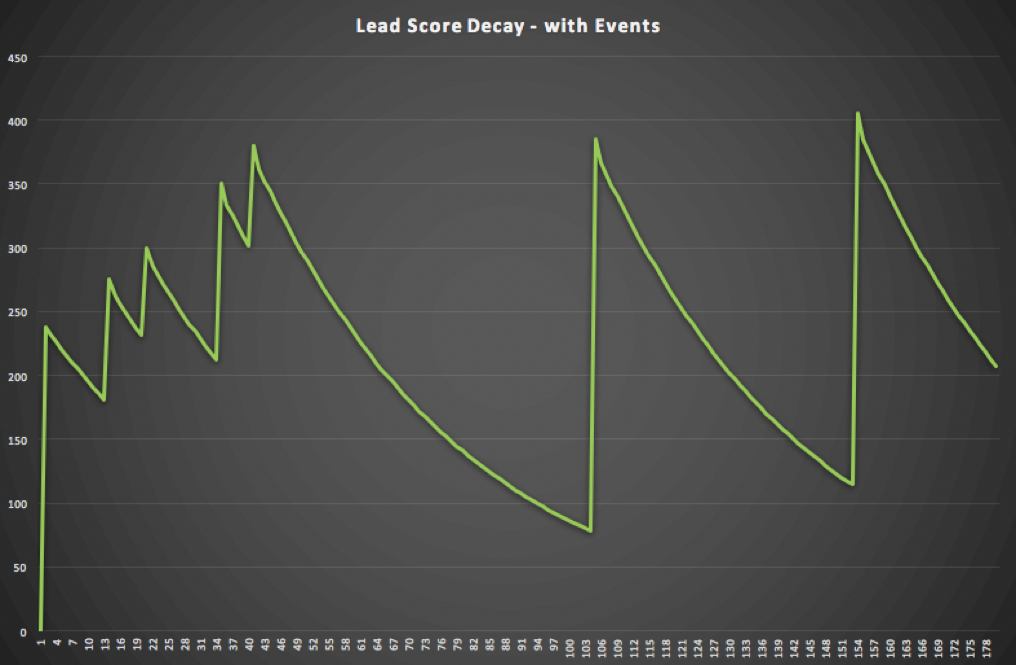
As the lead’s score decreases over time, the next event activity a lead takes part in that increases their score will count from the current value, which includes any decay up until that point. For example, if a lead had a score of 100 which decayed down to 60 after the course of a few months, and that lead then took part in an an event that increased the lead score by 20 points, the new lead score would be 80.
Decay activity is event-specific. As an example, consider that a lead took part in Event A on 1 January, which accumulated 80 points. The lead later took part in Event B on 1 February, which accumulated 60 points. Event A would be one month into its decay when the points from Event B are added to the total lead score value. However, this does not reset the lead score decay on Event A. The lead score will continue to decay for the set time period, with Event B’s decay beginning on 1 February.
Conclusion
Effective score decay management is integral to maintaining the accuracy and relevance of your scoring systems. By understanding the impact of score decay and implementing strategies such as time-based decay functions, activity-based adjustments, periodic reviews, predictive analytics, and automation, you can ensure that your scores remain dynamic and actionable. Embracing these practices will enhance your data accuracy, optimize decision-making processes, and ultimately drive better outcomes for your organization.