Introduction
In the fast-paced real estate world, scaling isn’t just about adding more agents — it’s about creating a repeatable, data-driven growth machine. For many brokerages and property developers, Salesforce Cloud Solutions and Propertybase have become the backbone of this machine.
The numbers speak for themselves:
- Real estate teams using centralized CRM platforms see 25–35% faster deal cycles (NAR, 2024).
- Brokerages leveraging automated lead assignment report up to 40% higher agent productivity.
- Centralized reporting systems improve decision-making speed by 50%.
Yet, many firms struggle to get beyond “CRM as a contact database.” They miss out on automation, data intelligence, and cross-team collaboration — the very capabilities that Salesforce + Propertybase excel at delivering.
This guide will show how to architect, configure, and optimize Salesforce Cloud Solutions with Propertybase to scale a real estate business without adding operational chaos. We’ll cover:
- The technical anatomy of the integration
- Scalable architecture for multi-agent, multi-office teams
- Key benefits and pitfalls to avoid
- Must-use features that deliver ROI from day one
- Real-world case studies proving the model works
If you’re serious about growing your real estate operation with technology that scales as fast as your deals, read on.
What is Propertybase for Salesforce?
Propertybase is a real estate-specific application layer built on the Salesforce platform. It takes Salesforce’s core CRM functionality and layers on real estate–focused features such as:
- MLS/IDX Integration
- Pulls live property data directly into Salesforce records.
- Uses REST or RETS APIs to sync listings, price changes, and availability.
- Example: An agent updates a listing in the MLS, and within minutes, the changes appear in Salesforce via automated data ingestion jobs.
- Pulls live property data directly into Salesforce records.
- Lead & Deal Management
- Extends Salesforce Leads, Contacts, and Opportunities with property-specific fields (e.g., property type, price range, buyer preferences).
- Can be customized with Salesforce Flow for automated lead scoring and routing.
- Extends Salesforce Leads, Contacts, and Opportunities with property-specific fields (e.g., property type, price range, buyer preferences).
- Marketing Automation
- Built-in email campaigns, landing pages, and follow-up sequences tailored for real estate.
- Syncs with Salesforce Marketing Cloud or Pardot for advanced segmentation.
- Built-in email campaigns, landing pages, and follow-up sequences tailored for real estate.
Key Terminology
- IDX (Internet Data Exchange) — A framework for displaying MLS listings on websites, directly integrated with CRM data.
- RETS (Real Estate Transaction Standard) — An older but still common protocol for MLS data exchange.
- Flow Orchestration — A Salesforce feature for chaining multiple Flows together for complex workflows.
- Custom Objects — In Propertybase, these might store property records, showing schedules, or closing documents.
- Governor Limits — Salesforce execution constraints that impact how bulk MLS data updates should be handled.
Architecture :
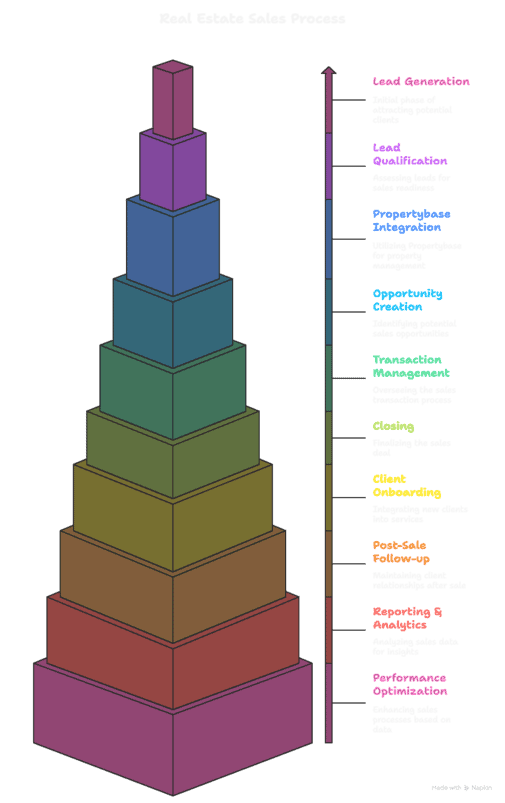
Why Use Salesforce + Propertybase for Scaling?
Gap #1: Disconnected Lead Sources
A multi-office brokerage had leads coming from websites, Zillow, and walk-ins — all in different spreadsheets. With Propertybase integrated into Salesforce, every lead flowed into one queue, deduplicated, scored, and routed in real time.
Gap #2: Lack of Property Intelligence
A luxury real estate team was losing high-value buyers because they couldn’t instantly match them to newly listed properties. Propertybase solved this by triggering notifications when MLS feeds are updated, matching listings.
Compliance & Data Security:
Real estate deals often require GDPR or CCPA compliance for client data. Salesforce’s platform encryption and Propertybase’s secure record access ensure compliance without slowing down deal flow.
Key Benefits
Benefit | Technical How | Business Impact | Example |
Centralized Data | MLS → Propertybase → Salesforce | Eliminates data silos | One brokerage reduced duplicate records by 85% |
Automated Lead Routing | Flow & Apex Rules | Faster agent response | 40% higher lead conversion |
Mobile-Ready Access | Salesforce1 + Propertybase Mobile | Agents work anywhere | Increased field productivity by 30% |
Real-Time Property Alerts | Platform Events | Engaged buyers faster | 25% higher showing-to-offer ratio |
Pipeline Transparency | Dashboards & Reports | Better forecasting | Managers spot slow-moving deals instantly |
Custom Workflows | Flow Orchestration | Tailored processes | Reduced manual admin by 12 hrs/week |
Marketing Sync | Marketing Cloud Connector | Consistent branding | Improved campaign CTR by 18% |
Practical Must-Use Features
- Bulk API 2.0 for MLS Updates
- Benefit: Handles large property datasets efficiently.
- Pitfall: Watch for Governor Limits when processing images.
- Best Practice: Batch in 5,000 record chunks; test in sandbox before production.
- Benefit: Handles large property datasets efficiently.
- Lead Assignment Rules
- Benefit: Auto-assign leads to agents based on location, performance, or schedule.
- Pitfall: Overcomplicated rules slow processing.
- Best Practice: Keep criteria minimal and measure conversion impact monthly.
- Benefit: Auto-assign leads to agents based on location, performance, or schedule.
- Custom Property Objects
- Benefit: Store listing details beyond standard fields.
- Pitfall: Too many custom fields can hit Salesforce storage limits.
- Best Practice: Archive inactive property records periodically.
- Benefit: Store listing details beyond standard fields.
- Flow Orchestration for Transactions
- Benefit: Automates contract-to-close process.
- Pitfall: Poorly tested Flows can break mid-transaction.
- Best Practice: Always include rollback logic.
- Benefit: Automates contract-to-close process.
Twopir-Proven Checklist
- Test MLS sync in full copy sandbox
- Document all custom fields for property objects
- Keep automation modular (Flows < 100 elements)
- Monitor Governor Limits weekly
- Implement data deduplication rules
- Train agents on mobile workflows before launch
Real-World Use Cases
Case Study 1: Luxury Brokerage Expansion
- Industry Context: High-end coastal properties.
- Challenge: Missed follow-ups on million-dollar leads.
- Solution: Implemented automated lead scoring, Flow-based assignment, and mobile notifications.
- Results: Lead response time dropped from 4 hours to 10 minutes; annual sales volume grew 22%.
Case Study 2: Multi-Office Franchise Network
- Industry Context: 50+ offices nationwide.
- Challenge: Disconnected lead and listing data.
- Solution: Bulk API sync from 10 MLS feeds into centralized Salesforce org; created region-specific dashboards.
- Results: Reduced duplicate records by 80%, improved cross-office referral revenue by 35%.
Conclusion
Scaling a real estate team isn’t about hiring faster — it’s about making each hire exponentially more productive. Salesforce Cloud Solutions paired with Propertybase delivers exactly that: a single source of truth for leads, listings, and performance.
From automated lead routing to real-time property alerts and mobile-enabled deal management, this setup allows brokerages to grow without losing control.
If you’re starting your scaling journey:
- Test your MLS integration in the sandbox.
- Implement core automation first — lead routing, property matching, and basic dashboards.
- Train your agents to use mobile and automation tools from day one.
The future of real estate is data-driven, mobile, and integrated — and with Salesforce + Propertybase, you’re not just keeping up; you’re setting the pace.