Introduction:
Salesforce Agentforce is an AI-driven framework inside the Salesforce ecosystem that enables enterprises to deploy autonomous AI agents capable of executing workflows, interacting with CRM data, and performing operational tasks within revenue systems.
But the real significance of Salesforce Agentforce AI is not the technology itself.
Enterprises are moving from human-operated CRM workflows to AI-assisted operational systems, where AI agents in Salesforce CRM act as operational actors inside the revenue lifecycle.
Organizations that treat Agentforce Salesforce AI agents as automation tools will create fragmented workflows and governance risks.
Organizations that design Agentforce architecture inside a governed revenue lifecycle system can unlock:
- Autonomous sales operations
- AI-driven workflow orchestration
- Scalable customer lifecycle automation
- Real-time operational decisioning inside CRM
In other words, Salesforce Agentforce is not an AI feature. It is a new operational layer for enterprise CRM systems.
The Market Shift: From CRM Automation to Autonomous Revenue Systems
For more than a decade, CRM automation has relied on:
- Rule-based workflows
- Manual sales operations
- Batch data processing
- Human-driven task management
This model worked when revenue operations were relatively simple.
But modern enterprise revenue systems now include:
- Complex SaaS sales cycles
- Multi-product pricing models
- Global sales teams
- Partner-driven channels
- AI-driven customer engagement
Traditional automation cannot keep up with this complexity.
This is where Salesforce autonomous agents change the architecture.
Instead of static workflows, Agentforce enables dynamic AI agents that can:
- analyze CRM data in real time
- trigger workflow actions
- interact with customer systems
- coordinate cross-platform processes
This transforms Salesforce from a workflow engine into an AI-powered operational platform.
However, deploying Salesforce AI workflow automation without architectural planning often leads to operational chaos.
If you want to learn about Salesforce Agentforce: Enterprise Architecture, Operational Model, and Strategic Impact, Please Click Here.
Business Failure Patterns in Agentforce Adoption
Most companies exploring Agentforce implementation approach it as a technology rollout rather than a system design exercise.
This leads to predictable failure patterns.
1. AI Layered on Broken CRM Architecture
If the underlying Salesforce data model is inconsistent, AI agents produce unreliable outcomes.
Common issues include:
- duplicate records
- inconsistent opportunity structures
- fragmented account hierarchies
- disconnected product catalogs
AI agents amplify these issues rather than solving them.
2. Workflow Sprawl Inside Salesforce
Many organizations already have:
- hundreds of flows
- unmanaged triggers
- overlapping automation rules
Adding Salesforce AI automation platform capabilities without workflow rationalization creates unpredictable system behavior.
3. No Lifecycle Ownership
Agentforce agents operate across:
- sales
- marketing
- customer success
- support
Without lifecycle ownership, AI agents operate inside organizational silos rather than coordinated systems.
4. Automation Without Governance
AI agents capable of executing actions introduce new risks:
- Incorrect deal updates
- automated customer communication errors
- unauthorized system actions
Without governance frameworks, AI automation can create operational risk rather than efficiency.
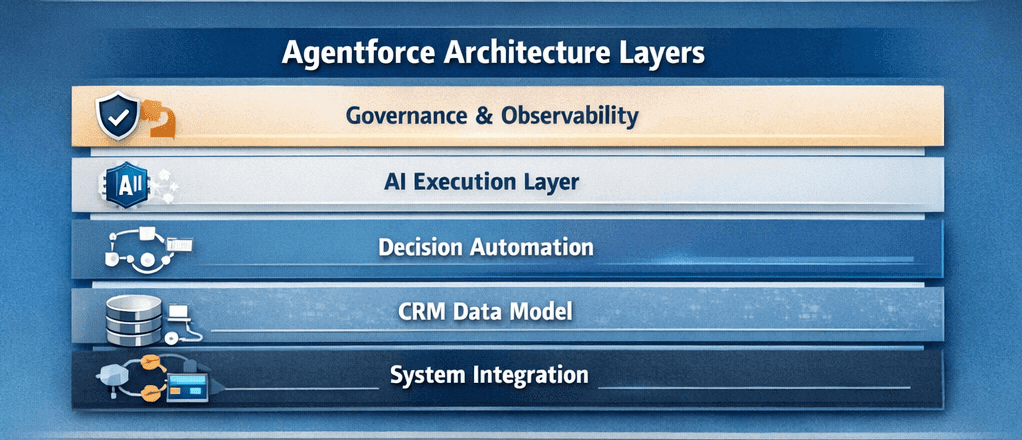
The Autonomous Revenue Systems Framework™:
At Twopir Consulting, successful Agentforce architecture follows a structured lifecycle model.
Autonomous Revenue Systems Framework™
This framework ensures AI agents operate within a governed revenue lifecycle architecture rather than isolated workflows.
Layer 1 — Revenue Lifecycle Architecture
Before deploying Agentforce Salesforce AI agents, organizations must map the entire revenue lifecycle:
- lead generation
- pipeline management
- deal execution
- post-sale expansion
- customer success
AI agents must operate inside clearly defined lifecycle boundaries.
Layer 2 — CRM Data Model Integrity
AI agents rely on structured CRM data.
This layer focuses on:
- opportunity architecture
- account hierarchy models
- product catalog design
- contract data structures
- customer lifecycle stages
Without a data architecture discipline, AI decision-making becomes unreliable.
Layer 3 — Decision Automation Design
This layer defines:
- What decisions AI agents can make
- What actions require human oversight
- What data signals trigger agent actions
This prevents uncontrolled AI automation.
Layer 4 — Agent Execution Layer
Only after the above layers exist should enterprises deploy Salesforce autonomous agents capable of:
- workflow execution
- operational decisioning
- task automation
- data enrichment
Layer 5 — Governance and Observability
Enterprise AI agents must be governed through:
- audit logs
- action visibility
- role-based control
- lifecycle ownership
This ensures AI operates as a managed operational system rather than uncontrolled automation.
Execution Architecture Model for Salesforce Agentforce
A typical enterprise Agentforce architecture includes several interconnected layers.
1. Data Intelligence Layer
AI agents require structured, real-time data from:
- Salesforce CRM objects
- customer activity signals
- transactional systems
- marketing automation platforms
This data layer determines the accuracy of AI actions.
2. AI Decision Layer
Here, Salesforce Agentforce AI models analyze data signals to determine operational actions.
This may include:
- pipeline prioritization
- deal risk identification
- customer engagement triggers
- opportunity progression recommendations
3. Workflow Orchestration Layer
Once decisions are made, Salesforce AI workflow automation executes operational actions such as:
- creating tasks
- triggering approvals
- initiating communications
- updating CRM records
This replaces manual operational work previously handled by RevOps teams.
4. System Integration Layer
Enterprise revenue systems rarely operate inside Salesforce alone.
Agentforce architecture must integrate with:
- CPQ platforms
- contract management systems
- document automation tools
- ERP systems
- support platforms
This ensures AI agents operate across the full commercial lifecycle.
Tool Enablement Layer
After architecture is defined, organizations enable the system using platform capabilities.
Within the Salesforce ecosystem, Agentforce implementation typically involves:
Core Salesforce Platform
- Salesforce Data Cloud
- AI models within the Salesforce platform
- Flow orchestration
- CRM object automation
These capabilities power Salesforce AI automation platform functionality.
Revenue Operations Ecosystem Tools
Enterprises often integrate Agentforce with operational platforms such as:
- CPQ systems for pricing automation
- document generation platforms for proposals and contracts
- workflow automation tools
- customer success platforms
These tools allow AI agents to execute revenue lifecycle operations beyond Salesforce itself.
But the tools only work when the underlying lifecycle architecture is correctly designed.
Governance and Risk Considerations
Deploying AI agents in Salesforce CRM introduces new operational risks that most organizations underestimate.
Enterprise governance models must address several areas.
AI Decision Boundaries
AI agents should have clearly defined permissions regarding:
- opportunity modifications
- account changes
- automated communications
- approval workflows
Auditability
Every AI-generated action must be traceable.
This includes:
- decision inputs
- workflow triggers
- system actions
- downstream impact
Without observability, AI automation becomes difficult to manage.
Cross-Functional Ownership
Agentforce operates across multiple departments.
Governance should include:
- RevOps leadership
- IT architecture oversight
- security governance
- operational process ownership
Without shared ownership, AI automation quickly fragments.
Measurable Business Outcomes
When deployed inside a properly designed architecture, Salesforce Agentforce can deliver measurable enterprise outcomes.
Operational Efficiency
AI-driven automation reduces manual RevOps workload by 30–50% in mature CRM environments.
Sales Productivity
Automated task execution and opportunity insights allow sales teams to spend more time on selling activities, increasing sales productivity by 20–35%.
Faster Deal Velocity
AI-driven workflow orchestration accelerates approvals, contract generation, and pricing processes, reducing sales cycle length by 15–25%.
Improved Forecast Accuracy
AI analysis of pipeline data helps identify deal risks and opportunity progression patterns, improving forecast reliability for revenue leadership.
Scalable Revenue Operations
Most importantly, enterprises can scale revenue systems without linearly scaling operational headcount.
FAQ: Salesforce Agentforce
What is Salesforce Agentforce?
Salesforce Agentforce is an AI-driven framework within the Salesforce ecosystem that enables organizations to deploy autonomous AI agents capable of executing CRM workflows, analyzing customer data, and performing operational tasks across revenue systems.
How does Salesforce Agentforce work?
Agentforce works by analyzing Salesforce data, identifying operational triggers, and executing predefined workflows through AI agents that interact with CRM objects, automation rules, and integrated systems.
What problems does Agentforce solve?
Agentforce addresses several enterprise challenges, including:
- manual CRM workflows
- operational inefficiencies
- fragmented revenue processes
- slow decision-making inside sales operations
By automating operational actions, AI agents reduce manual workload across the revenue lifecycle.
What is the architecture of Salesforce Agentforce?
Agentforce architecture typically includes:
- a CRM data layer
- AI decision models
- workflow orchestration engines
- integration layers with revenue systems
Together, these components enable autonomous operational workflows.
Is Agentforce replacing Salesforce workflows?
No. Agentforce does not replace Salesforce automation tools. Instead, it enhances them by allowing AI agents to dynamically evaluate conditions and trigger workflow actions across the CRM environment.
Strategic Advisory Perspective
Most organizations exploring Salesforce Agentforce are asking the wrong question.
They ask:
“How do we implement AI agents in Salesforce?”
The better question is:
“How should our revenue systems be architected so AI agents can operate safely and effectively?”
AI automation layered onto fragmented CRM systems simply creates faster operational chaos.
The real opportunity is building an AI-native revenue architecture.
Strategic Consulting CTA
At Twopir Consulting, we work with enterprise organizations to design the lifecycle architecture that makes AI-driven revenue systems possible.
Our work includes:
- CRM architecture design
- Revenue Lifecycle Modeling
- AI automation strategy
- Salesforce and RevOps system implementation
Because successful Agentforce implementation isn’t about enabling another platform feature.
It’s about building a revenue system architecture where AI agents can operate reliably, securely, and at scale.
If your organization is evaluating Salesforce Agentforce AI, the first step is not deployment.
The first step is architectural design.