Introduction:
Wealth management today goes far beyond portfolio performance. Clients—especially high-net-worth and mass-affluent investors—expect personalized advice, seamless digital experiences, and consistent engagement across every interaction. However, many advisory firms still struggle with fragmented client data spread across CRMs, portfolio systems, and compliance tools. This lack of a unified view makes it difficult for advisors to understand complete household relationships, respond quickly to client needs, and deliver truly personalized financial guidance at scale.

Salesforce Financial Services Cloud (FSC) addresses these challenges by providing an industry-specific CRM built for wealth management. Unlike traditional CRMs designed for simple sales tracking, FSC supports household relationships, financial accounts, and compliance-ready workflows on a single platform. By unifying client data, automating key advisory processes, and delivering actionable insights, Financial Services Cloud enables advisors to focus less on manual administration and more on building trust, strengthening relationships, and delivering long-term client value.
What Is Salesforce Financial Services Cloud?
Salesforce Financial Services Cloud is an industry-specific CRM layer built on Salesforce Sales and Service Cloud, designed specifically for wealth management, banking, and insurance use cases. For wealth managers, FSC provides data models, automation, and insights tailored to advisory relationships rather than transactional sales.
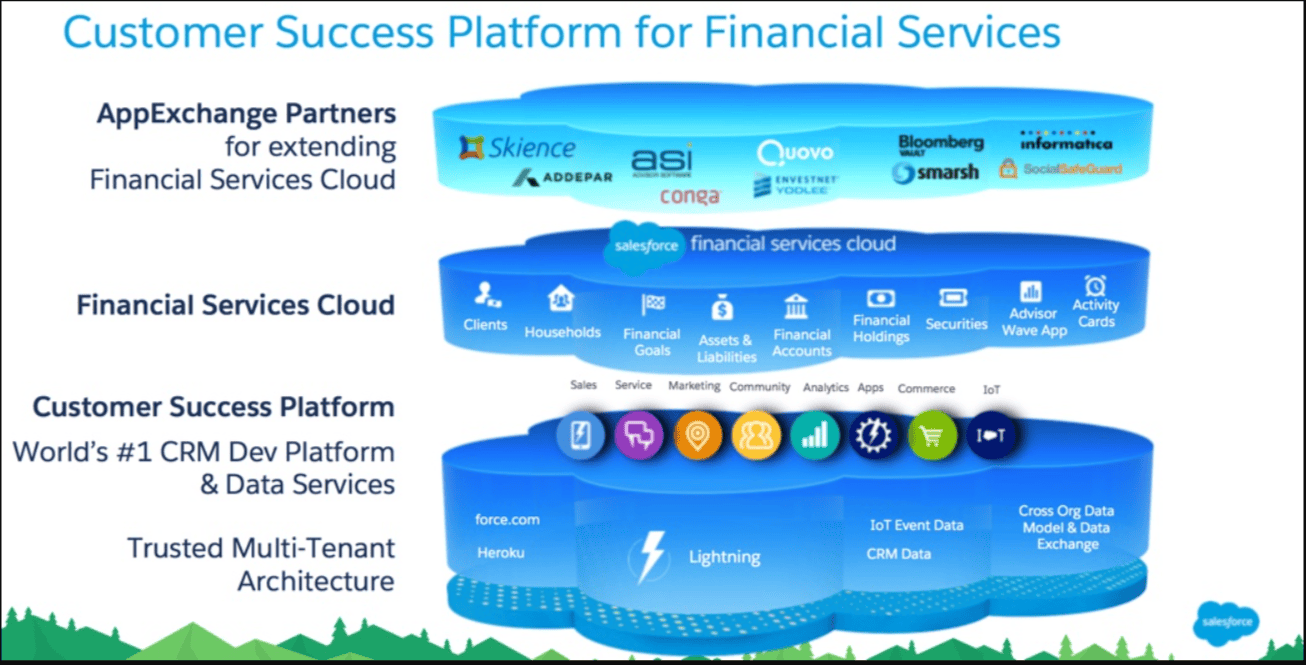
Technical Core Components
1. Financial Data Model & Custom Objects:
At the heart of FSC is a prebuilt financial data model that includes objects such as Financial Accounts, Assets, Liabilities, Transactions, and Holdings. Unlike generic CRMs, FSC understands how investment accounts, portfolios, and relationships connect.
For example:
- A single client can be linked to multiple accounts.
- Multiple clients can belong to a household.
- Assets and liabilities roll up into net worth automatically.
These objects integrate seamlessly with Salesforce standard objects like Account, Contact, and Opportunity.
2. Relationship Intelligence (Households & Client Groups):
FSC introduces households as a first-class concept. Advisors can model families, trusts, beneficiaries, and entities with role-based relationships. This is critical for wealth management, where advice is rarely one-to-one.
Example:
- A household includes spouses, children, and a family trust.
- Advisors can view aggregated assets and risks across the entire household.
3. Automation & Insights Layer:
FSC leverages Salesforce Flow, Apex, Einstein AI, and OmniStudio to automate reviews, alerts, and client outreach. Advisors receive proactive insights like:
- Portfolio drift alerts
- Life event reminders
- Risk exposure changes
Why Use Salesforce Financial Services Cloud?
Traditional CRM platforms are designed mainly for basic contact management and sales tracking. While they work well for standard sales processes, they fall short in wealth management, where advisors must manage complex client relationships, multiple financial accounts, and strict regulatory requirements. Salesforce Financial Services Cloud (FSC) is built specifically to address these challenges, making it a more practical and scalable solution for wealth management firms.
Filling Critical Gaps in Traditional CRMs
1: Lack of Relationship Context
Traditional CRMs focus on individual records — one contact, one account, one opportunity — which works fine for simple B2B or B2C sales scenarios. But in wealth management, client relationships are rarely simple.
In real practice:
- A high-net-worth client may have multiple accounts: investment accounts, retirement accounts, savings accounts, insurance policies, and trust assets.
- They may be linked to a household group that includes spouses, children, or business entities.
- Some accounts may belong to entities like trusts, partnerships, or charitable foundations.
- Beneficiaries, co-investors, and legal representatives may all play roles in decisions.
Standard CRMs cannot model this complexity without extensive customization — often resulting in scattered spreadsheets, disconnected systems, and inconsistent views of the client.
2: Manual Reviews & Compliance Risk
Wealth management is one of the most regulated financial sectors in the world. Firms must conduct periodic reviews, track client interactions, ensure suitability, and maintain audit-ready records at all times.
In many traditional setups:
- Quarterly reviews are manual — pulling data from custodians, exporting into spreadsheets, reconciling differences, generating reports, and then filing them
- Compliance officers receive snapshots that may be outdated or inconsistent
- There is no standardized system of record for reviewing outcomes, making audits difficult and time-consuming
These manual processes are error-prone, slow, and costly — and they create compliance risk.
Mini Case Scenario
A regional wealth management firm struggled to complete quarterly client reviews on time due to manual data collection and reconciliation across multiple systems. After implementing Salesforce Financial Services Cloud, the firm automated review workflows and centralized household financial data into advisor dashboards.
As a result, quarterly reviews that previously took several weeks were completed within a few days. Advisors spent more time engaging with clients, while compliance teams gained real-time visibility into review status and documentation accuracy.
Key Benefits :
1. True 360-Degree Client View:
Salesforce Financial Services Cloud consolidates client profiles, financial accounts, holdings, interactions, and service history into a single unified view across individuals and households. By aggregating assets, liabilities, and relationships in real time, advisors gain instant visibility into total client exposure and financial health. This eliminates data silos across portfolio systems, CRMs, and spreadsheets, enabling faster and more informed client conversations. Many firms report significantly shorter discovery and onboarding cycles due to this unified data access.
2. Household-Based Financial Planning:
Financial Services Cloud is built around household and relationship modeling, allowing advisors to connect spouses, dependents, trusts, beneficiaries, and related entities under one financial structure. Roll-up summaries provide a consolidated view of net worth, risk, and asset allocation across the entire household. This structure supports multi-generational planning, estate strategies, and succession discussions. As a result, wealth firms experience stronger family-level engagement and improved long-term asset retention.
3. Intelligent Automation:
Using Salesforce Flow and Apex, Financial Services Cloud automates repetitive advisory tasks such as periodic reviews, task assignments, client follow-ups, and alerts for portfolio changes. Automated workflows ensure no critical client activity is missed while reducing manual data entry and operational dependency on advisors. This allows advisors to focus on relationship management and strategic advice rather than administration. Firms typically see measurable productivity gains per advisor within weeks of implementation.
4. Embedded Compliance and Security:
Financial Services Cloud leverages Salesforce’s enterprise-grade security framework, including Platform Encryption, field-level security, audit trails, and role-based access controls. Every client interaction, data update, and advisory action is logged automatically, supporting regulatory requirements such as SEC, FINRA, GDPR, and regional compliance mandates. This built-in governance reduces compliance risk and manual audit preparation. Many firms report faster regulatory audits and greater confidence in data governance.
5. AI-Driven Insights and Recommendations:
With Einstein AI and Next Best Action, Financial Services Cloud analyzes client behavior, portfolio trends, and life events to surface proactive recommendations for advisors. These insights may include investment opportunities, risk alerts, or timely engagement prompts based on real data patterns. Advisors receive contextual guidance directly within their workflow, improving decision quality and client relevance. This leads to more personalized engagement and increased cross-sell or upsell success.
6. Scalability and Deep Customization:
Built on the Salesforce platform, Financial Services Cloud supports extensive customization through custom objects, OmniStudio, Apex, and Lightning components. Wealth firms can model complex investment structures, regulatory workflows, and advisory processes without changing core systems. The platform scales seamlessly as client volumes, assets under management, and data complexity grow. This ensures long-term flexibility without the need for costly CRM re-implementations.
7. Seamless Ecosystem Integration:
Financial Services Cloud integrates seamlessly with custodians, core banking systems, portfolio management platforms, and financial planning tools using APIs, MuleSoft, and event-based integrations. This creates a real-time, synchronized data ecosystem where Salesforce acts as the system of engagement. Advisors always work with the latest financial data, reducing reconciliation errors and delays. The result is a reliable single source of truth across the entire wealth management technology stack.
Must-Use Features:
1. Household & Relationship Management:
Financial Services Cloud allows advisors to group clients into households and define complex relationships such as spouses, beneficiaries, and trusts. This provides a holistic view of family wealth and enables more personalized, relationship-based financial advice.
2. Financial Account & Asset Data Model:
FSC includes prebuilt objects for financial accounts, assets, liabilities, and holdings. This structured data model helps firms track portfolios, net worth, and exposure accurately without heavy customization.
3. 360-Degree Client View:
All client interactions, financial data, service requests, and opportunities are unified into a single view. Advisors can instantly understand a client’s financial position and engagement history before every conversation.
4. Actionable Relationship Insights (Einstein AI):
Einstein AI surfaces insights like life events, portfolio changes, and cross-sell opportunities. These proactive alerts help advisors engage clients at the right time with relevant recommendations.
5. Automation with Salesforce Flow:
Routine processes like client reviews, onboarding, and follow-ups can be automated using Salesforce Flow. This reduces manual work and ensures consistent, compliant advisory workflows.
6. Omni-Channel Client Engagement:
Advisors can manage email, phone, chat, and service cases in one platform. This ensures seamless and consistent communication across all client touchpoints.
7. Scalable Integration Capabilities:
Financial Services Cloud integrates easily with custodians, core banking systems, and planning tools using APIs or MuleSoft. This creates a single source of truth across the firm’s technology ecosystem.
8. Advisor-Focused Dashboards & Analytics:
Prebuilt dashboards provide real-time visibility into AUM, client health, and advisor performance. Firms can quickly identify risks, opportunities, and growth trends.
Real-World Use Cases:
1: Private Wealth Firm (HNW Clients)
- Industry: Wealth Management
A private wealth firm serving high-net-worth individuals with multiple investment accounts, family relationships, and long-term advisory engagements. - Challenge: Fragmented household data and slow reviews
Client and portfolio data was spread across custodians, spreadsheets, and legacy systems. Advisors lacked a unified household view, making quarterly reviews slow and preparation-heavy. - Solution: FSC households, automated reviews, and data integration
Salesforce Financial Services Cloud households unified family relationships and accounts. Salesforce Flow automated review reminders, while custodian feeds kept financial data updated automatically.
Results: Measurable outcomes
- 40% faster client review cycles
- 25% improvement in advisor productivity
- Better client conversations using real-time household insights
2: Multi-Family Office
- Industry: Family Office
A multi-family office managing complex structures such as trusts, holding companies, and alternative investments for ultra-high-net-worth families. - Challenge: Complex entities and compliance reporting
Tracking ownership, beneficiaries, and compliance activities across entities was manual and error-prone. Audit preparation required significant time and resources. - Solution: Custom FSC objects and compliance automation
Custom Financial Services Cloud objects were created for trusts and legal entities. Apex automation enforced compliance workflows and logged advisory actions automatically.
Results: Measurable outcomes
- 90% reduction in audit preparation time
- Improved visibility across family entities
- Lower compliance and operational risk
Conclusion:
Salesforce Financial Services Cloud is not just an upgrade—it’s a foundational shift in how wealth management firms operate. By combining industry-specific data models, household intelligence, automation, and AI, FSC empowers advisors to deliver personalized, compliant, and scalable advice.
The firms winning today are those that treat CRM as a strategic platform—not just a contact database. FSC enables that transformation by aligning technology with how wealth management actually works.
Next Step: Start by testing Financial Services Cloud in a Salesforce sandbox. Model a real household, integrate sample account data, and build one automated review workflow. The insights you gain will quickly demonstrate FSC’s value.
Looking ahead, firms that scale FSC with tools like MuleSoft, Einstein AI, and custom analytics will be best positioned to deliver next-generation advisory experiences—efficiently, securely, and at scale.