Introduction:
Propertybase + Salesforce represents one of the most powerful enterprise CRM architectures for real estate organizations that need to manage leads, listings, transactions, and client relationships across the entire property lifecycle.
Unlike traditional real estate CRMs that operate as isolated marketing tools, Propertybase Salesforce architecture enables brokerages, developers, and real estate investment firms to build a unified revenue system connecting marketing acquisition, listing management, sales operations, transaction execution, and post-sale client lifecycle management.
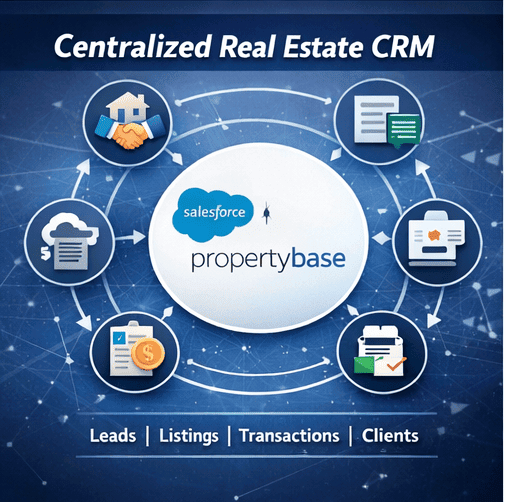
However, most real estate organizations implement Propertybase as a CRM tool, rather than as a lifecycle architecture platform. The result is predictable:
- Fragmented lead routing
- Disconnected listing workflows
- Manual transaction management
- Poor visibility into pipeline performance
When implemented as an enterprise architecture layer, Propertybase and Salesforce become the operational backbone for:
- Brokerage revenue operations
- Property lifecycle orchestration
- Developer sales management
- Multi-office franchise governance
This guide explains how Propertybase Salesforce CRM architecture works, where implementations fail, and how real estate organizations can design scalable lifecycle systems rather than disconnected CRM deployments.
Market Context: Why Real Estate CRM Systems Break at Scale
Real estate organizations operate in one of the most complex lifecycle environments in any industry.
A single property transaction often involves:
- Marketing campaigns
- Lead qualification
- Agent assignment
- Listing lifecycle management
- Showings and negotiations
- Legal documentation
- Transaction coordination
- Post-sale relationship management
Most brokerages attempt to manage this lifecycle with a mixture of:
- Listing portals
- Email marketing tools
- Spreadsheets
- Basic CRM systems
These fragmented systems cannot support enterprise-grade brokerage operations.
Fragmented Lead Management:
Marketing leads arrive from multiple sources:
- Listing portals
- Website inquiries
- Social advertising
- Developer campaigns
Without centralized architecture, lead distribution becomes inconsistent and difficult to govern.
Poor Listing Lifecycle Visibility
Listings often move through stages such as:
- Pre-listing preparation
- Marketing launch
- Active listing
- Negotiation
- Under contract
- Closed
Many CRMs cannot model this lifecycle effectively.
Transaction Coordination Chaos
Once a property moves under contract, coordination across:
- Agents
- Buyers
- Sellers
- Legal teams
- Mortgage partners
Becomes operationally complex. Most CRM tools lack structured transaction orchestration.
Lack of Brokerage-Level Revenue Visibility
Executives struggle to answer critical questions:
- Which marketing channels drive high-value buyers?
- Which agents close deals fastest?
- Where are deals stalling in the pipeline?
- Which listings generate the most demand?
This is where Propertybase Salesforce architecture becomes critical.
Failure Pattern: Why Many Propertybase Implementations Underperform
Despite being built on the powerful Salesforce platform, many Propertybase CRM deployments fail to deliver enterprise value.
The problem is rarely the technology.
The real issue is architectural maturity.
Failure Pattern 1: CRM Instead of Lifecycle Architecture
- Many implementations treat Propertybase as simply:
- A lead database for agents. But real estate organizations require end-to-end lifecycle orchestration.
Failure Pattern 2: No Governance Model
Brokerages often operate with:
- Independent agents
- Multiple offices
- Franchise structures
Without governance frameworks, CRM systems become fragmented across teams.
Failure Pattern 3: Disconnected Listing and Transaction Data
- Listings, buyers, and transactions must be linked in a structured data model.
- Many implementations fail to connect these lifecycle objects properly.
Failure Pattern 4: Automation Without Process Design
Organizations often deploy automation tools before defining:
- Lead routing rules
- Listing lifecycle stages
- Transaction milestones
- Compliance checkpoints
Automation amplifies bad architecture if the lifecycle is not designed first.
Twopir Property Lifecycle Architecture Model™
To solve these issues, enterprise real estate organizations must adopt a structured lifecycle architecture.
At Twopir Consulting, we use the Property Lifecycle Architecture Model™ to design scalable real estate CRM systems.
This model structures the property business across five operational layers.
1. Demand Generation Layer
This layer captures demand from:
- Listing portals
- Developer marketing campaigns
- Brokerage websites
- Social advertising
The goal is to standardize lead ingestion into the CRM architecture.
2. Lead Qualification Layer
This stage manages:
- Buyer qualification
- Seller opportunity identification
- Agent assignment
- Nurture automation
Lead scoring and routing ensure that high-value opportunities reach the right agents.
3. Listing Lifecycle Layer
Listings move through defined stages such as:
- Listing preparation
- Marketing activation
- Showing management
- Negotiation
- Contract initiation
Each stage must be represented in the CRM data model.
4. Transaction Execution Layer
Once deals move under contract, organizations require structured coordination across:
- Documentation
- Compliance approvals
- Transaction milestones
- Closing preparation
5. Client Lifecycle Layer
After closing, the relationship continues through:
- Referrals
- Repeat buyers
- Investor relationships
- Portfolio expansion
This stage is often overlooked but represents a major revenue opportunity.
Execution Architecture: Propertybase Salesforce Data Model
Because Propertybase is built on Salesforce architecture, organizations can design a powerful real estate data model.
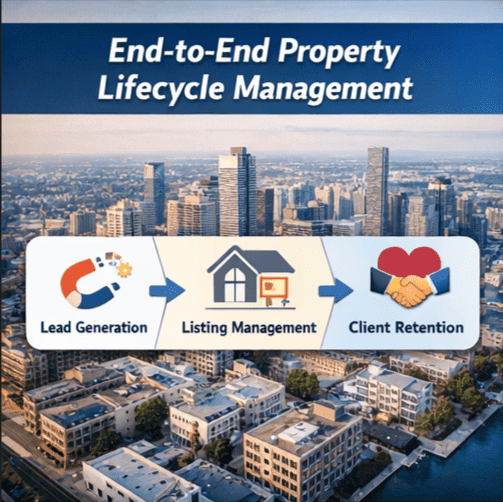
Key lifecycle objects typically include:
Contact
- Represents all known individuals in the ecosystem — buyers, sellers, investors, and partners — as persistent lifecycle entities.
- Acts as the central relationship node linking deals, properties, and engagement history across the revenue system.
Lead
- Captures unqualified inbound or outbound inquiries before they enter the structured sales lifecycle.
- Functions as a controlled intake layer to ensure proper qualification, source attribution, and routing before conversion into Contacts and Opportunities.
Property / Listing
- Represents the core revenue asset (inventory layer) being marketed, transacted, and analyzed.
- Unlike standard CRM products, listings must be lifecycle-driven objects with states, demand signals, and direct linkage to pipeline and revenue.
Opportunity
- Represents a potential or active deal construct, connecting buyer demand with a specific property or portfolio.
- Serves as the primary pipeline object for forecasting, stage progression, and revenue visibility.
Transaction
- Coordinates post-agreement execution workflows, including documentation, approvals, compliance, and closing processes.
- Separates deal intent (Opportunity) from execution reality, enabling structured control over complex real estate transactions.
Activity & Communication History
- Captures all engagement signals — calls, emails, meetings, and showings — as a time-sequenced interaction layer.
- Provides visibility into agent behavior, buyer intent, and deal momentum, forming the foundation for performance analytics and automation triggers.
Tracks interactions across:
- Calls
- Emails
- Showings
- Meetings
The strength of Propertybase Salesforce architecture lies in how these objects connect to represent the full lifecycle.
Automation Strategy for Real Estate CRM
Once architecture is established, automation can dramatically improve operational efficiency.
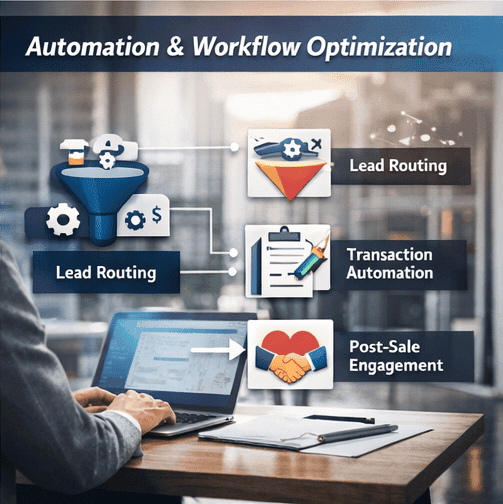
Common automation layers include:
Lead Routing Automation
Automatically distribute inquiries to agents based on:
- Geography
- Property type
- Agent availability
- Performance metrics
Listing Lifecycle Automation
Trigger workflows for:
- Marketing launch
- Showing coordination
- Listing updates
- Price adjustments
Transaction Workflow Automation
Automate tasks such as:
- Document requests
- Compliance approvals
- Milestone tracking
- Closing coordination
Post-Sale Engagement Automation
Automated lifecycle programs maintain long-term relationships with clients.
Tool Enablement Layer
Tools should enable the architecture, not define it.
Within a Propertybase ecosystem, organizations may leverage platforms such as:
- Salesforce for CRM architecture
- Propertybase for real estate workflows
Additional automation platforms can support extended workflows where necessary.
However, tools must always sit below the lifecycle architecture layer.
Governance and Operational Control
Enterprise real estate organizations must implement governance frameworks to prevent CRM fragmentation.
Key governance considerations include:
Data Governance
Standardized structures for:
- Listing data
- Client records
- Deal information
Agent Access Controls
Brokerages must manage permissions across:
- Offices
- Franchise locations
- Independent agents
Process Governance
Define standardized workflows for:
- Listing activation
- Transaction approval
- Compliance checkpoints
Automation Governance
Ensure workflows are documented and monitored to prevent automation conflicts.
Measurable Business Impact
When implemented with proper architecture, Propertybase Salesforce systems generate measurable enterprise impact.
Revenue Growth
Improved lead routing increases conversion rates and deal velocity.
Sales Productivity
Agents spend less time on manual coordination and more time closing deals.
Pipeline Visibility
Leadership gains accurate forecasting across:
- Listings
- Negotiations
- Transactions
Operational Efficiency
Automation reduces manual administrative overhead.
Client Lifetime Value
Post-sale lifecycle engagement drives referrals and repeat transactions.
Internal Knowledge Resources
To explore Propertybase capabilities further, see:
Propertybase Overview :
https://twopirconsulting.com/propertybase/
Propertybase Enhanced Solutions:
https://twopirconsulting.com/propertybase-enhanced-solutions/
Propertybase Case Study:
https://twopirconsulting.com/case-study/streamlining-property-management-with-propertybase/
Official Documentation:
https://help.propertybase.com/hc/en-us/articles/115001044191-Welcome-to-Propertybase
Frequently Asked Questions
What is Propertybase Salesforce?
Propertybase Salesforce is a real estate CRM platform built on the Salesforce architecture that enables brokerages and developers to manage leads, listings, transactions, and client relationships within a unified system.
Why is Salesforce used for real estate CRM?
Salesforce provides enterprise CRM capabilities, including:
- Data architecture flexibility
- Automation frameworks
- Reporting and analytics
- Integration capabilities
Propertybase extends these capabilities specifically for real estate workflows.
What types of companies use Propertybase?
Propertybase is commonly used by:
- Real estate brokerages
- Property developers
- Real estate franchises
- Commercial real estate firms
- Property investment organizations
Can Propertybase support large real estate organizations?
Yes. Because it runs on Salesforce architecture, Propertybase can support:
- Multi-office brokerages
- Global franchise networks
- Enterprise property developers
However, scalability depends heavily on proper architecture and governance.
How long does a Propertybase implementation take?
Implementation timelines vary based on organizational complexity but typically range from 3 to 9 months for enterprise-grade deployments.
Strategic Consulting Perspective
Real estate organizations often invest in CRM technology, expecting immediate operational transformation.
But the real driver of success is not the platform.
It is a lifecycle architecture design.
Without structured lifecycle architecture:
- CRM systems fragment
- Automation breaks
- Agents revert to manual processes
With the right architecture, Propertybase and Salesforce become a powerful revenue system for real estate organizations.
Strategic Consulting Support
Designing an enterprise real estate CRM requires expertise across:
- Revenue architecture
- Salesforce platform design
- Automation governance
- Real estate lifecycle modeling
At Twopir Consulting, we help real estate organizations design and implement scalable Propertybase Salesforce architectures that support long-term growth.
Our approach focuses on:
- Lifecycle architecture design
- CRM governance frameworks
- Automation strategy
- Enterprise implementation planning
If your organization is evaluating Propertybase Salesforce architecture or struggling with CRM scalability, our team can help design a system that supports the full property lifecycle and revenue operations model.