
Introduction:
Reply.io & Salesforce integration is often misunderstood as a sync setup between an outreach tool and a CRM. In reality, it is a core architectural layer that defines how outbound motion translates into a measurable pipeline.

At enterprise scale, outbound fails not because of poor messaging—but because:
- Data is not lifecycle-governed
- Outreach is not eligibility-controlled
- Engagement signals are not structurally captured
In a properly designed system:
- In a well-architected setup, Salesforce serves as the central authority for lifecycle, data integrity, and pipeline governance. All critical decisions and state transitions originate here.
- Reply.io operates as a multi-channel execution layer responsible for delivering outreach across email, calls, and social channels. It executes—but does not control lifecycle decisions.
Simply connecting systems does not create business value. Integration without architectural design only increases activity, not efficiency or predictability.
The true objective is to build a structured outbound architecture where data, triggers, engagement, and conversion operate as a unified system. This is what enables scalable and predictable revenue generation.
Enterprise Context: Why “Integration” Fails to Deliver Outcomes
Most organizations approach integration as a functional setup rather than a system design problem. They connect tools, enable sync, and expect outcomes to follow. This creates operational activity—but lacks the structure required for predictable revenue generation.
Most organizations implement integration at a functional level:
- Sync leads
Leads are pushed from Salesforce into Reply.io without clear qualification criteria. This results in unfiltered data entering outreach, reducing targeting precision and response quality. - Run sequences
Sequences are executed as isolated campaigns rather than lifecycle-driven actions. Outreach happens, but without alignment to lead stage, intent, or ownership, making it inconsistent and hard to scale. - Track replies
Replies and engagement signals are captured and synced back, but without structured mapping to lifecycle states. This limits their usefulness in driving pipeline progression or decision-making.
This Creates Activity—But Not a System:
While emails are sent and replies are tracked, there is no unified framework governing when and why actions occur. Without lifecycle control and data discipline, outbound remains reactive instead of predictable.
Enterprise Reality
As organizations scale, integration complexity increases beyond simple sync logic. Systems must support cross-functional workflows, evolving data models, and compliance requirements—all while maintaining accuracy and control.
As organizations scale:
- Multiple teams touch the same lead (Marketing, SDR, AE)
Different teams interact with leads at various stages, often with conflicting objectives. Without clear ownership and lifecycle governance, this leads to duplicated efforts and inconsistent messaging. - Data models evolve (multi-product, multi-region)
Enterprise CRM structures become more complex with multiple products, geographies, and business units. Integration must adapt to these variations, or it risks breaking data consistency and reporting accuracy. - Compliance and opt-out handling become critical
Outbound must comply with regulations (GDPR, CAN-SPAM, etc.), requiring strict control over consent and communication preferences. Poor integration can result in compliance risks and brand damage. - Reporting must align to revenue, not activity
Tracking email opens and replies is insufficient at scale. Leadership requires visibility into how outbound contributes to pipeline, conversion rates, and revenue outcomes.
The Core Misalignment
The fundamental issue is not technical—it is architectural. Systems are connected, but not aligned around a shared lifecycle model.
CRM is treated as storage
Salesforce becomes a passive database where records are stored but not actively governed. Lifecycle stages exist, but they do not consistently control downstream actions like outreach or qualification.
Outreach tools are treated as execution
Reply.io operates as a campaign engine running sequences independently of CRM logic. This disconnect causes outreach to happen without full context of lead readiness or business rules.
There is no governed connection between lifecycle state and engagement action
There is no enforced logic linking “lead stage” to “outreach behavior.” As a result, engagement becomes inconsistent, poorly timed, and disconnected from revenue progression.
Architecture Design Model: The Outbound Lifecycle Control™ Framework
To move beyond tool-level integration, outbound must be designed as a lifecycle-governed system, where every action is controlled by data state—not manual execution. The Outbound Lifecycle Control™ Framework ensures that outreach is predictable, auditable, and scalable across the revenue engine.
Lifecycle Authority (CRM):
The CRM—typically Salesforce—acts as the single source of truth that defines when a lead is ready for outbound. Lifecycle stages, qualification criteria, and ownership rules are centrally managed here to prevent inconsistency across teams.
This ensures outreach is not triggered by guesswork but by structured lifecycle progression, maintaining alignment between Marketing, SDRs, and Sales.
Eligibility Layer:
This layer applies strict validation rules before any lead enters outreach, such as required fields, lead status, and qualification thresholds. It acts as a gatekeeper, ensuring only “outreach-ready” records are activated.
By filtering out incomplete or unqualified data, this layer directly improves targeting precision, response rates, and overall campaign efficiency.
Execution Layer:
The execution layer is where Reply.io operates as a controlled engagement engine, running multi-channel sequences (email, calls, LinkedIn). However, it does not decide who to engage—it only executes based on CRM-driven inputs.
This separation ensures that outreach remains consistent, scalable, and free from manual intervention or list-based errors.
Signal Capture Layer:
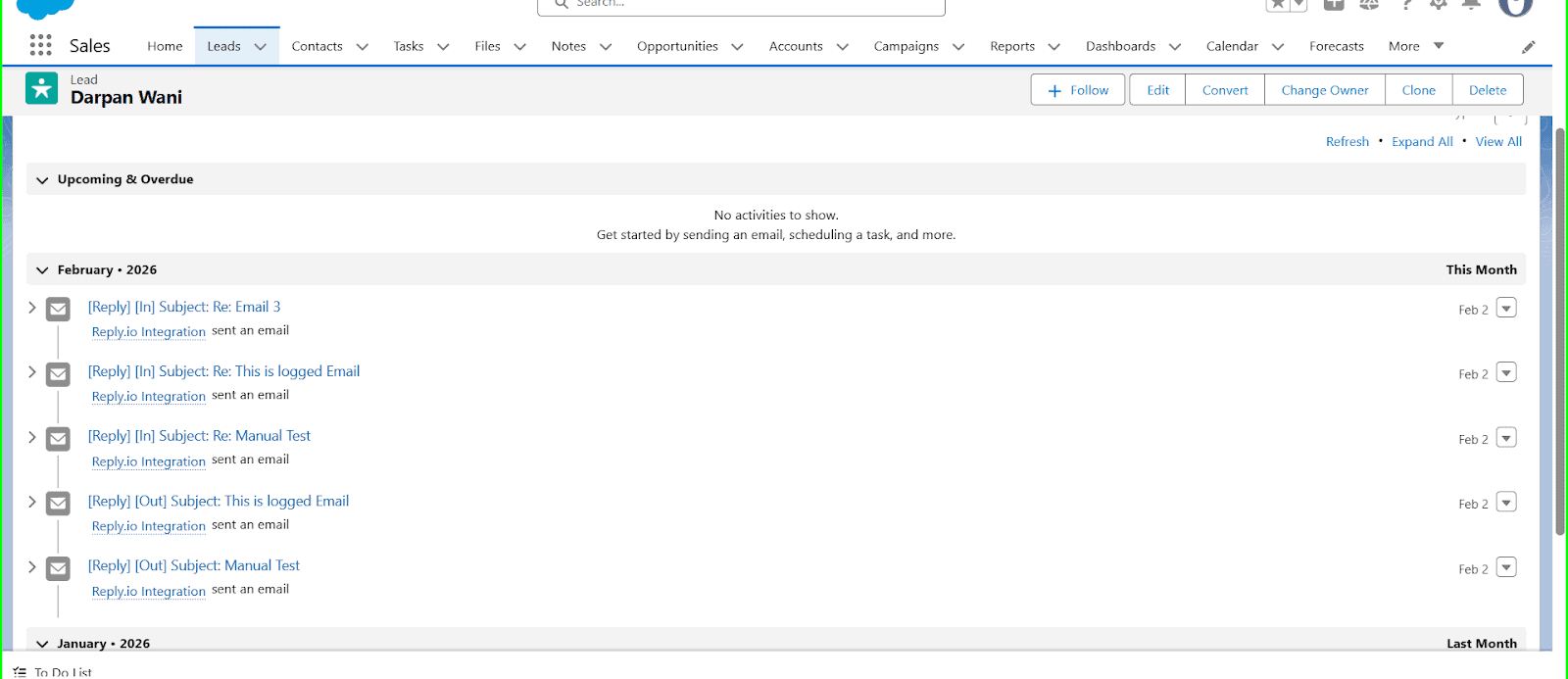
All engagement activities—emails sent, opens, replies, calls—are captured and normalized back into the CRM as structured data. This creates a complete and unified interaction history across all touchpoints.
Instead of fragmented activity logs, organizations gain centralized visibility, enabling accurate reporting, collaboration, and performance analysis.
Conversion Layer:
This layer translates engagement signals into meaningful business outcomes, such as updating lead status or creating opportunities. For example, a positive reply can automatically trigger qualification updates and pipeline creation.
By formalizing this transition, outbound shifts from activity tracking to revenue contribution, ensuring every interaction has a defined path to conversion.
Before vs After Maturity Shift
| Stage | Before Integration | After Architecture |
| Data | Fragmented | Centralized |
| Outreach | Manual / ad hoc | Trigger-based |
| Visibility | Partial | Full funnel |
| Ownership | Unclear | Defined |
| Pipeline | Unpredictable | Structured |
Data & Object Mapping (Where Most Implementations Break)
This is where integration success is decided—if objects and data are not mapped correctly, the entire outbound system becomes inconsistent and unreliable.
Core Objects in Salesforce
- Lead (Pre-account stage)
Represents early-stage prospects who are not yet associated with an account; this is typically where outbound targeting and initial qualification begin. - Contact (Account-linked stage)
Represents a qualified individual linked to an Account, enabling structured engagement and deeper sales interactions.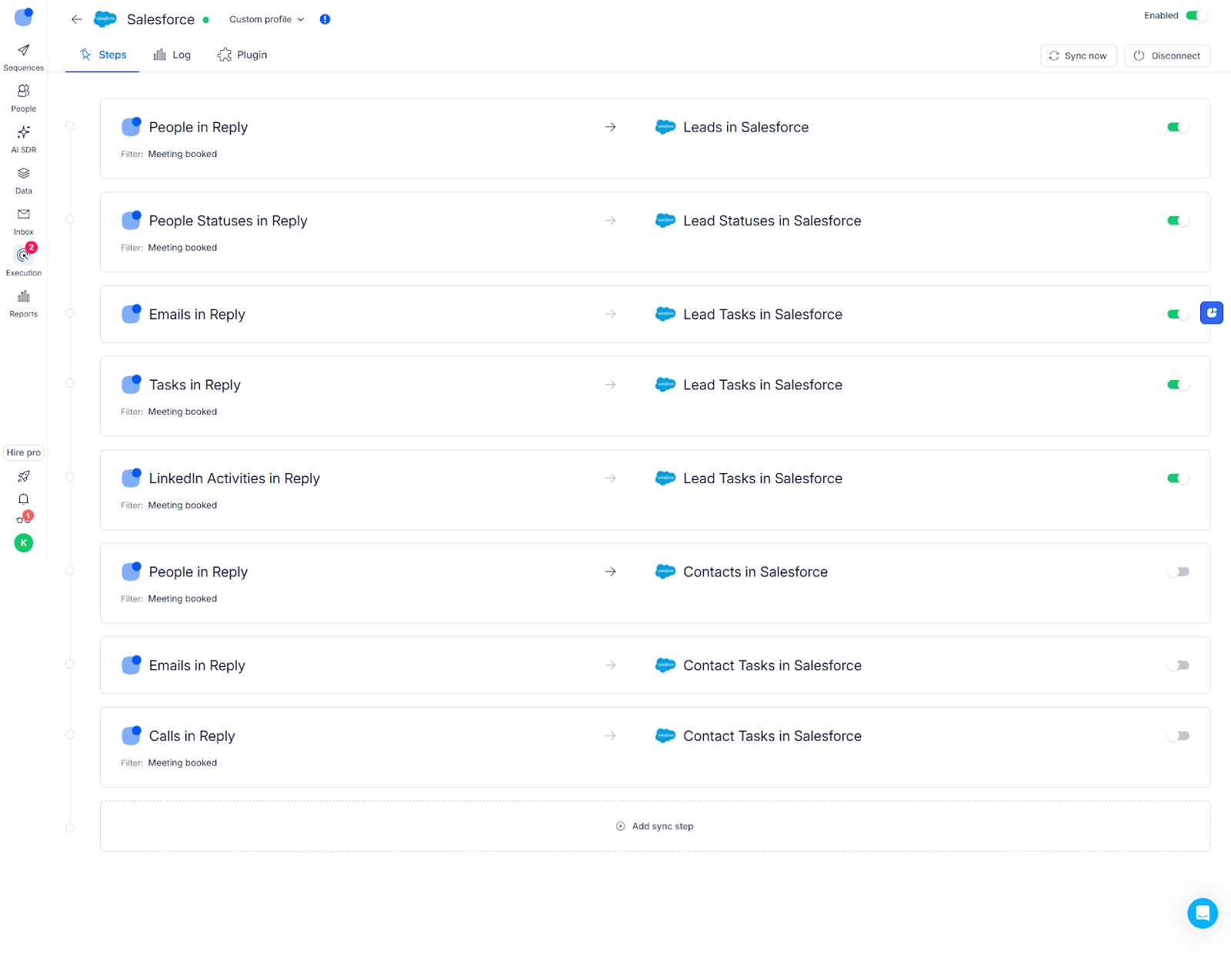

- Activity (Tasks & Events)
Captures all engagement actions (emails, calls, meetings), ensuring full visibility into outreach and sales efforts within the CRM. - Opportunity (Revenue conversion)
Represents a qualified deal in the pipeline, created when outbound engagement translates into a real revenue opportunity.
Critical Field Architecture
| Object | Field | Role |
| Lead | Outbound Readiness Flag | Controls sync eligibility |
| Lead | Sequence Enrollment ID | Prevents duplication |
| Contact | Engagement Status | Tracks the interaction level |
| Activity | Source = Reply | Normalizes reporting |
| Opportunity | Source Attribution | Revenue linkage |
Key Principle
1. Reply.io should never control lifecycle fields : Reply.io is an execution layer, not a decision system—allowing it to update lifecycle stages can create inconsistencies and break CRM data integrity.
2. All lifecycle movement must be governed within Salesforce : Lifecycle stages (MQL, SQL, Opportunity) must be controlled centrally in Salesforce to ensure consistent qualification logic, accurate reporting, and cross-team alignment.
Integration Layer (API & Sync Logic):
Integration Type
- REST API-based sync
Enables structured, real-time data exchange between Salesforce and Reply.io using standard API calls for record creation, updates, and status sync. - Webhook-driven engagement updates
Allows Reply.io to instantly push engagement signals (opens, replies, calls) to Salesforce as events occur, ensuring near real-time visibility. - Scheduled fallback sync
A periodic sync mechanism that reconciles missed or failed updates to maintain data consistency across systems.
Directional Architecture
1. CRM → Reply.io
- Lifecycle Stage = MQL / SQL : Only leads that meet defined qualification stages are eligible for outbound, preventing premature or irrelevant outreach.
- Required fields are complete : Ensures records have essential data (email, name, segmentation fields) before entering sequences, improving targeting quality.
- No active outreach conflict : Prevents duplicate or overlapping sequences by checking if the lead is already enrolled or recently contacted.
2. Reply.io → CRM
- Replies (positive/negative): Captures prospect intent and updates CRM status, enabling immediate follow-up or disqualification workflows.
- Calls completed: Logs call activities as structured CRM tasks, ensuring visibility into SDR execution and engagement history.
- Sequence progression: Tracks sequence steps (sent, opened, completed) in CRM to provide a complete engagement timeline.
Ownership Structure
Data Model — CRM Architect
Defines object structure, field design, and data relationships to ensure scalability, consistency, and reporting integrity within the CRM.
Lifecycle Definition — RevOps
Owns lead stages, qualification logic, and movement rules to ensure all teams operate on a unified revenue lifecycle.
Outreach Strategy — Sales Leadership
Determines targeting, sequencing logic, and engagement approach to align outbound execution with pipeline and revenue goals.
Integration Logic — Systems Architect
Designs and manages API flows, sync rules, and data movement to ensure reliable, secure, and controlled system interaction.
Control Mechanisms
- Field-level permissions to protect lifecycle fields
- Validation rules to block incomplete records
- Controlled sequence enrollment via CRM triggers
- Audit logs for all sync events
Performance & Scalability Considerations
1. Activity Volume Explosion
- High outbound volume creates thousands of CRM activities, which can slow reporting and degrade system performance.
- Mitigation: Use activity summarization (log key events only) and archival policies to reduce data load.
2. API Load Management
- Large-scale campaigns can exceed API limits, causing sync delays or failures between Salesforce and Reply.io.
- Mitigation: Implement batch processing and event-driven architecture to control and distribute API calls efficiently.
3. Duplicate Outreach Risk
- Multiple triggers or poor sync logic can enroll the same lead into sequences repeatedly, damaging prospect experience.
- Mitigation: Use enrollment lock flags and unique sequence tracking IDs to ensure one active outreach flow per record.
Failure Pattern Analysis
Failure 1: Treating Integration as a One-Time Setup
Integration is not static—without continuous optimization of triggers, data rules, and sequences, performance declines as market conditions and data quality evolve.
Failure 2: Over-Syncing Data
Pushing all leads into outreach dilutes targeting quality, resulting in low engagement rates and wasted SDR effort on unqualified prospects.
Failure 3: Lifecycle Misalignment
When Marketing and Sales define qualification differently, leads enter outreach prematurely or too late, breaking conversion flow and pipeline consistency.
Failure 4: Lack of Attribution
Engagement data exists, but without structured mapping to opportunities, the business cannot measure which outbound efforts actually drive revenue.
Failure 5: Tool-Led Decisions
Optimizing sequences inside Reply.io without aligning to Salesforce lifecycle logic creates disconnected execution with no strategic impact.
Strategic Consulting CTA
Most organizations believe they need better sequences.
At the surface level, outbound challenges often appear to be messaging or cadence issues. Teams try to optimize subject lines, timing, or channel mix, assuming performance gaps are execution-related.
In reality, they need better outbound architecture.
The real constraint is structural—how leads are qualified, when outreach is triggered, and how engagement is governed. Without architectural control, even the best sequences fail to deliver consistent outcomes.
Then your integration is functional—but not strategic.
The tools may be connected, but they are not operating as a unified system. Without architectural alignment, integration delivers activity, not measurable business outcomes.
Work with Twopir to transform outbound from activity into a predictable revenue system.
We focus on designing the underlying system that drives consistency, scalability, and revenue impact. The goal is not more outreach—it is controlled, measurable, and repeatable pipeline generation.
