
Advisors Were Flying Blind.
Salesforce Next Best Action
Gave Them a Playbook.
A US-based asset management firm with 180+ advisors and four offices had the client data — but no system telling advisors when to act, what to say, or which accounts to prioritise. We deployed Salesforce Next Best Action on the Advisor Detail View, connected to live opportunity and engagement signals, and cut advisor response lag by 68% within the first quarter.
advisor response lag
conversion rate
decisions automated
template send rate
full team deployment
- Salesforce Sales Cloud — with Contact and Opportunity objects in active use by advisors
- Activity history logged in Salesforce — emails and calls captured in CRM, not just personal inboxes
- Advisor account ownership mapped — each Contact or Account linked to a named advisor
- Salesforce Flow enabled — NBA strategy rules run on Flow; admin or dev access required to build them
- Data hygiene baseline — Contact records need Last Activity Date, Opportunity Stage, and AUM fields populated
- Business sign-off on decision rules — stakeholder consensus on what triggers each NBA recommendation before build begins
- How to structure NBA strategy rules — that surface contextual actions based on real advisor activity signals
- How to build Accept / Reject / Snooze flows — including auto-populating email templates on Accept
- How to surface NBA on the Advisor Detail View — on both Contact and Opportunity objects simultaneously
- How to capture rejection reasons — and use them to retrain strategy rules over time
- How to integrate NBA with Lightning email composer — so advisors can act without leaving the record
- How to govern the NBA model — setting snooze windows, rotation logic, and action priority ranking
A Growing US Asset Manager — With Advisor Data Sitting Idle in Salesforce
By the time they engaged us, this firm had been on Salesforce Sales Cloud for over two years — but the platform was functioning as little more than an expensive contacts database. Advisors were logging calls inconsistently, opportunity stages weren't reflecting actual pipeline health, and the decision of when to contact a client was still being made by gut feel and spreadsheet reminders. Senior advisors had good instincts. Junior advisors were guessing.
The firm's head of advisor operations had heard about Salesforce Next Best Action from a peer at a competitor firm but didn't know where to start. Their internal Salesforce admin was capable but had never built NBA strategy rules at this scale. The original vendor who implemented their Sales Cloud instance was no longer engaged. They needed a team that had done this before — across financial services orgs — and could move fast without breaking the data model they already had.
Four Operational Gaps That Were Costing Real Advisor Performance
After a two-week discovery process — which included listening calls with 12 advisors across three offices — we identified four systemic problems that weren't process failures. They were system failures that the current Salesforce setup was incapable of solving without NBA.
No Signal for When to Contact a Client
Advisors were manually reviewing their book of business each morning to decide who needed a touchpoint. For a book of 80–120 accounts, this took 45–60 minutes of productive time daily — and still missed clients who had gone 30+ days without contact. Three of the firm's largest client losses in the prior year were traced back to engagement gaps the advisor didn't catch until it was too late.
Follow-Up Decisions Were Person-Dependent, Not System-Driven
The top 20% of advisors had developed personal systems — colour-coded spreadsheets, calendar blocks, reminder sequences. The bottom 60% had none. This meant advisor performance variance of over 3× between the top quartile and average, with no structural way to close the gap. Senior advisors were being asked to coach junior peers on processes that lived in their heads, not in Salesforce.
Email Templates Existed — But Were Almost Never Used
The marketing team had built 14 Salesforce email templates for advisor outreach. Usage data showed fewer than 3 of those templates had been sent in the prior 90 days. Advisors weren't finding the templates, weren't selecting the right one for context, and were defaulting to personal Gmail accounts — creating compliance gaps and breaking email attribution entirely.
Opportunity Stalls Were Invisible Until Deals Went Cold
Opportunities sitting in the same stage for 14+ days weren't being flagged. There was no alert, no nudge, no action surfaced to the advisor. 43% of closed-lost opportunities in the prior two quarters had stalled in Negotiation or Proposal Sent for over 21 days before anyone noticed. A system that could identify a stall and recommend an action would have caught most of them.
How We Structured the Engagement
We've implemented Salesforce Next Best Action across financial services, healthcare, and SaaS orgs — and the failure pattern is always the same: teams try to build NBA without first defining the decision logic that should drive it. We refused to write a single Flow rule until we'd mapped every advisor-to-client interaction pattern and gotten business sign-off on which signals should trigger which actions. That groundwork is what separates NBA deployments that advisors actually use from ones they ignore after week three.
The engagement ran across five structured phases — from data audit to live deployment with role-based training. We built 11 distinct NBA strategy rules covering engagements on both the Contact and Opportunity objects, with full Accept/Reject/Snooze mechanics, automated email triggering, rejection reason capture, and a 7-day snooze cycle.
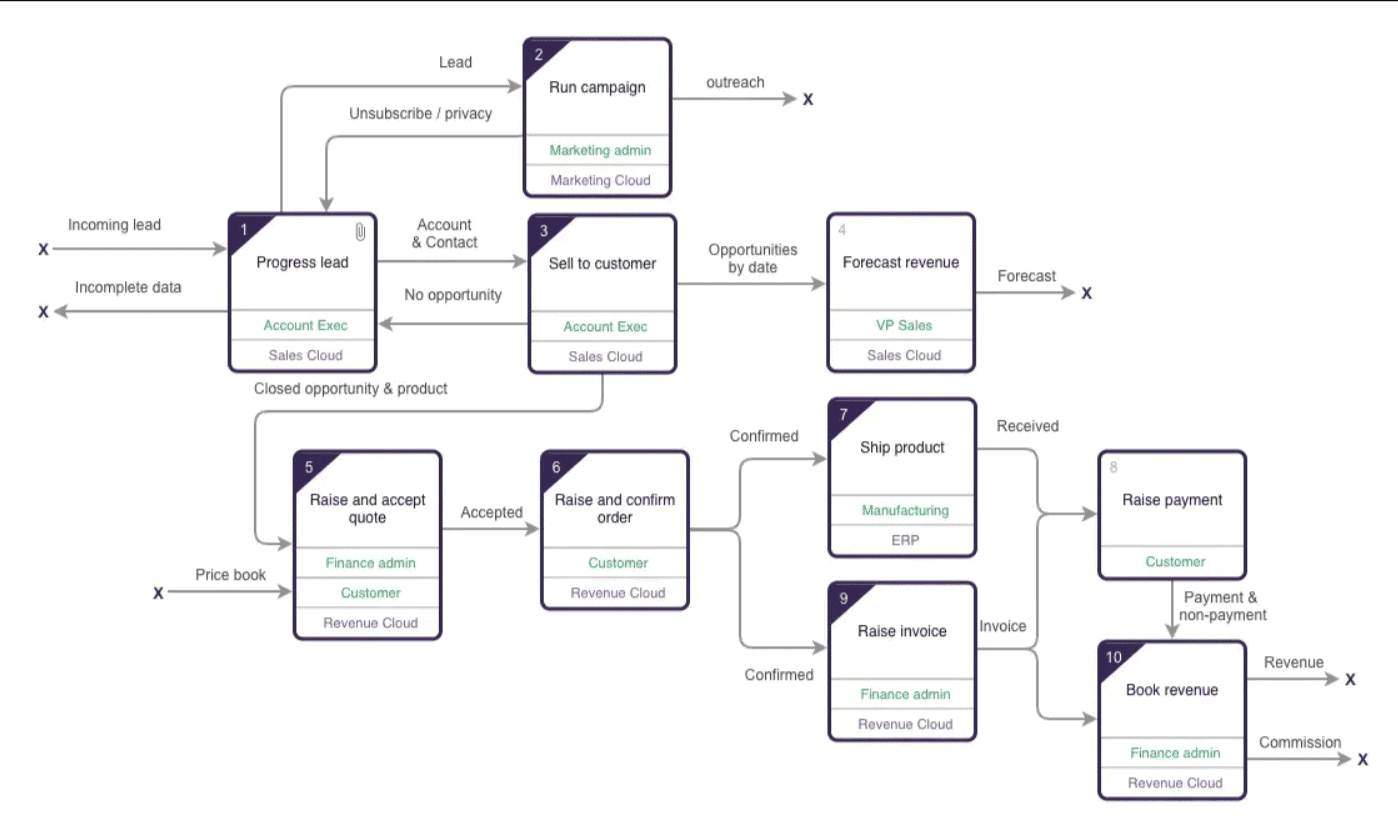
Discovery — Mapping the Real Advisor Workflow
Salesforce Next Best Action runs on strategy rules — and bad strategy rules are worse than no rules at all. If the first actions an advisor sees are irrelevant, they'll dismiss the component and never look at it again. The first two weeks were entirely about understanding how this firm's top-performing advisors actually make contact decisions.
We ran structured listening sessions with 12 advisors across all four offices, and a separate session with the compliance lead and operations head. From those sessions, we built a decision logic map: 11 advisor actions, ranked by business priority, each with defined triggers. This document became the authoritative source for every NBA strategy rule in Phase 03.
Data Readiness & Salesforce Object Mapping
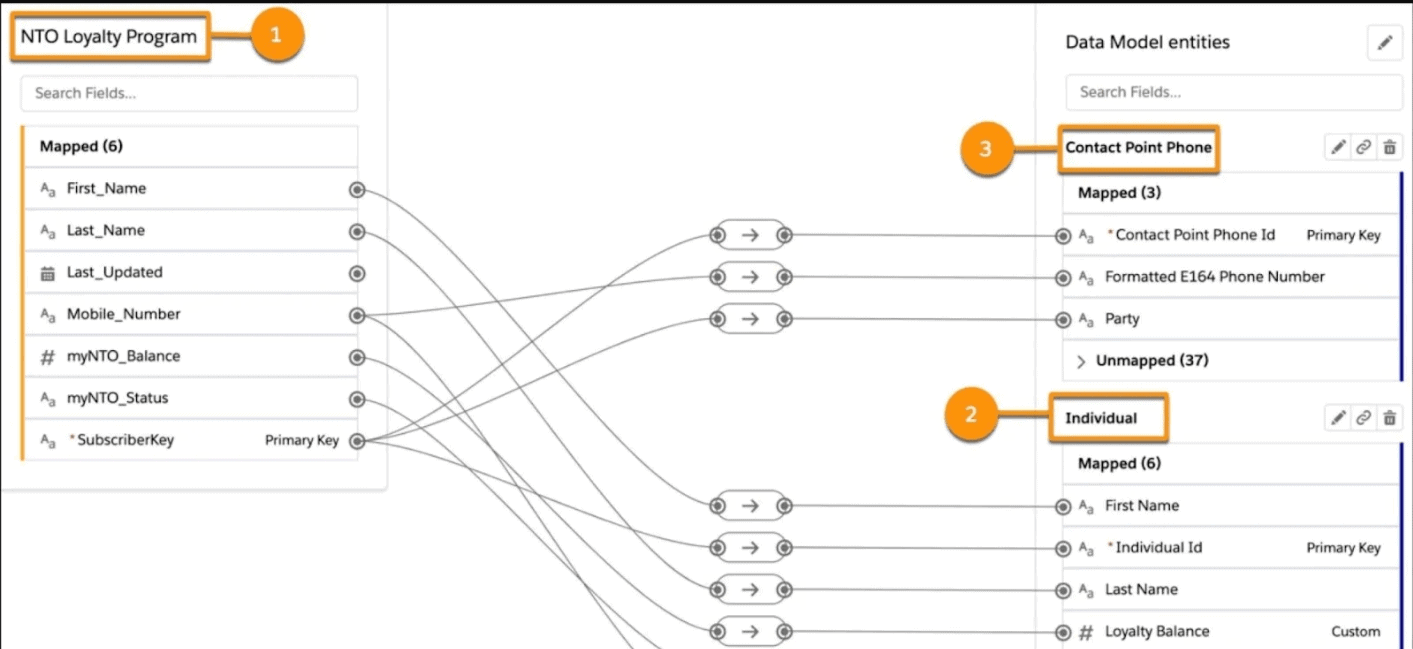
NBA recommendations are only as useful as the data feeding them. We ran a full audit of the client's Salesforce org: field population rates on Contact and Opportunity records, activity log completeness, ownership mapping between advisors and accounts, and the state of their AUM and engagement score fields — which turned out to be largely empty.
We mapped every NBA trigger field to the correct Salesforce object, confirmed the Activity Timeline was capturing data reliably, and identified three custom fields that needed to be built to support the strategy logic from Phase 01. We also audited the 14 email templates, retired six that were outdated, and restructured the remaining eight so they could be auto-opened by an Accept action in the NBA flow.
NBA Strategy Build — Flow Rules, Actions & Accept/Reject/Snooze Logic
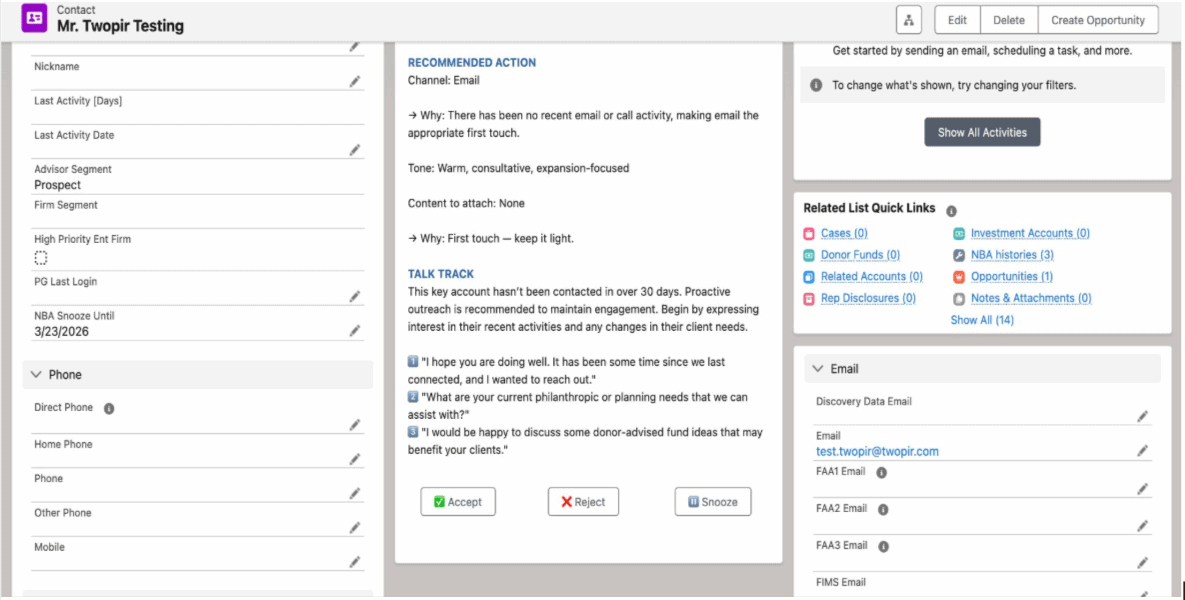
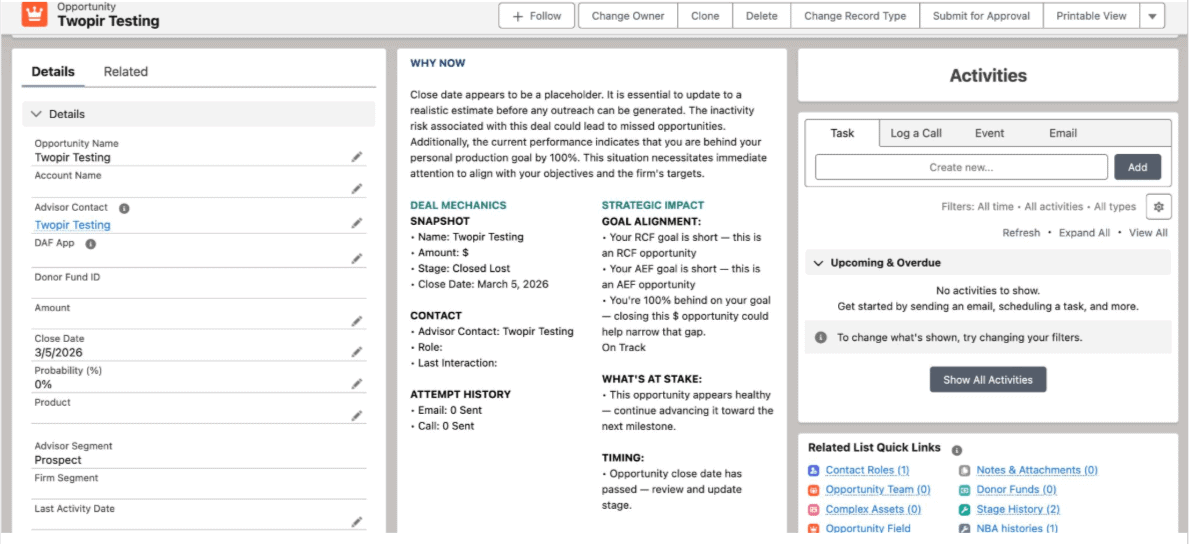
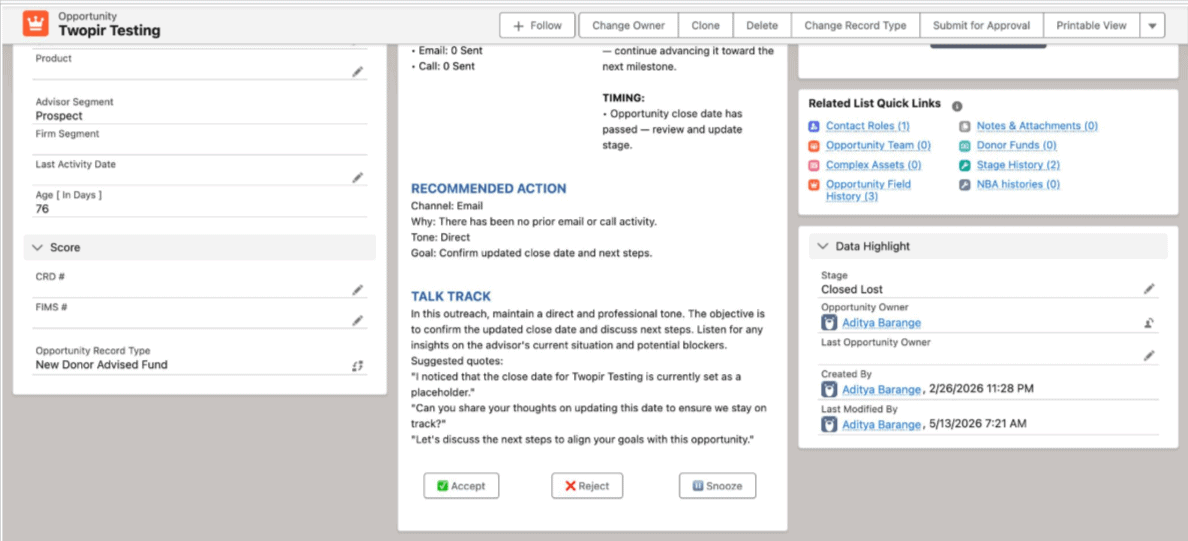
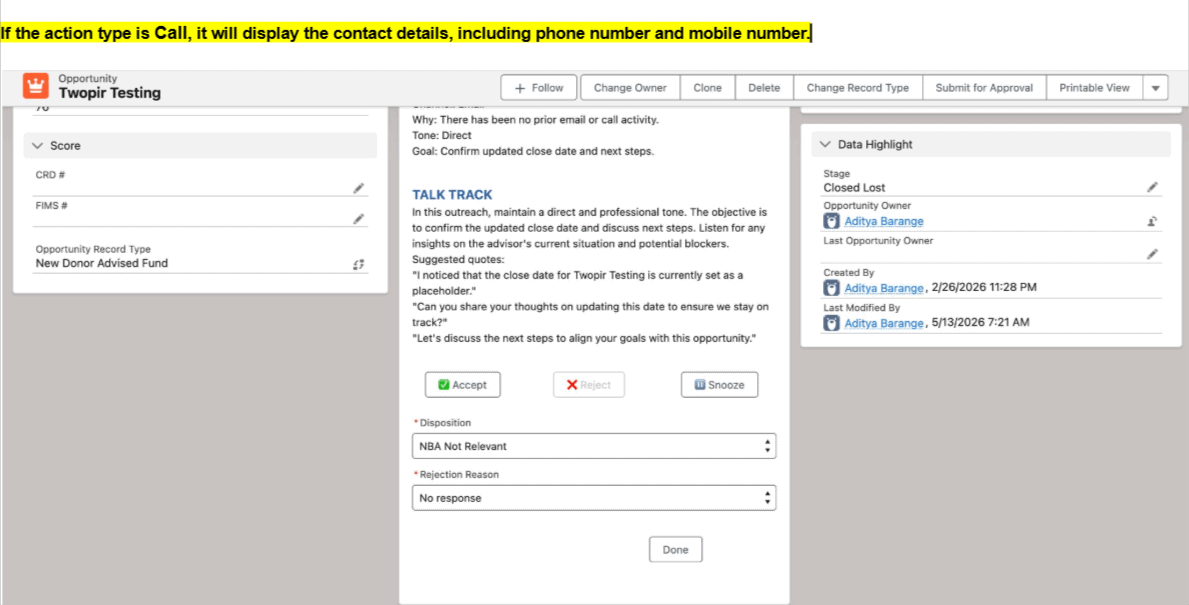
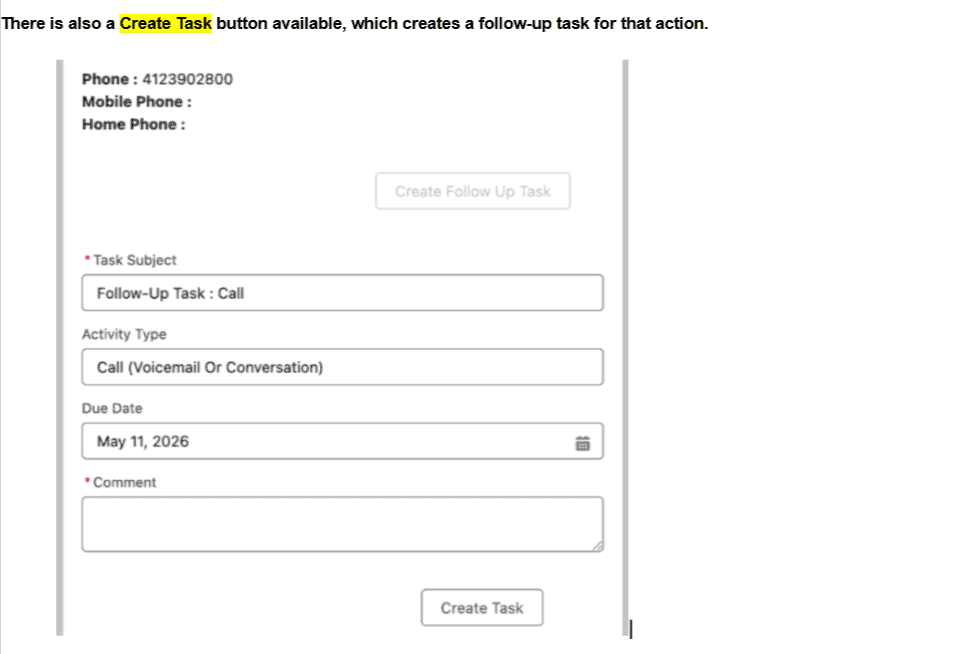
We used Salesforce Flow to create 11 strategy rules, each mapped to the decision logic from Phase 01. Each rule evaluates a set of field conditions — last contact date, opportunity stage, AUM tier, days since last activity — and when triggered, surfaces a specific recommended action on the Advisor Detail View component. The actions were configured for both Contact records and Opportunity records, each with their own display priority and trigger logic.
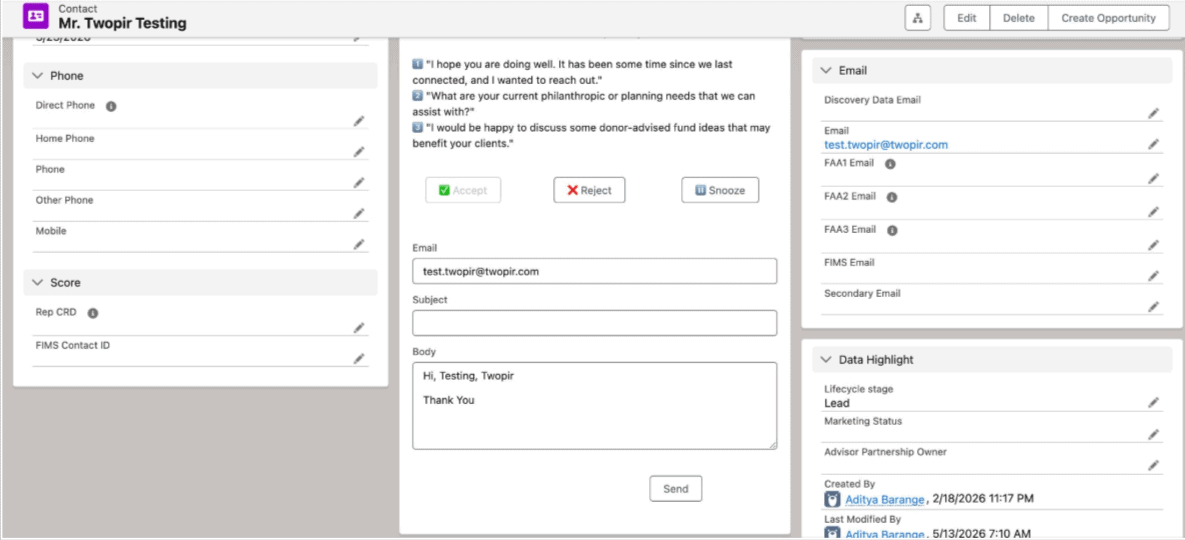
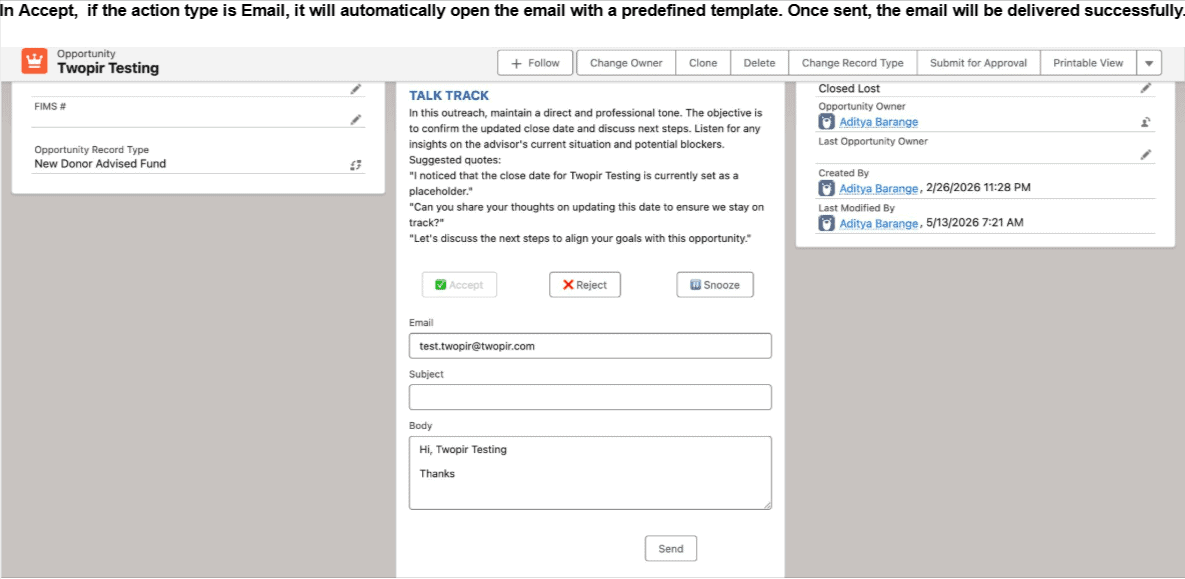
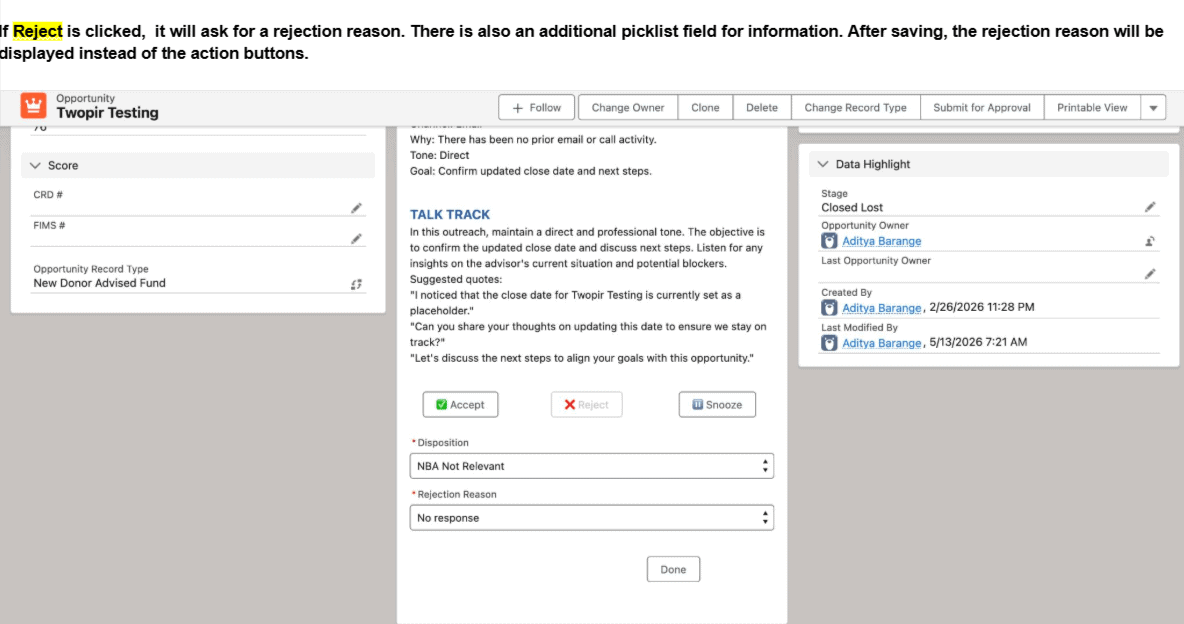
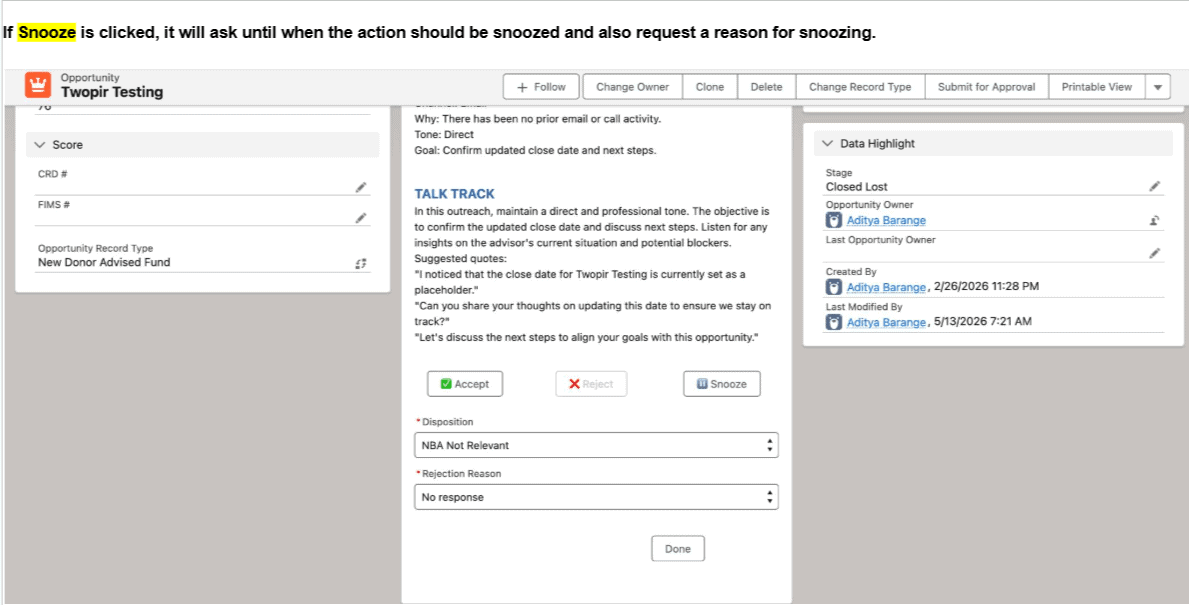
The three-action mechanic — Accept, Reject, Snooze — required custom Flow builds for each path. On Accept for an Email action type, the flow automatically launches the Lightning email composer pre-loaded with the relevant template. The advisor sends, the activity logs to the Timeline, and the NBA action is marked complete. On Reject, the advisor selects a rejection reason from a controlled picklist — those reasons feed a report built for the operations team to monitor strategy rule performance weekly.
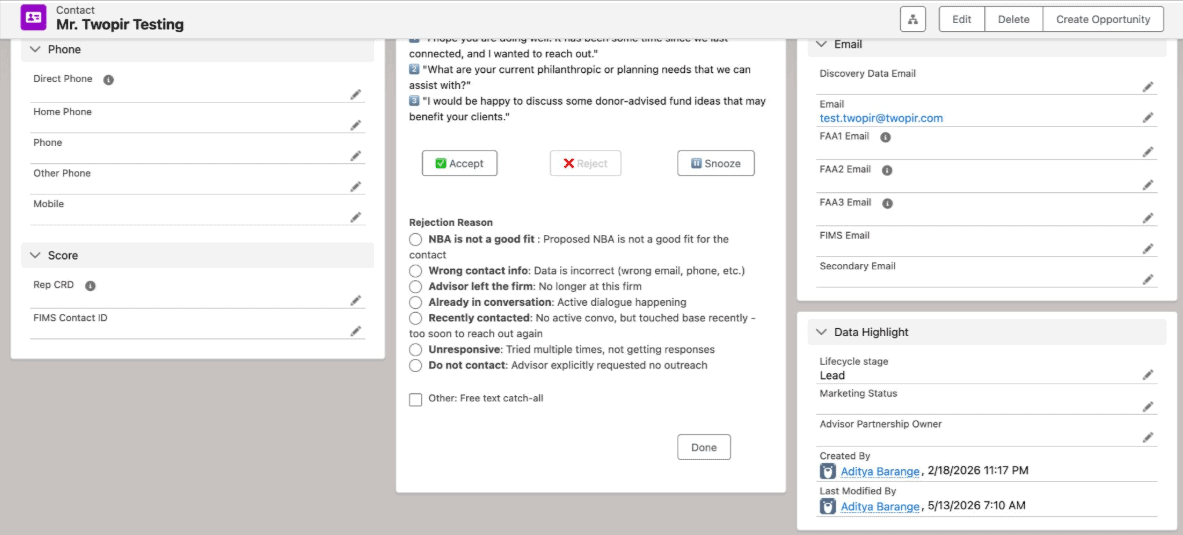
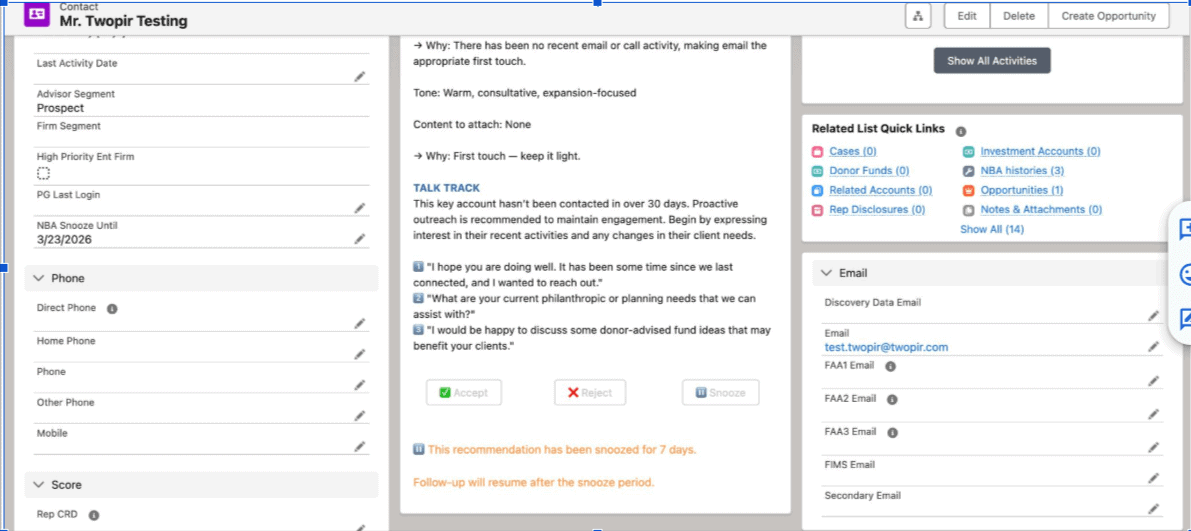
Advisor Detail View Deployment — Lightning UI & Component Configuration
The NBA component needed to feel like part of the Advisor Detail View — not a widget bolted on. We configured the Next Best Action Lightning component to sit prominently in the record layout, above the Activity Timeline on Contact records and in a dedicated column on Opportunity records. The placement decision came directly from the advisor listening sessions in Phase 01.
We ran two rounds of UAT with a pilot group of six advisors — three senior, three junior — before opening the deployment to the full team. UAT surfaced two issues, both resolved before the full rollout. Deployment ran office-by-office, giving the operations team time to monitor adoption at each stage.
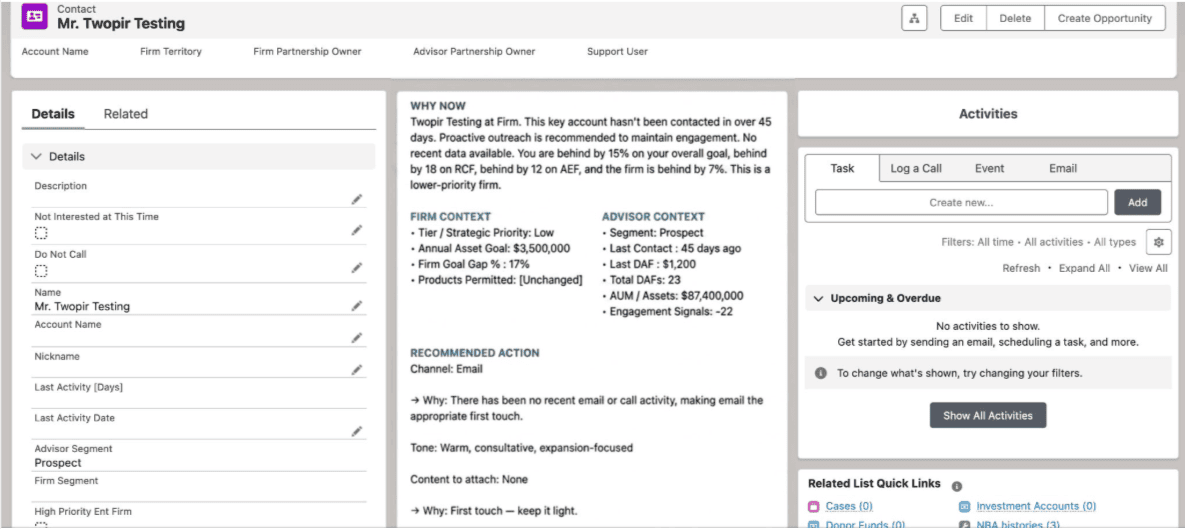
Training, Adoption Monitoring & Ops Team Handoff
We ran structured role-based training sessions for advisors, team leads, and the operations team separately — each with a different focus. Advisors learned how to read and act on NBA recommendations, how to use the Snooze function intentionally, and what the Reject reasons mean and why capturing them matters. Team leads learned how to read the strategy performance dashboard to coach their teams. The ops admin learned how to modify strategy rule conditions without re-engaging a developer.
We stayed engaged for 30 days post-go-live with weekly check-in calls and a shared Slack channel for real-time questions. Usage data showed that by Day 14, over 70% of advisors were acting on at least one NBA recommendation per week. By Day 30, that number was 84%. The rejection reason data from the first 30 days also allowed us to retire two of the 11 strategy rules that were generating actions advisors consistently found irrelevant.
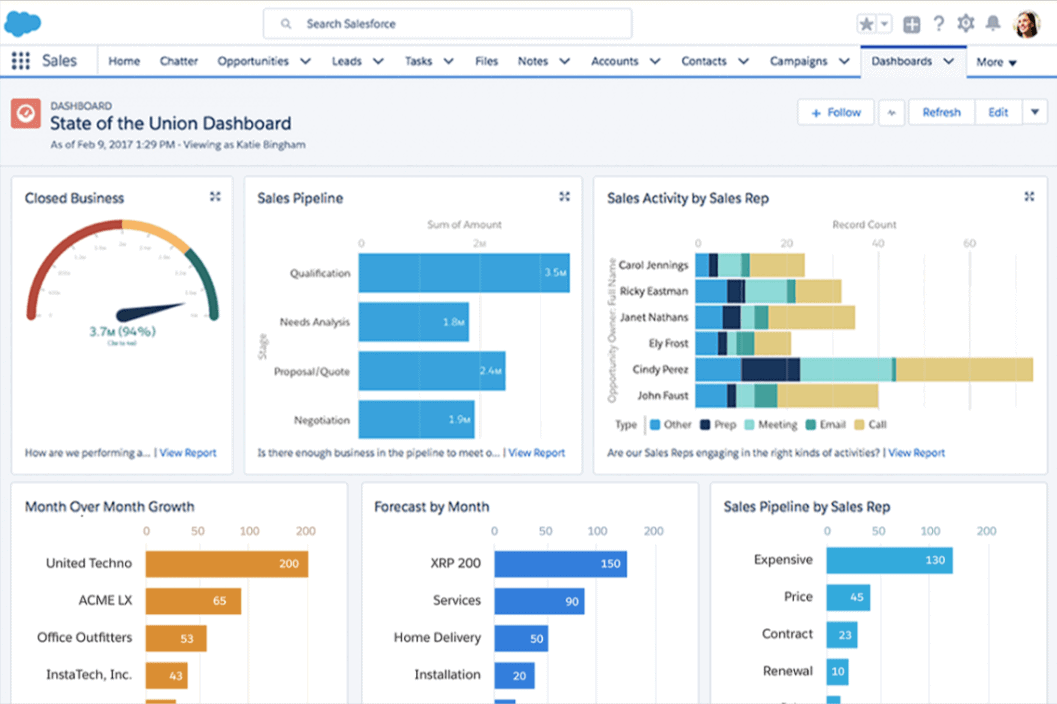
Is Your Salesforce Org Sitting on Data Your Advisors Can't Use?
Most orgs have the signals. They just don't have the engine that surfaces the right action at the right moment. We audit Salesforce setups and deliver written findings in 5 business days — at no cost.
What Changed — In Numbers and In Practice
The number that stuck with the operations head wasn't the conversion lift — it was that junior advisors' performance had moved from 40% below the team average to within 12% of it in 90 days. Not because they'd suddenly become better advisors. Because they now had the same information system that top advisors had been running in their own heads for years.
"Before NBA, the difference between a senior advisor's performance and a junior advisor's wasn't skill — it was that senior advisors had a system in their head that told them when to call, what to say, and when to escalate. We've now put that system in Salesforce. And junior advisors are using it."
— Twopir Project Lead · US Asset Management · 2024Salesforce Next Best Action for Financial Services — Common Questions
Related Case Studies
Your Salesforce Has the Data.
Your Advisors Need the Signal.
We run a free CRM audit to assess your org's NBA readiness — data completeness, object mapping, Flow capacity, and where the quick wins are. You get findings in 5 business days, with a clear implementation scope if you choose to move forward.
Serving US · UK · Australia · UAE · Canada · US EST · UK GMT · AEST coverage · Response within 24 hours guaranteed
