
Salesforce Industry Cloud for Technology Companies: What It Is and How to Build It
There is no single "Technology Cloud" to buy. Salesforce for Technology is a solution built from Sales Cloud, Service Cloud, Revenue Cloud, Data 360, Agentforce and partner tools. This guide explains which pieces software and hardware companies need, what they cost, and in what order to build them.
Key Takeaways
- There is no "Technology Cloud" license. Salesforce for Technology is one of Salesforce's 16+ industry solutions, assembled from Customer 360 products rather than sold as one industry cloud.
- The core products Salesforce lists for technology companies are Sales Cloud, Service Cloud, Revenue Cloud, Data 360, Agentforce, Slack and Tableau. Partner Relationship Management covers channel sales.
- Five jobs matter most for software and hardware companies: product-led sales, quote-to-cash for subscriptions, partner and channel sales, retention and renewals, and unified data for AI.
- Some things are not included, such as product lifecycle management and project delivery. They come from AppExchange apps, custom builds or integrations.
- Build in stages. Get the sales and service data model right first. Add Revenue Cloud, partner portals, Data 360 and agents when the business needs them.
Salesforce for technology companies is not a single product. When Salesforce talks about its "Technology" industry solution, it means a set of Customer 360 products (Sales Cloud, Service Cloud, Revenue Cloud, Data 360, Agentforce, Slack and Tableau) configured for the way software, hardware and platform companies sell, bill and keep customers. Knowing that changes how you buy it: you choose the pieces your revenue model needs, not a bundle.
This guide is written for growing and mid-market companies in SaaS and technology that are choosing, expanding or fixing a Salesforce setup. It replaces our earlier overview with Salesforce's current product line-up, list prices, the gaps the platform does not cover out of the box, and a stage-by-stage plan.
Does Salesforce Have an Industry Cloud for Technology Companies?
Yes and no. Salesforce lists Technology among its industry solutions, but unlike Manufacturing Cloud or Communications Cloud, there is no separate "Technology Cloud" with its own data model to license. Salesforce describes the technology solution as products from the Customer 360: Sales Cloud, Service Cloud, Revenue Cloud, Data 360, Agentforce, Slack and Tableau, plus partner apps.
The technology solution fits if you sell subscriptions or usage-based plans, run a product-led or hybrid sales motion, sell through resellers or partners, or need renewal and expansion data that sales, finance and customer success all trust.
Do not expect a ready-made tech data model for licences, entitlements and usage out of the box, or built-in product lifecycle management. Those come from Revenue Cloud configuration, AppExchange apps or integrations, and they need design work before go-live.
The practical consequence: two technology companies on "Salesforce for Technology" can have very different orgs. One may run Sales Cloud and Service Cloud only. Another may add Revenue Cloud, a partner portal, Data 360 and AI agents. The right mix depends on how you make money.
What Is the Salesforce Industry Cloud for Technology?
It is Salesforce's industry solution for software, hardware and technology platform companies. In Salesforce's words, it "allows companies to solve a variety of industry problems using the Salesforce Platform". It combines automation, unified data and AI across product, sales, service and customer success, and focuses on product-led growth, recurring revenue, partner channels and net revenue retention.
Salesforce for Industries covers more than 16 industries. Each solution is described as five connected layers: data that gives AI its context, industry applications and workflows, AI agents, analytics, and customer engagement. For some industries the application layer is a dedicated product. For technology, it is the standard clouds configured around subscriptions, entitlements and product usage.
| Industry | Dedicated industry cloud? | What Salesforce says it adds |
|---|---|---|
| Communications | Communications Cloud | "Purpose-built for communications service providers", with its own applications, data model and integrations. |
| Manufacturing | Manufacturing Cloud | Unifies sales, service and channel operations for manufacturers. |
| Technology | Built from Customer 360 | Agentforce, Sales Cloud, Data 360, Service Cloud, Slack, Tableau and Revenue Cloud, plus partner apps and experts. |
Sources: Salesforce for Communications, Salesforce for Manufacturing and Salesforce for Technology, 21 October 2026.
Which Salesforce Products Make Up the Technology Solution?
Seven products form the core, with partner management and integration added as needed. Sales Cloud runs the pipeline, Service Cloud runs support, Revenue Cloud handles quote-to-cash, Data 360 unifies customer and product data, Agentforce adds AI agents, Slack connects teams, and Tableau handles analytics. Partner Relationship Management and MuleSoft extend it to channels and other systems.
Sales Cloud
Leads, accounts, opportunities, forecasting and pipeline management. The base every other block plugs into.
Service Cloud
Case management, routing, self-service portals and a service console. Salesforce positions it for reducing churn and raising renewal rates.
Revenue Cloud
Product catalog, pricing, quoting, contracts, orders, subscriptions and billing on one data model.
Data 360
Unifies sales, service, marketing and web interactions into one profile, and can federate product data from existing data lakes without moving it.
Agentforce
AI agents for service, employee support and sales development, such as answering product questions and booking meetings.
Partner Relationship Management
Partner portal, deal registration, lead routing to partners, partner marketing funds and partner analytics.
Slack and Tableau sit across all of these: Slack for deal rooms and case swarming between support, engineering and customer success, and Tableau for analytics across the revenue lifecycle. MuleSoft connects Salesforce to billing, product and finance systems when an AppExchange connector is not enough.
How Do Technology Companies Use Salesforce? Five Core Use Cases
Technology companies use Salesforce for five jobs: converting product-qualified leads, quoting and billing subscriptions, selling through partners, retaining and expanding customers, and unifying data so people and AI agents work from the same facts. Each job maps to specific products, and most companies start with one or two.
Turn product usage into pipeline
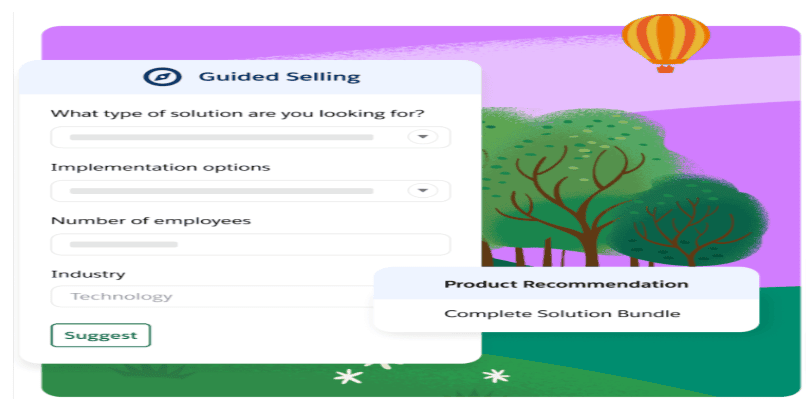
In a product-led or hybrid model, the strongest buying signal is what users do inside the product. Salesforce describes unifying engagement and usage data from any source so marketing can segment precisely and hand product-qualified leads (PQLs) to sales. In practice, that means usage events flow into Data 360 or Sales Cloud, a scoring model flags accounts that hit activation milestones, and routing rules put them in front of the right rep while intent is high.
Quote, contract and bill subscriptions in one system
Revenue Cloud unifies pricing, quoting, contracting and billing on a single data model. For subscription businesses, the parts that matter most are product bundling and pricing rules, asset lifecycle management (amend, renew or cancel at any point in the contract), subscription management and order automation. Salesforce says asset lifecycle management supports reporting on metrics like ARR and NRR, which is the number most tech boards ask for first.
Run resellers, referral partners and alliances from the CRM
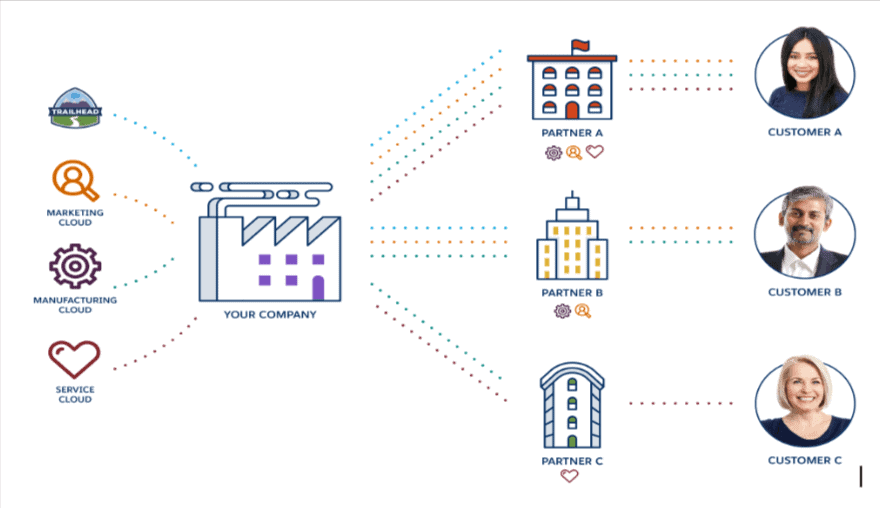
Many technology companies sell through resellers, distributors, system integrators or marketplaces. Salesforce's Partner Relationship Management adds a branded partner portal built with Experience Builder, deal registration, lead routing to partners, partner marketing fund and campaign requests, and partner scorecards and analytics. Partner deals are tracked in Sales Cloud, so channel revenue appears in the same forecast as direct revenue.
Protect and grow recurring revenue
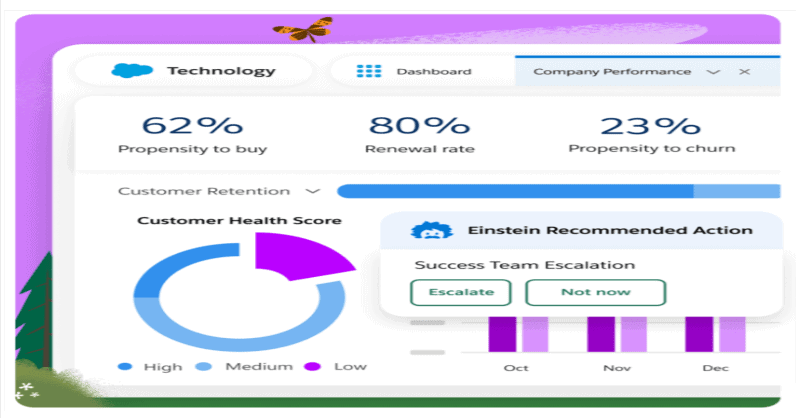
In recurring revenue businesses, churn and expansion decide growth. Salesforce's approach for technology companies combines Service Cloud for support (AI case management, routing, self-service and a unified console), Data 360 for a single customer view, and Agentforce to resolve issues and surface churn risk and expansion opportunities early. A working setup usually adds a customer health score built from usage, open cases and engagement, plus renewal opportunities created automatically ahead of each contract end date.
Give teams and AI agents the same customer facts
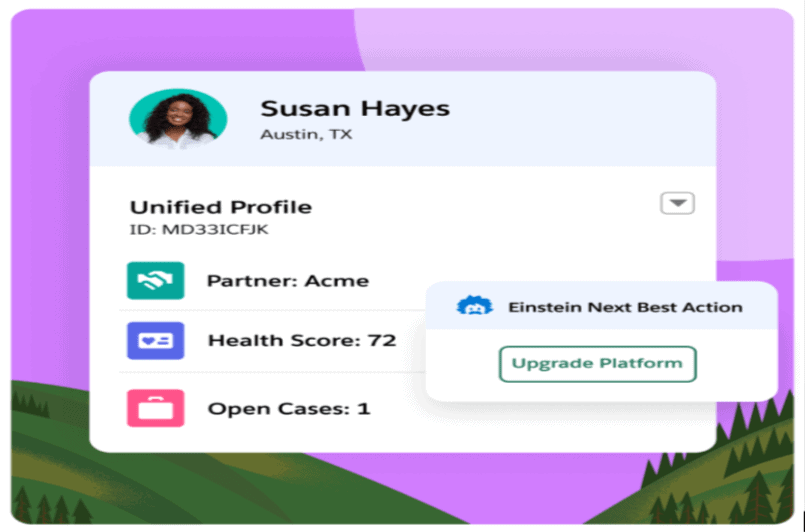
Technology companies tend to have customer data in many places: the product database, billing, support, marketing automation and the CRM. Data 360 unifies interactions across sales, service, marketing and web into one profile, and Salesforce says it can activate existing data lakes and product signals through zero-copy federation, without a migration. That unified profile is also what grounds Agentforce agents, so they act on the same contract, entitlement and usage facts as your team.
What Does Salesforce for Technology Not Include Out of the Box?
Product lifecycle management, project delivery, a ready-made model for licences and usage, and a finance ledger are not among the products Salesforce lists for its technology solution. Each is a common need in tech companies, and each is filled by an AppExchange app, a custom build or an integration. Plan for them up front.
How Much Does Salesforce Cost for a Technology Company?
There is no single price, because you license each product separately. At list price, Sales Cloud Core is $195 USD per user per month, Revenue Cloud Growth $150 and Advanced $200 per user per month, and Partner Relationship Management starts at $10 per login per month. Data 360 and Agentforce are mainly priced by usage.
| Product | Starting list price (USD) | Notes |
|---|---|---|
| Starter Suite / Pro Suite | $25 / $100 per user per month | Small business suites for early-stage teams |
| Sales Cloud Core | $195 per user per month | Billed annually |
| Revenue Cloud Growth | $150 per user per month | Quoting, configurator, order capture, subscriptions |
| Revenue Cloud Advanced | $200 per user per month | Adds contracts, orders, consumption, invoicing, AI and analytics |
| Partner Relationship Management | From $10 per login per month | Some Sales Cloud editions support PRM out of the box |
| Agentforce for Sales | From $125 per user per month | Sales Cloud Core and above |
| Agentforce (platform) | Flex Credits, per conversation or per user | Consumption-based or per-user options |
| Data 360 | Usage-based | Pay for what you use |
Sources: Salesforce Sales Cloud pricing, Revenue Cloud pricing, Agentforce pricing and Data 360, 21 October 2026. List prices exclude taxes and add-ons.
Licences are only part of the cost. Implementation, integration with billing and product systems, and data clean-up often decide whether the investment pays back. Budget for them alongside the licences, and phase the products so each one is adopted before the next arrives.
Which Salesforce Stack Fits Your Technology Company's Stage?
Answer these in order. Each yes adds a block on top of the one before.
How to Implement Salesforce for a Technology Company: A Six-Step Roadmap
Implement in phases: map the customer lifecycle, fix the data model, launch sales and service, then add quote-to-cash, partners, and data and AI. Each phase should go live and be adopted before the next starts. This order keeps every new product on data your teams already trust.
| Step | What to do |
|---|---|
| 1. Map the lifecycle | Write down each stage from first signup or lead to renewal and expansion, who owns it, and which system holds its data today. |
| 2. Design the data model | Decide how accounts, contacts, products, subscriptions, assets and entitlements relate. This is the hardest decision to reverse. |
| 3. Launch sales and service | Go live with Sales Cloud and Service Cloud on one account model, with lead routing, stages, case routing and core dashboards. |
| 4. Add quote-to-cash | Configure the product catalog, pricing rules and subscriptions in Revenue Cloud, and integrate billing and finance. |
| 5. Open the partner channel | Launch the partner portal with deal registration and lead routing, then partner analytics once deal volume builds. |
| 6. Unify data, then add agents | Bring product usage into Data 360, build health scores, and deploy Agentforce on one well-defined use case before widening it. |
Steps 4 to 6 can change order. A channel-led hardware company may need partners before Revenue Cloud, and a product-led SaaS company may need usage data first. Steps 1 to 3 should not move.
What Results Have Technology Companies Seen?
Published results are specific to each company, so read them as examples, not benchmarks. Salesforce's own customer stories and our published case study show the same pattern: the gains came from connecting data that was spread across tools, then automating work on top of it.
Wonolo
Salesforce customer storyFocus: AI-assisted support in Service Cloud.
The on-demand staffing platform uses AI-generated chat replies in Service Cloud. According to Salesforce's customer story, average handle time fell 20% for newer agents and 12% for senior agents. Its sales team also moved lead tracking from Google Sheets into Sales Cloud.
Uber Eats
Salesforce customer storyFocus: One service view across many systems.
Service agents once worked across about 30 global systems to resolve a merchant dispute. In Salesforce's customer story, integrations now pull case data from those systems into one view, using Service Cloud, Sales Cloud, MuleSoft, Tableau and the Salesforce Platform.
A US B2B SaaS FinTech
Twopir case studyFocus: Salesforce CPQ and a connected sales stack.
A North American subscription software company of about 250 people had Salesforce, Outreach and a prospecting tool that did not share data. Twopir Consulting connected Salesforce CPQ, Outreach, Apollo.io and Zapier, and the company reported 35% pipeline growth in the first quarter after launch. Read the full case study.
How Twopir Consulting Helps Technology Companies on Salesforce
Twopir Consulting is a Salesforce Partner and HubSpot Partner. We help growing and mid-market companies solve complex CRM, integration and business system challenges: we implement, rescue, optimize, and integrate complex CRM and revenue systems. For technology companies, that means building the Salesforce side of the customer lifecycle, from lead capture and demo routing through pipeline, onboarding, health scoring, renewal and expansion.
- SaaS revenue infrastructure: our Salesforce for SaaS practice designs the data model, automation and reporting across the full lifecycle, including subscription billing integration.
- Revenue operations: RevOps services that align sales, customer success and finance on one set of numbers.
- Data and AI: Data 360 and Agentforce implementation, starting with the data the agents will rely on.
- Partner portals: Experience Cloud services for partner and customer portals.
Map Your Salesforce Stack Before You Buy the Next Product
On a 30-minute discovery call, a Twopir Salesforce architect will review your revenue model, current org and integrations, and tell you which products you need now, which can wait, and what to fix first.
Schedule a Discovery CallThe Bottom Line
Salesforce for Technology is a way of assembling Salesforce, not a product you switch on. The companies that get value from it choose the blocks their revenue model needs, design the data model before buying more licences, and add quote-to-cash, partner and AI capabilities only when the foundation is adopted.
- 1
There is no standalone Technology Cloud. The solution is built from Customer 360 products.
- 2
Sales Cloud and Service Cloud are the foundation. Revenue Cloud, partner management, Data 360 and Agentforce are added by need.
- 3
PLM, project delivery, usage data and the general ledger need apps or integrations. Plan for them.
- 4
Each product is licensed separately, so phase the purchase with the rollout.
- 5
Clean, connected data comes before AI agents and health scores.
Frequently Asked Questions
Not as a separate product. Salesforce lists Technology among its industry solutions, but builds it from Customer 360 products: Sales Cloud, Service Cloud, Revenue Cloud, Data 360, Agentforce, Slack and Tableau. Industries such as communications and manufacturing have dedicated clouds; technology does not.
Most SaaS companies start with Sales Cloud for pipeline and forecasting and Service Cloud for support, on one shared account model. Revenue Cloud follows when quoting and subscriptions get complex, and Data 360 when product usage data needs to reach the CRM.
No. Product lifecycle management is not among the products Salesforce lists for its technology solution. Hardware companies that need bills of materials and change management usually add a PLM app from AppExchange or integrate their existing PLM system.
Revenue Cloud covers the product catalog, pricing, quoting, contracts, orders, subscription management and billing on one data model. Revenue Cloud Growth starts at $150 USD per user per month and Revenue Cloud Advanced, which adds contracts, consumption and invoicing, at $200, billed annually.
Yes. Partner Relationship Management adds a partner portal, deal registration, lead routing to partners, marketing fund requests and partner analytics, with partner deals tracked in Sales Cloud. Salesforce lists it from $10 USD per login per month, and some Sales Cloud editions support it out of the box.
Yes, for defined jobs such as answering support questions, helping employees and qualifying or booking meetings with prospects. Agents work best when Data 360 gives them accurate contract, entitlement and usage data, so start with one use case on clean data.
Not if you start small. Starter Suite at $25 and Pro Suite at $100 per user per month suit early teams with a simple process. Move to Sales Cloud and add other products as the sales model, pricing and channels grow more complex.
