
Chili Piper Distro for Salesforce: Route Every Record to the Right Rep
Distro is Chili Piper's router for Salesforce records. It decides who owns each new lead, contact, account, opportunity or case, keeps distribution fair, and reassigns work nobody touches. This guide explains how a Distro router works today, how to set one up, and how to troubleshoot it when a record isn't routed.
Key Takeaways
- Chili Piper Distro assigns Salesforce records (leads, contacts, accounts, opportunities, cases and activated custom objects) to the right owner, in real time, with rules, round robin and matching.
- Distro works with Salesforce only. It does not route HubSpot CRM records.
- A router runs in order: trigger, optional delay and entry rule, matching, routing rules, then actions such as assigning the owner, updating fields, creating tasks or converting the lead.
- Weights, caps, fallback owners, out-of-office handling and SLAs are what make routing fair and make sure leads actually get worked.
- When a record isn't routed, open Distro Logs: the Record Evaluation table shows which condition failed, and errored records can be re-routed.
Chili Piper Distro automates one of the most argued-about jobs in sales operations: deciding who owns a new record in Salesforce. Without it, many teams rely on a single lead assignment rule, a queue that someone checks between meetings, or a Flow that grew one branch at a time until nobody wants to touch it. The result is slow first responses, reps who feel the split is unfair, and accounts owned by one rep while their new leads go to another.
This guide is for sales operations, RevOps and Salesforce admins at growing and mid-market companies that run Salesforce and are evaluating, setting up or fixing Distro. It replaces our 2023 walkthrough, which described the older Rules, Teams and CRM Routers tabs. Distro has since moved to a visual flow builder and added SLAs, capping, matching, scheduled runs and assignment tables, so the steps and terms below reflect Chili Piper's current documentation.
What Is Chili Piper Distro?
Chili Piper Distro is lead routing software for Salesforce. It watches Salesforce for new or updated records, evaluates them against your rules, and writes the right owner back to the record, using round robin, ownership or territory logic. It also matches leads to existing accounts and enforces follow-up SLAs. Distro integrates with Salesforce only.
Distro is one product in what Chili Piper calls its Demand Conversion Platform, where users, teams and routing logic are set up once and shared across products. That shared setup is why people confuse Distro with the scheduling products. The difference is simple: Distro assigns CRM records; the others route people to meetings.
| Chili Piper product | What it routes | Typical moment |
|---|---|---|
| Distro | Salesforce records: their owner and related fields | A lead is created from a list upload, a webinar sync, an outbound tool or an enrichment update |
| Concierge | Website form submissions to a qualified meeting | A prospect fills in a demo form and books straight onto a rep's calendar |
| Handoff | Meetings between internal teams | An SDR books the account executive, or a closed-won deal is handed to implementation |
Chili Piper's lead distribution page also lists Chili Assist for building routing rules in plain English. If you are looking for scheduling, our guide to Chili Piper Concierge covers the form side.
Chili Piper Distro vs Salesforce Lead Assignment Rules: When Do You Need Distro?
You need Distro when routing depends on more than "first matching rule wins". Native assignment rules assign leads and cases to a user or queue, top to bottom, and stop at the first match. Distro adds weighted round robin, caps, out-of-office handling, account matching, SLAs and routing for any object. If one rule and a queue cover you, stay native.
Salesforce's own documentation sets the limits. Assignment rules exist for leads and cases, and for each rule type only one rule can be active at a time. Rule entries are evaluated in order and stop at the first match; a record that matches nothing goes to a default owner. The assignment-rule documentation does not describe round robin, weighting or caps, which is why teams build them with Flow, Apex or an app.
| Need | Salesforce assignment rules | Salesforce Omni-Channel | Chili Piper Distro |
|---|---|---|---|
| Objects routed | Leads and cases | Work items, mainly service channels | Lead, Contact, Account, Opportunity, Case, plus activated custom objects |
| Logic | One active rule, ordered entries, first match wins | Queues, skills, priority and capacity | Ownership rules, round robin rules, catch-all, assignment tables |
| Fair distribution | Not described; built with Flow or Apex | Most available or least active agent | Weighted round robin with credit and skip |
| Rep availability | Assignees cannot be inactive users | Agent presence and capacity | Calendar out-of-office, working hours, caps, fallback owner |
| Account matching | No | No | Lead-to-account, lead-to-opportunity, lead-to-case and more |
| Follow-up SLAs | No | Routing happens once, at assignment | Remind, reassign or update a field when a rule is still true after a set time |
| Set up by | Salesforce admin | Service admin | RevOps or admin, paid Chili Piper plan |
Omni-Channel is Salesforce's routing engine for service work: it pushes items to the most available, qualified agents based on priority and capacity, and standard Omni-Channel was retired in Summer '26 in favour of Enhanced Omni-Channel. It is a strong fit for support queues. For sales ownership across leads, accounts and opportunities, it is rarely the tool teams choose.
Native rules are enough when you route only leads or cases, territories are simple, a queue is acceptable, and nobody needs fair rotation, caps or reassignment of untouched records.
Consider Distro when you need weighted round robin, account-based ownership, SLA reassignment, routing on contacts, opportunities or custom objects, or when your routing Flow has become too fragile to change.
Building routing yourself is also a valid path. Our post on five ways to do round-robin assignment in Salesforce compares the native and custom options.
How Does a Chili Piper Distro Router Work?
A Distro router is a flow of nodes that runs in a fixed order. A Salesforce event triggers it; an optional delay and entry rule decide whether it proceeds; matching, enrichment and spam nodes prepare the record; routing rules pick the path; and action nodes assign the owner and update Salesforce. SLA nodes then check that the assignee follows up.
When should the router run?
On a Salesforce event (record created, record updated on fields you choose, or either), when started by another router, or on a schedule. Formula fields can't be used as triggers.
Is the record ready, and is it in scope?
An optional delay waits, for example while an enrichment tool fills fields. The entry rule lists conditions that must be true before routing continues.
Matching, duplicates, enrichment and spam
Optional nodes match the lead to an existing account, opportunity or case, check Salesforce duplicate rules, enrich fields from a data provider, and block spam.
Which path does the record take?
Rules are ownership-based (send to the matched owner), round robin (send to a distribution of reps), or a catch-all for everything else. Rules are checked one by one until one matches.
What happens to the record?
Assign and update ownership, update fields, create an opportunity or a task, and convert the lead last. SLA nodes remind, reassign or update a field if the rep hasn't acted.
What changed since the 2023 interface?
If you learned Distro from older guides, including our original post, the building blocks are the same ideas under new names. Chili Piper's newest articles are also starting to call routers "Distro Flows", so expect both terms for a while.
| 2023 interface | Today |
|---|---|
| Rules tab: reusable conditions | Entry rule and routing rule conditions set on nodes inside the router |
| Teams tab: users with weights | A Distribution (team via round robin) chosen in the Assign & Update Ownership node |
| CRM Router: trigger, rule, team, delay, ownership field | Router built in a visual flow builder ("Create CRM Router" or "Create Distro Flow") |
| Triggers: New Record or Field Update | Created, updated, created or updated, started by another flow, or scheduled |
| Distro Log tab | Distro > Logs, with record-level evaluation and re-routing |
What Does Distro Need From Salesforce?
A Salesforce admin who can log in through the browser, a short list of permissions, and the Streaming API. Distro hears about new and changed records through Salesforce PushTopics, so it routes in real time without polling. An API-only Integration User license cannot complete the first connection, though you can move to one afterwards.
Chili Piper's Salesforce integration guide lists the requirements. Check them before the setup call, because a missing permission is the most common reason a first router never fires.
- 1
Connect with OAuth from Command Center > Integrations, as a Salesforce admin with a standard (browser) login.
- 2
Grant system permissions: API Enabled, View Setup and Configuration, View Roles and Role Hierarchy, and View All Users.
- 3
Grant object permissions for the objects you route (Read, Edit and View All on leads, contacts and accounts; Read on opportunities and cases if used), plus Create, Read and Edit on PushTopic, which only Distro needs.
- 4
Enable the Streaming API for the integration user. Distro creates PushTopics named "ChiliPiper-(object type)" for the objects it watches.
- 5
Install the connected app. Since September 2025, Salesforce restricts uninstalled connected apps; if you see an OAUTH_APPROVAL_GENERIC error, install the Chili Piper app from Setup > Connected Apps OAuth Usage.
- 6
Test in a sandbox first. Chili Piper connects a Salesforce sandbox to a Chili Piper sandbox tenant when you add
?isSandbox=trueto the integrations URL before you click Connect. - 7
Add the Distro package for reporting. Chili Piper's Distro for Salesforce package adds fields such as
Distro_Assigned_CPandLast_Distro_Route_CPand a reports folder. Give users Read and Edit on those fields.
Distro is available to Admins and Workspace Managers on Chili Piper's All Products or Routing & Scheduling plans. In October 2026, Chili Piper's pricing page lists Routing & Scheduling from $1,250 a month, billed annually, for up to 15 seats, with Salesforce routing included. Check the page for current terms.
How Do You Set Up a Chili Piper Distro Router for Salesforce?
Create a router, choose the object and trigger, add an entry rule, build routing rules, set the assignee and ownership field, then preview with a real record and publish. Start with one object and one path, usually new inbound leads, and add matching, caps and SLAs once the basic route is proven in the logs.
- 1
Create the router. In Distro, open the router area and click Create CRM Router (or Create Distro Flow in the newest interface). Name it after the job it does, such as "Inbound leads: North America".
- 2
Pick the trigger and object. Choose On Salesforce Events, the object (Lead, for example) and the event: record created, record updated, or either. For updates, select the fields to watch and whether they combine with AND (all must change) or OR.
- 3
Add a delay if fields arrive late. If enrichment or a form tool fills country or company size a minute after creation, a short delay stops the router from evaluating an empty record.
- 4
Set the entry rule. Keep records out that shouldn't be routed, for example leads already owned by a rep, or a status of "Disqualified".
- 5
Build the routing rules. Add ownership rules first (for example, the lead matches an account that already has an owner), then round robin rules by segment, then a catch-all so nothing falls through.
- 6
Configure the action. In Assign & Update Ownership, choose the distribution, the user-lookup field to write (usually Owner ID), working-hours delay and Slack or email notifications.
- 7
Preview, then publish. Preview mode runs the router against a real 15- or 18-character Salesforce ID without updating Salesforce. Changes take effect only after you publish, and Version History lets you restore an earlier version.
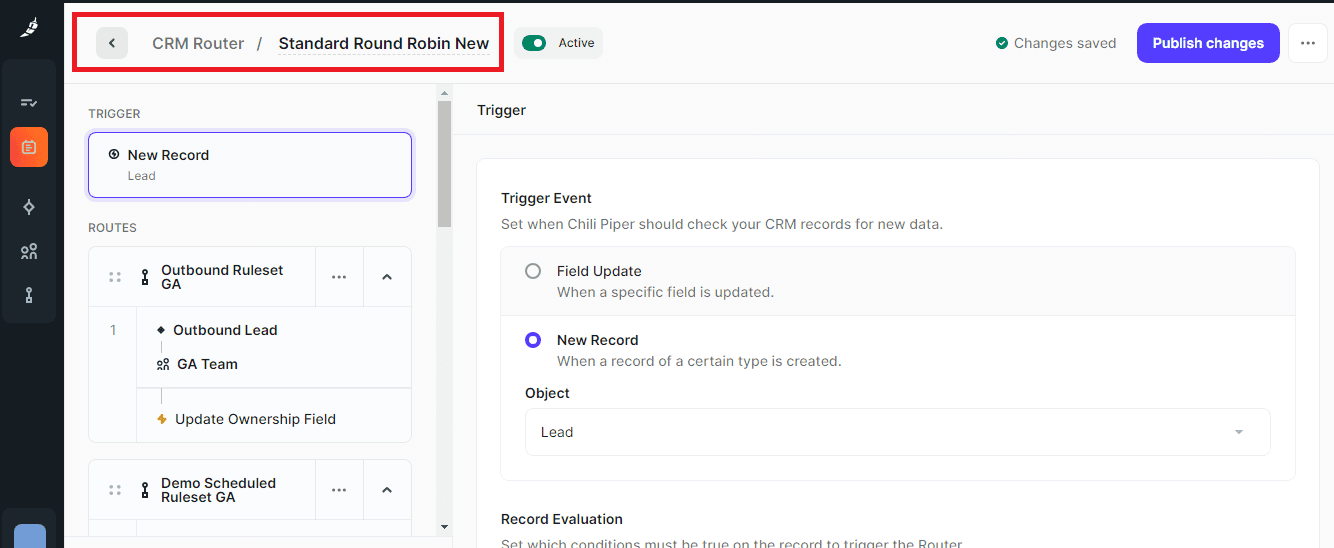
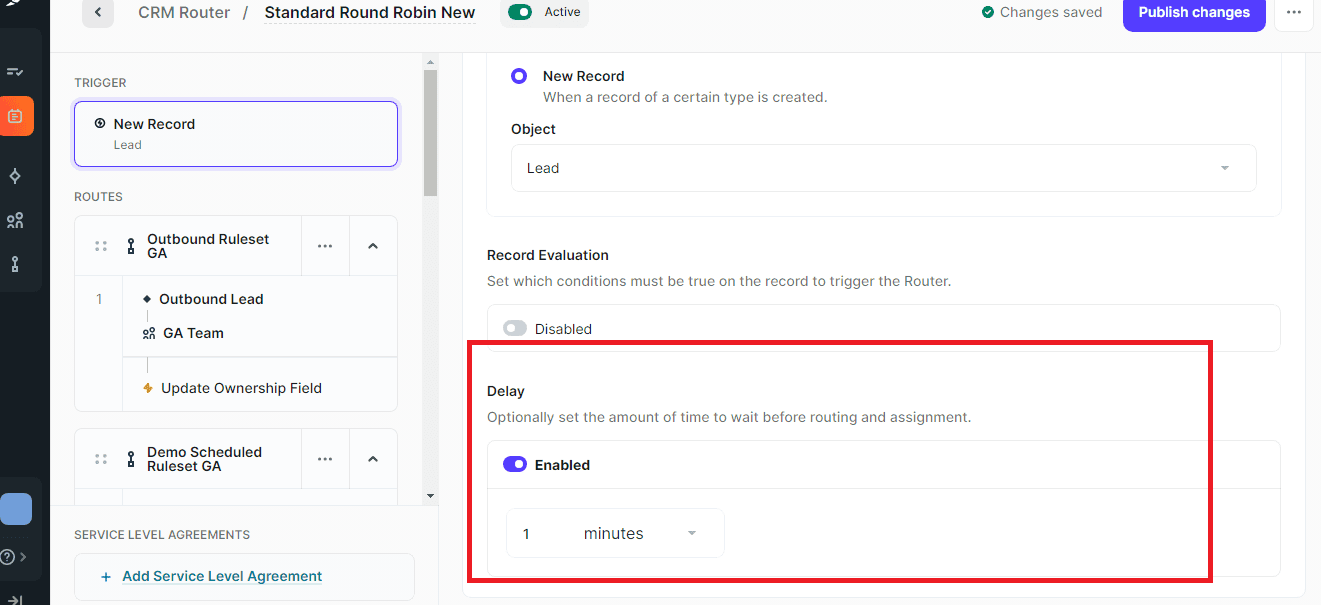
Two more nodes are worth knowing early. Send to Router chains routers, so a lead router can pass the matched account to an account router. The scheduled trigger, added in 2026, runs a router on a recurring schedule, on a set date or on demand, against records selected with a visual filter or SOQL. That makes it useful for re-routing a backlog or reassigning a departing rep's book.
How Does Distro Keep Round Robin Lead Assignment Fair?
Through weights, caps, calibration and availability. Each rep in a distribution has a weight, 100% by default, that sets their share. Caps limit how many records a rep gets per day, week or month. Credit and skip correct the rotation by hand, and reps who are out of office drop out of the queue until they return.
Fairness is tracked per team, not per route. According to Chili Piper's fairness and weighting guide, if two routes use the same team, the next record goes to the next rep in line, whichever route it came through.
Weighting
Weights of 200%, 100% and 100% across 60 records give 30, 15 and 15. Use it to give senior reps more volume or ramp new hires slowly.
Capping
Limit records per assignee on a daily, weekly or monthly cycle, in a chosen time zone, for the whole team or per member.
Fallback owner
When a rep is unavailable or capped, records go to no one, a named user or another team by round robin. You set each case separately.
Availability
Distro reads reps' calendars and skips anyone out of office. "Delay assignment until working hours" holds a record until the rep's day starts.
Capping and fallback work together: when every member of a team hits the cap, records go to the fallback owner. Router reporting shows who is next in line and how many records each member has received, and Adjust Distribution lets you change weights or apply credit and skip. One caution: changing a rule's algorithm, or changing the cycle mid-cycle, can reset weights to 100%, so recheck them after any change.
How Does Distro Handle Lead-to-Account Matching and Territories?
Matching nodes check whether a new lead belongs to something you already own. If a lead matches an account with an owner, an ownership rule sends it to that owner; if not, it falls through to round robin. Assignment tables then handle territories by country, state or postal code in one table instead of one path per region.
CRM matching nodes
Account-based routingBest for: B2B teams where one account can generate many leads.
Distro's matching nodes cover lead to account, lead to opportunity, lead to case, related leads and custom-object matches. Each node has a true and a false path, and nodes can be combined. Chili Piper says lead-to-account matching uses exact and fuzzy matching across several fields, and the log shows the result with a link to the matched record.
Duplicate matching
Data qualityBest for: Teams whose lists and forms create the same person twice.
The duplicate match node uses your Salesforce duplicate rules, works on lead and contact routers, sits before the routing rules, and can merge records. The "Report" option on the duplicate rule must be ticked for Distro to see matches.
Assignment tables
TerritoriesBest for: Territory or segment models with many rows.
Released in 2026, assignment tables keep territories in one table checked from top to bottom, first match wins. A CSV upload replaces every row, and an empty cell means the field must be empty unless you switch on "Treat empty cells as a match". Fallbacks are not available on a path that uses an assignment table, so add a catch-all row.
Two newer nodes also run before routing: an Enrich node that fills lead and contact fields from LeadIQ, Apollo, Lusha or ZoomInfo (with a paid plan from that provider), and a Spam Checker that blocks junk records and logs them as "Blocked as Spam".
How Do Distro SLAs Make Sure Leads Get Worked?
An SLA node waits a set time after assignment, checks a rule, and acts if the rule is still true. For example: after 30 working minutes, if the lead status is still "New", send the rep a Slack reminder, then reassign the lead to the next rep in the same team. Routing gets the lead to a rep; the SLA makes sure someone acts on it.
Chili Piper's SLA documentation describes three parts: After (instant time, which ignores working hours, or working time, which respects them), Evaluate If (the condition) and Take Action. Actions can be combined in order:
| SLA action | Use it when |
|---|---|
| Slack notification to the assignee | A nudge is usually enough and your team lives in Slack |
| Email reminder to the assignee | Reps work from the inbox, or Slack isn't connected |
| Reassign the record | Speed matters more than continuity, for example inbound demo requests |
| Update a field on the record | You want to flag the miss for reporting or start other automation |
Two details matter in practice. Calendar meetings don't pause SLA actions, so set a realistic window. And if a router created a follow-up task, an SLA reassignment moves the task to the new owner too.
How Do You Troubleshoot Chili Piper Distro With Distro Logs?
Open Distro > Logs, open the router, and filter by status. Each record shows whether it was routed and, in a Record Evaluation table, which field and condition decided the outcome. Most "Distro didn't route my lead" tickets are No Match results, where the record didn't meet the entry rule or any routing rule, not system errors.
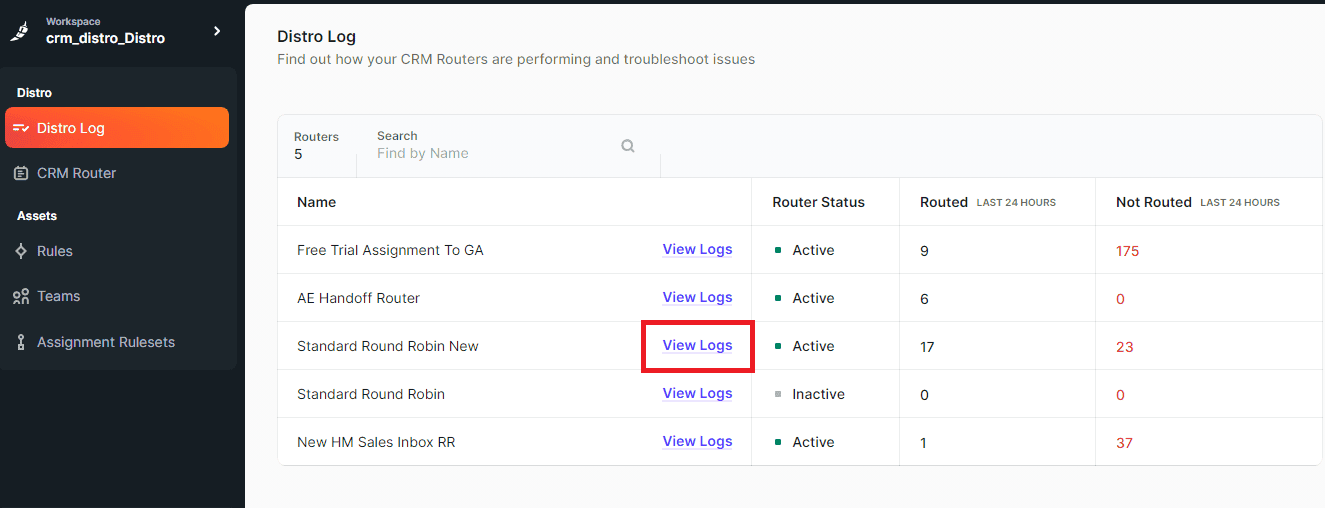
According to Chili Piper's Distro Logs guide, the router view opens on "Today"; change the range under Distribution, filter reps under Assigned To, and filter outcomes under Status. Two statuses are hidden by default, so switch them on when a record seems to be missing.
| Log status | What it means | What to check |
|---|---|---|
| Routed | The record was assigned | Nothing, unless the owner is wrong; then review rule order |
| No Match | The record failed evaluation or matched no route | The Record Evaluation table; add or fix a catch-all rule |
| No Match to Entry Rule | The entry rule kept the record out | Whether the entry rule is stricter than intended |
| Delayed | The record is waiting out a delay | Delay length and working-hours settings |
| Discarded by Delay | The record was updated while already in progress (hidden by default) | Other automation that edits the record during the delay |
| Not Triggered | The event didn't meet the trigger (hidden by default) | Trigger fields and the AND/OR setting |
| Error | Distro couldn't complete the action | The error message, then use Re-Route this record |
The three errors Chili Piper sees most
What Are the Most Common Chili Piper Distro Mistakes?
Most problems come from design, not the tool: no catch-all rule, triggers on fields Distro can't watch, routers changed without publishing, and bulk loads that skip records. Each one below comes from Chili Piper's documentation, and each has a simple fix.
Routing also overlaps with other automation. If a Salesforce assignment rule, a Flow or another app also sets the owner, the record can change hands twice. Decide which system owns the Owner field for each object before you switch Distro on.
The Bottom Line
Chili Piper Distro is worth it when routing has become a business rule rather than a setting: when ownership depends on accounts, fairness, availability and follow-up, not just a region field. It works only with Salesforce, and it works best when the routing design is clear before the first router is built.
Routing is rarely a tool problem alone. In a published Twopir case study, a UAE luxury real estate group with 250+ agents was assigning portal, web and referral enquiries by hand. We built routing logic inside Salesforce that assigns each lead by property type, region and live workload, alongside a HubSpot–Salesforce integration and SLA dashboards, and lead response became twice as fast. The same principle applies to Distro: design ownership first, then automate it.
- 1
Use native assignment rules if one ordered rule and a queue cover your needs.
- 2
Check permissions, the Streaming API and PushTopics before building routers.
- 3
Order rules from ownership, to segment round robin, to catch-all.
- 4
Add weights, caps, fallback owners and SLAs once the basic route is proven.
- 5
Review Distro Logs weekly, starting with No Match records.
Get Every Lead to the Right Rep, Fast
On a 30-minute discovery call, a Twopir Salesforce consultant will review how leads, accounts and opportunities are assigned in your org today, and recommend whether native rules, Chili Piper Distro or a custom build fits your routing best.
Schedule a Discovery CallFrequently Asked Questions
Chili Piper Distro is lead routing software for Salesforce. It watches for new or updated records, evaluates them against your rules, and assigns an owner using ownership, round robin or territory logic. It also matches leads to accounts, enforces follow-up SLAs and logs every routing decision.
No. Chili Piper states that Distro currently integrates only with Salesforce. Distro writes owners and fields directly to Salesforce records, so a team that runs HubSpot as its CRM needs a different routing approach.
Lead, Contact, Account, Opportunity and Case are available by default. Any other standard or custom object can be routed once an admin activates it under Distro > Objects. Rules can also use fields on related objects, such as a contact's account.
Not with assignment rules alone. Salesforce assignment rules route leads and cases in order, first match wins, and their documentation does not describe round robin. Teams build rotation with Flow, Apex or an AppExchange app, or use Distro for weighted round robin with caps and availability.
Distro reads reps' calendars and removes anyone out of office from the rotation until they return. You can also delay assignment until a rep's working hours start, cap how many records each rep receives, and set a fallback owner for when a rep is unavailable or capped.
Open Distro Logs, find the record and check its status. No Match means it failed the entry rule or every routing rule; the Record Evaluation table shows which condition. Error usually points to push topic or Streaming API limits, or a Salesforce update that a validation rule blocked.
A Salesforce admin connects through OAuth with API Enabled, View Setup and Configuration, View Roles and Role Hierarchy, and View All Users, plus access to the routed objects and Create, Read and Edit on PushTopic. The Streaming API must be enabled. Test the connection in a sandbox first.
