
iManage Salesforce Integration: How to Connect Documents, Emails and Matters
A practical guide to connecting iManage Work with Salesforce: the three ways to do it, what users can do without leaving a Salesforce record, how security and ethical walls carry over, the set-up checklist, and the pitfalls the vendor documents.
Key Takeaways
- An iManage Salesforce integration lets lawyers and business teams work with iManage workspaces, folders, documents and emails from inside a Salesforce record. The files stay in iManage, under iManage security.
- There are three routes: the packaged iManage Integration for Salesforce on AppExchange (built by AdvoLogix, now listed by Mitratech), iManage for Mitratech CaseCloud for firms that run CaseCloud, and a custom build on the iManage Work API.
- Salesforce Files Connect is not a route: its set-up options cover Google Drive, Quip, SharePoint Online, OneDrive for Business and Box, not iManage.
- The packaged connector needs Lightning Experience and iManage Work 10.2 or later with the Universal API (v2 REST API) enabled. It does not support Salesforce Classic.
- Security is mostly enforced in iManage. With standard navigation, iManage permissions and ethical walls decide what a user can open, so Salesforce record sharing should be designed to match them.
Most legal teams keep their documents and emails in iManage Work and their clients, matters, intake and business development in Salesforce. Without an iManage Salesforce integration, every contract review or client update starts with the same detour: leave Salesforce, find the right iManage workspace, then come back to record what happened. A good integration removes that detour. The Salesforce record shows the right iManage workspace, and documents can be opened, created or filed from the same screen.
This guide is for operations, IT and practice leaders at law firms, corporate legal departments and the growing and mid-market companies that run legal work on Salesforce. It explains the integration options that exist in 2026, how records map to workspaces, where permissions are enforced, and what to check before you start. Product details come from iManage, Mitratech and Salesforce documentation, linked inline.
What Is an iManage Salesforce Integration?
An iManage Salesforce integration connects iManage Work, the document and email management system used by many law firms and legal departments, to Salesforce records. Users browse, open, create and upload iManage content from a matter, account or opportunity in Salesforce. Documents stay in iManage under iManage security, and each Salesforce record is mapped to the right workspace.
iManage describes Work as a "single source of truth for all documents, emails, and chat conversations" (iManage Work). Salesforce is where many firms track the client relationship and the matter. The integration does not merge the two. It gives users a window into iManage from the Salesforce record they already have open. Use this as a quick fit check.
The integration pays off when lawyers, paralegals or business development staff already work in Salesforce every day, iManage is your system of record for documents and email, matters or clients exist in both systems, and people regularly leave Salesforce to find a file.
Think twice if only a few users touch Salesforce, your client and matter numbering differs between the two systems with no agreed key, or your org still runs Salesforce Classic. Agree on a shared identifier and move to Lightning first, or the mapping will not hold.
The Three Ways to Connect iManage and Salesforce
You can connect iManage and Salesforce in three ways. Install the packaged iManage Integration for Salesforce from AppExchange, use iManage for Mitratech CaseCloud if your firm runs CaseCloud, or build a custom integration on the iManage Work API. Most teams start with the packaged connector. A custom build only makes sense for requirements the connector cannot meet.
The naming has changed over time, which confuses many buyers. In 2022 iManage launched "the iManage integration for Salesforce, powered by AdvoLogix", sold and supported through iManage (iManage announcement). AdvoLogix has since become Mitratech CaseCloud, and the same app is now listed on AppExchange by Mitratech as "iManage Integration for Salesforce Powered by Mitratech CaseCloud™". Version 1.28.1 was released in August 2026 (AppExchange listing, release notes). In September 2025, iManage and Mitratech also announced a separate product, iManage for Mitratech CaseCloud™, which embeds iManage Work in CaseCloud.
| Aspect | Packaged connector (AppExchange) | iManage for Mitratech CaseCloud | Custom build |
|---|---|---|---|
| What it is | A managed package that adds iManage components to Lightning record pages on any object | iManage Work embedded in the CaseCloud legal practice management app | Your own Apex and Lightning Web Components calling the iManage Work API |
| Who maintains it | Mitratech (vendor upgrades through the managed package) | Mitratech, as part of CaseCloud | You or your implementation partner |
| Best for | Any Salesforce org (Sales Cloud, Service Cloud or a custom legal app) that needs iManage on records | Firms that run, or are moving to, CaseCloud for matter management | Folder logic, triggers or multi-system orchestration the package cannot handle |
| Record mapping | Workspace Configuration Manager: per object and record type, by workspace name or custom profile | Built into CaseCloud matters; confirm the details with Mitratech | Whatever you design, for example client ID, matter ID and matter type |
| Effort | Configuration, permission sets, page layouts and optional Flows | Part of a CaseCloud implementation | Design, development, security review and ongoing maintenance |
| Watch for | Lightning only; vendor-documented known issues (see Pitfalls) | Technical differences from the connector are not published | You own upgrades and security; API documentation and app registration come through iManage |
Sources: iManage Integration for Salesforce on AppExchange, vendor integration guide, iManage and Mitratech partnership announcement, iManage Control Center: Applications.
What about Salesforce Files Connect? Files Connect links Salesforce to external file stores, but its documented set-up paths cover Google Drive, Quip, SharePoint Online or OneDrive for Business, and Box. iManage is not one of them (Salesforce Help: Files Connect), so it is not an option for iManage.
What Users Can Do in iManage Without Leaving Salesforce
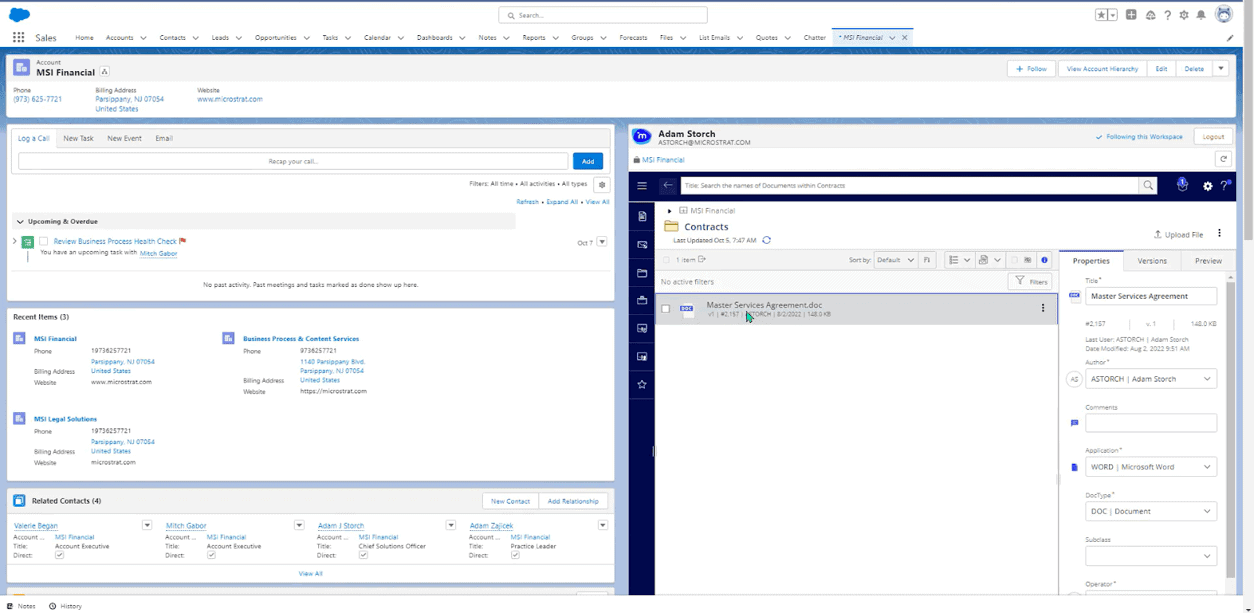
With the packaged connector on a Lightning record page, users can open the record's iManage workspace, browse folders, preview and edit documents, upload files by drag-and-drop, create workspaces, folders and documents from templates, and follow workspaces for change notifications. All of this happens from the Salesforce record.
Browse the right workspace
Each record can be associated with one or more iManage workspaces, so users open the matter's folders with a click instead of searching for them.
Upload and file
Users drag documents onto the component, or pick them from a file dialog, and the files are saved straight into iManage.
Create from templates
Users can create workspaces and folders, or use defined iManage templates. They can also start new documents, spreadsheets and presentations from the connector.
Check out and check in
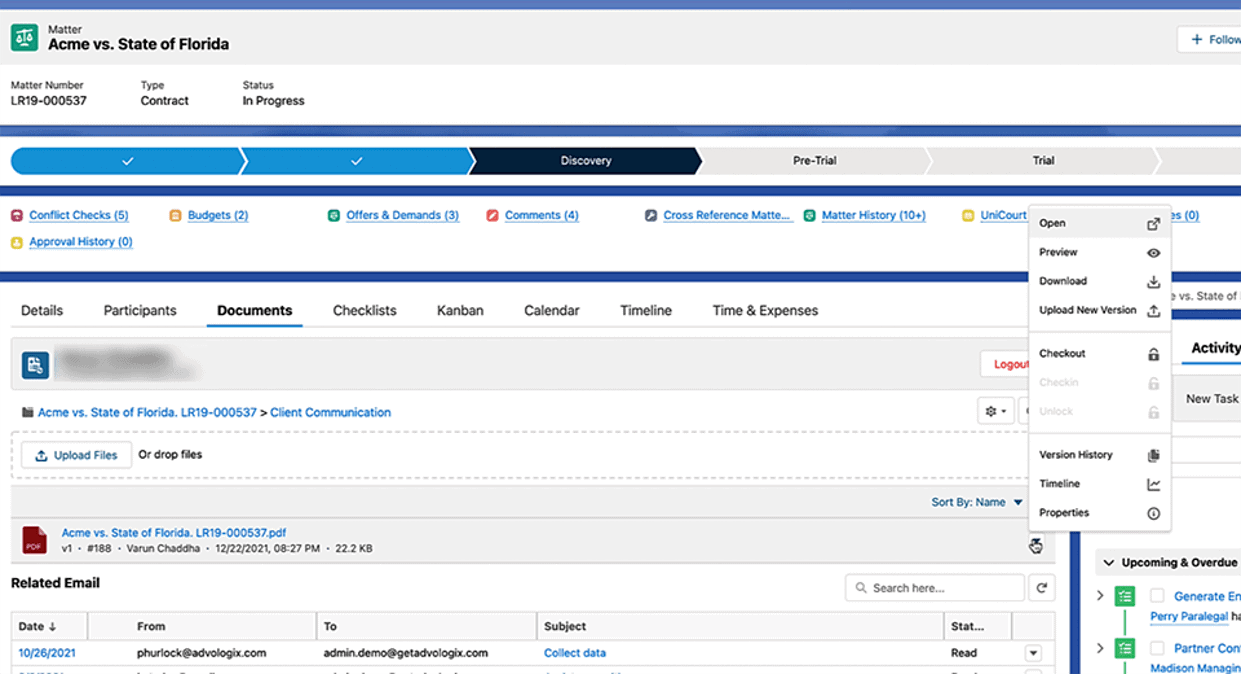
Documents can be checked out and back in with iManage Work for desktop, so version control stays in iManage.
Filed emails in context
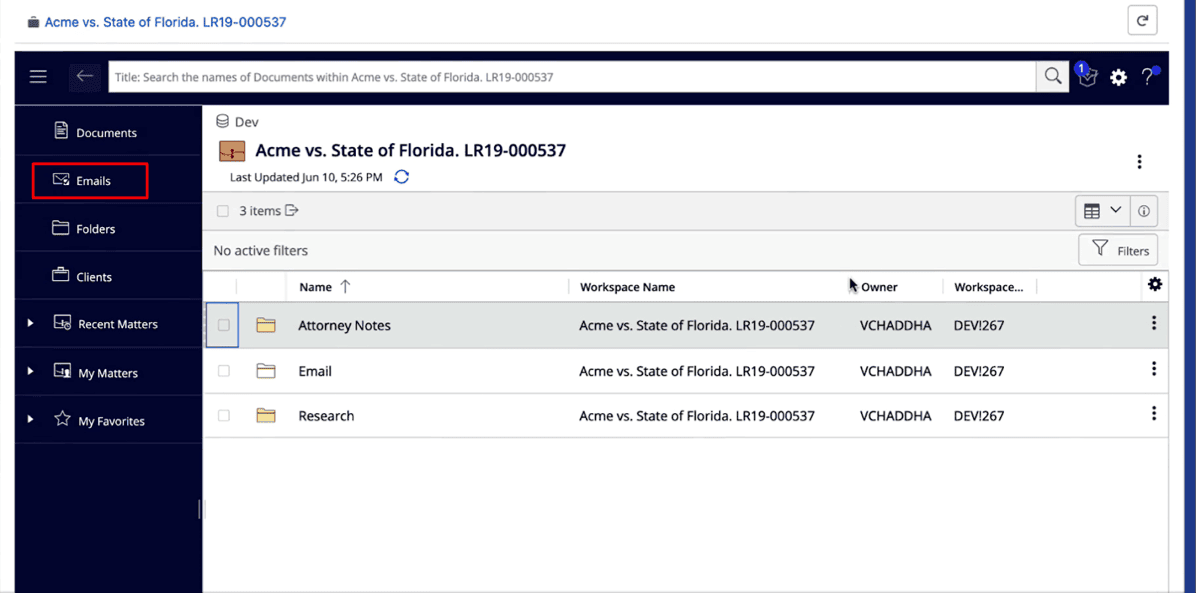
iManage Work treats emails as documents, so emails filed to a matter workspace appear next to its documents.
Follow and favourite
Users can follow workspaces to receive notifications of changes, and save frequently used folders as shortcuts in My Favorites.
Sources: iManage Integration for Salesforce datasheet, iManage Connector component guide, iManage: Containers and Documents.
How Salesforce Records Map to iManage Workspaces
In the packaged connector, a workspace configuration ties a Salesforce object, and optionally a record type, to iManage workspaces. A naming format built from Salesforce fields, or a custom profile value, finds or creates the matching workspace. Flow templates and Apex actions can then create workspaces and upload files automatically.
iManage organises content into workspaces, which a firm may call matters. Each workspace has a profile of properties such as client, matter, attorney or jurisdiction, and workspaces are always created from an administrator-defined template (iManage: Containers and Documents). The integration's job is to match each Salesforce record to the right workspace, every time. The design has three layers:
Which object maps to which workspace
The Workspace Configuration Manager binds workspaces to records per object, such as a custom Matter object, Account or Opportunity, and optionally per record type. Each configuration names the iManage library and a workspace naming format built from merge fields such as {{FieldName}} (Workspace Configuration Manager).
How a record finds its workspace
A record is associated with a workspace by workspace name (the resolved naming format) or by a custom profile value, such as a matter number. Users with the manual-mapping permission can also link a record to an existing workspace or folder, or clear that link.
What happens without a click
The package ships Flow templates. "iManage: Create Workspace" runs when a record is created or updated, and "iManage: Upload Document" pushes Salesforce Files into a workspace folder. Apex actions also create, update and find workspaces, create folders and upload documents (Apex invocable methods).
Example. A firm keeps matters in a custom Salesforce object. Its workspace configuration uses a naming format that combines the client number, the matter number and the matter name. When intake opens a new matter, a record-triggered Flow calls "Create Workspace" with the firm's litigation template. The workspace exists in iManage before the first document arrives, and its name always matches the Salesforce record. The field names are illustrative; use whatever identifiers your two systems already share.
Be clear about what does not sync. Documents stay in iManage and are viewed from Salesforce. The vendor documentation describes workspace names and custom profile values set when a workspace is created or updated, not a continuous two-way sync of every field. If you need more, such as status changes in Salesforce updating iManage profile fields, plan it as automation (the Update Workspace action) and test it.
Do iManage Security and Ethical Walls Still Apply Inside Salesforce?
Yes, for the documents themselves. By default the connector uses standard iManage navigation, where all permissions are assigned and managed in iManage Work, so iManage access rights and any ethical walls set there still decide what a user can open. Salesforce controls who sees the Salesforce record, so the two permission models need to agree.
iManage Security Policy Manager applies ethical wall policies "at the client, matter, department, or firm level", and access "updates automatically when staffing or billing data changes" (iManage Security Policy Manager). Those policies govern iManage content. We found no iManage documentation of a Security Policy Manager agent that pushes walls into Salesforce, so Salesforce sharing has to be designed separately.
| What is protected | Enforced by | What to do |
|---|---|---|
| Documents and emails | iManage Work security and Security Policy Manager walls | Keep standard iManage navigation unless you have a reason not to |
| The Salesforce record (matter name, client, notes) | Salesforce sharing, profiles and permission sets | Mirror walled matters with restricted sharing so record details do not leak |
| Connector actions (create workspace, upload, read-only) | The package's permission sets and custom permissions | Group the shipped sets in a Permission Set Group; mute what users should not do |
| Acting for other users | Secured logins (at most 10 users) | Reserve them for service and automation accounts |
One detail matters for regulated firms. The connector's custom permissions "apply only within the non-native iManage User Interface", and they are bypassed when users browse through the standard iManage interface (permission set-up guide). In other words, Salesforce permissions can narrow what the connector lets a user do, but they never replace iManage security. The shipped permission sets are iManage Admin, iManage User and iManage Read-Only, and they cannot be edited, so the vendor recommends a Permission Set Group with muted permissions. Secured logins, which let a user act in iManage on behalf of another user, are capped at 10 (secured logins).
Prerequisites and Set-Up Steps for the iManage Salesforce Connector
Before installing, confirm that Salesforce runs in Lightning Experience, iManage Work is version 10.2 or later with the Universal API (v2 REST API) enabled, and you have an iManage administrator with NRTADMIN or Tier 2 Control Center rights. Set-up then registers the app in iManage, connects Salesforce, maps workspaces and assigns permissions.
Prerequisites checklist
- Salesforce Lightning Experience. The connector does not support Salesforce Classic (integration guide).
- iManage Work 10.2 or later on a cloudimanage.com (public) or imanage.work (private) endpoint, with the Universal API (v2 REST API) enabled.
- An iManage administrator in the NRTADMIN group, or with a Tier 2 Control Center role, to register the application (Control Center set-up).
- A Salesforce administrator with the Customize Application permission, and a sandbox for the first install.
- Workspace templates already defined in iManage for each matter or client type you plan to map.
- A licence. The AppExchange listing is marked Paid and shows no public price, so ask Mitratech or iManage for a quote.
Set-up sequence
https://[my domain name]--imanage.vf.force.com/apex/iManageConnect and is entered in both iManage and Salesforce (redirect URL guide).iManage Inside Mitratech CaseCloud (Formerly AdvoLogix)
If your firm runs Mitratech CaseCloud, formerly AdvoLogix, for matter management on Salesforce, iManage can sit inside the matter record. CaseCloud lists iManage among its document integrations, and since September 2025 Mitratech has offered iManage for Mitratech CaseCloud, which embeds iManage Work in the platform for new and existing CaseCloud users.
CaseCloud's AppExchange listing names iManage, NetDocuments, Google Drive, SharePoint and Mitratech HotDocs under document management and automation (CaseCloud on AppExchange). The 2025 partnership announcement describes iManage for Mitratech CaseCloud as "fully embedded" rather than a connector (Mitratech announcement). Mitratech has not published how it differs technically from the AppExchange connector, so ask for a demo against your own matter structure before you decide.
For a CaseCloud firm, the practical benefit is one matter record that holds intake, conflicts, time, billing and documents together. For a firm that does not use CaseCloud, the packaged connector works on any Salesforce object, so you do not need CaseCloud to get iManage into Salesforce. Twopir Consulting implements CaseCloud as a delivery partner, not as the software vendor. See our Mitratech CaseCloud services.
When a Custom iManage Salesforce Integration Makes Sense
Build custom only when the packaged connector cannot meet a firm requirement: folder structures that depend on matter type, automation across several systems, or behaviour the package's configuration cannot express. A custom build calls the iManage Work API from Apex, registers as an OAuth 2.0 application in iManage, and is yours to maintain.
Twopir Consulting has delivered this kind of build. In a published iManage and Salesforce case study, a law firm needed iManage folders organised by matter type and remote access to files and emails. Selecting a "Create iManage Folder" option in Salesforce ran Apex that created the client, matter and workspace in iManage. Field mapping covered Client ID, Matter ID and Matter type code, authorization used a configurable setting, and the workspace was visible against the matter in Salesforce.
If you build today, use current Salesforce patterns:
- Lightning Web Components for the user interface, rather than Visualforce pages.
- Named credentials with external credentials for the OAuth 2.0 callouts. Salesforce strongly recommends the named credentials introduced in Winter '23 over legacy ones, and stores per-user tokens encrypted (Salesforce Help: Named Credentials).
- Application registration in iManage. Any custom development against the iManage Work APIs must be registered as a client application in Control Center by an NRTADMIN user (iManage Applications).
- Asynchronous processing (Queueable Apex or platform events) for workspace creation and uploads, so record saves never wait on an external call.
The trade-off is ownership. Every Salesforce release, iManage upgrade and security review is your responsibility, and access to iManage API documentation and application registration runs through iManage and your iManage administrators. Many firms take a middle route: they install the packaged connector for browsing and uploading, and add a small amount of custom Apex or Flow for firm-specific rules.
Implementation Pitfalls Most Guides Skip
These come from the vendor's own help centre and release notes. Each one is worth checking before go-live.
Which iManage Salesforce Integration Route Fits Your Firm?
Start with the packaged connector unless you already run CaseCloud or have a requirement it cannot meet. CaseCloud firms should evaluate iManage for Mitratech CaseCloud first. Choose a custom build, or connector plus custom automation, only for firm-specific rules that configuration and Flow cannot express.
What Results Can a Law Firm Expect, and How Do You Measure Them?
The gains come from removed detours: fewer system switches, faster retrieval and fewer misfiled documents. In one published Twopir engagement, a US law firm reported 85% faster document retrieval, six hours of admin time saved per attorney per week, 90% fewer misfiled or duplicate documents, and go-live in eight weeks.
That firm's attorneys used to leave Salesforce to open a document stored in iManage. The project embedded iManage workspaces, folders, documents and emails in Salesforce, mapped records to workspaces, added drag-and-drop upload through the AppExchange integration, and onboarded both the legal and business development teams (iManage + Salesforce integration for law firms case study). Those figures are that firm's results, not a promise. Your results depend on how often people switch systems today and how clean your matter data is, so measure your own baseline.
| Metric | What moves it | How to measure |
|---|---|---|
| Time to find a document | Record-to-workspace mapping, one-click navigation | Time a set of common retrieval tasks before and after go-live |
| Admin time per fee earner | Drag-and-drop upload, automatic workspace creation | Short time-tracking sample or survey, same roles, same season |
| Misfiled or duplicate documents | Workspaces created from templates with consistent names | iManage reports on documents filed outside the expected workspace |
| Matters with a workspace on day one | The Create Workspace Flow at intake | Salesforce report: new matters with a linked workspace |
| Adoption | Training, page layout placement, permissions | Active users of the connector component by team |
How Twopir Consulting Helps With iManage and Salesforce
We implement, rescue, optimize, and integrate complex CRM and revenue systems. For legal teams, that means designing the Salesforce side of an iManage integration: the matter data model, the record-to-workspace mapping, the automation at intake, sharing that respects your ethical walls, and the rollout to lawyers and business development staff. We have delivered both packaged and custom iManage integrations, as described in our AppExchange case study and our custom-build case study.
We work with growing, mid-market, and enterprise organizations, including law firms and corporate legal teams. See our legal Salesforce consulting, our guide to Salesforce for law firms, and our wider integration services.
Plan Your iManage and Salesforce Integration With an Architect
In a 30-minute discovery call, a Twopir Salesforce architect will review how your teams move between iManage and Salesforce today, recommend the right integration route, and outline the mapping and security design.
Schedule a Discovery CallThe Bottom Line
An iManage Salesforce integration earns its keep by removing a detour people make dozens of times a day: leaving the matter in Salesforce to find its documents in iManage. The packaged connector covers most needs, CaseCloud firms have an embedded option, and a custom build is there for firm-specific rules. Whichever route you choose, a clean shared identifier and a security design that respects iManage walls matter more than the tool.
- 1
Documents stay in iManage, and Salesforce becomes the window into the right workspace for each record.
- 2
Start with the AppExchange connector, or iManage for Mitratech CaseCloud if you run CaseCloud. Files Connect does not support iManage.
- 3
Confirm Lightning, iManage Work 10.2 or later with the v2 API, and admin rights on both sides before you start.
- 4
Design Salesforce sharing for walled matters, and baseline retrieval time before go-live so you can prove the gain.
Frequently Asked Questions
Yes. The iManage Integration for Salesforce, now listed on AppExchange by Mitratech, adds iManage components to Lightning record pages so users can browse, open, create and upload iManage workspaces, folders, documents and emails from Salesforce. Firms on Mitratech CaseCloud can use iManage for Mitratech CaseCloud, and custom builds can use the iManage Work API.
AdvoLogix developed it, and iManage launched it in 2022 as the iManage integration for Salesforce, powered by AdvoLogix. AdvoLogix is now Mitratech CaseCloud, and the app is listed on AppExchange by Mitratech as iManage Integration for Salesforce Powered by Mitratech CaseCloud, with version 1.28.1 released in August 2026.
The AppExchange listing marks the app as Paid but publishes no price, so pricing comes from a quote from Mitratech or iManage. Budget separately for implementation: configuration, workspace mapping, automation, security design, testing and training, plus any separately purchased options such as large-file upload.
No. Salesforce documents Files Connect set-up for Google Drive, Quip, SharePoint Online or OneDrive for Business, and Box. iManage is not among them. To reach iManage from Salesforce, use the packaged iManage Integration for Salesforce, iManage for Mitratech CaseCloud, or a custom integration on the iManage Work API.
They apply to iManage content. With the connector's default standard navigation, permissions are managed in iManage Work, so walls set there still decide which documents a user can open. They do not restrict the Salesforce record itself, so walled matters also need matching Salesforce sharing rules.
It does not support Salesforce Classic, so you need Lightning Experience. It supports iManage Work 10.2 and later where the Universal API (v2 REST API) is enabled, on cloudimanage.com or imanage.work endpoints. The application is registered automatically for cloudimanage.com and manually for imanage.work and on-premise.
It depends on scope and data quality. In one published Twopir case study, a US law firm went live on the AppExchange integration in eight weeks, including discovery, set-up, workspace mapping, document workflow and rollout. Custom builds and firms with inconsistent matter numbering take longer.
