
Salesforce CloudPages Guide: Landing Pages, Smart Capture and Journeys
CloudPages is where Marketing Cloud Engagement hosts the pages your emails, texts and ads point to. Built well, every form submission lands in the right data extension and starts the right journey. Built carelessly, it leaks data, bills bot traffic and never reaches Sales Cloud. Here is how to build it properly in 2026.
Key Takeaways
- Salesforce CloudPages is the web publishing tool in Marketing Cloud Engagement. It builds landing pages, microsites, interactive email pages and code resources from Content Builder blocks, AMPscript and server-side JavaScript.
- A Smart Capture form writes each submission to a sendable data extension and can start a journey through the CloudPages Form Submit Event. Leads and contacts reach Sales Cloud only through a journey activity or AMPscript with Marketing Cloud Connect, never automatically.
- Every successful load of a published page is a CloudPages impression, which Salesforce bills against Super Messages. Code resources are not counted, and bot traffic is, so block crawlers you do not want.
- Branded URLs need a private domain or Sender Authentication Package plus a separate SSL licence for each hostname.
- Salesforce now recommends Marketing Cloud Next for new customers, and its landing pages and forms run on Experience Cloud, not CloudPages. Teams on Marketing Cloud Engagement keep CloudPages.
What is Salesforce CloudPages? CloudPages is the part of Salesforce Marketing Cloud Engagement that builds and hosts web content: landing pages, microsites, interactive email pages and code resources. Pages are assembled from Content Builder blocks and can run AMPscript and server-side JavaScript. Their forms write straight into Marketing Cloud data extensions and can start Journey Builder journeys, so a visitor's details are used the moment they submit.
We first published this guide in 2023. This version is rebuilt from Salesforce Help, Salesforce developer documentation and Trailhead, checked in October 2026. It adds where CloudPages sits beside Marketing Cloud Next, how Smart Capture forms start journeys, the AMPscript functions that read and write Salesforce data, domains and SSL, Super Message costs, security and measurement. It also corrects claims the original made that Salesforce's documentation does not support. It is written for marketing operations teams, Marketing Cloud admins and RevOps leaders at growing and mid-market companies, and for the developers who build their pages.
What Is Salesforce CloudPages, and What Can You Build With It?
CloudPages is Marketing Cloud Engagement's tool for the pages people reach from your messages. Salesforce describes it as a way to capture, organize and act on prospect data: capture forms grow the audience, and journeys nurture it. You can build four kinds of content, organize it in folders, and publish it on a Marketing Cloud domain or your own.
| Content type | What it is | Typical use |
|---|---|---|
| Landing page | A single web page built from Content Builder blocks, with optional Smart Capture forms and code | Campaign offers, sign-ups, preference centers, thank-you pages |
| Microsite | A collection of landing pages organized into a site map | A small site for a new product, service or campaign |
| Interactive email page | The page that receives and validates data from an Interactive Email Form | Reviews, surveys and lead forms completed inside the inbox |
| Code resource | A published file of CSS, JSON, JavaScript, RSS, XML or text | Shared stylesheets and scripts, data endpoints, a robots.txt file |
The content types come from Salesforce's article on creating content in CloudPages. Trailhead also lists MobilePush pages, which CloudPages hosts for push messages. Content is grouped in folders, formerly called collections, which can be nested.
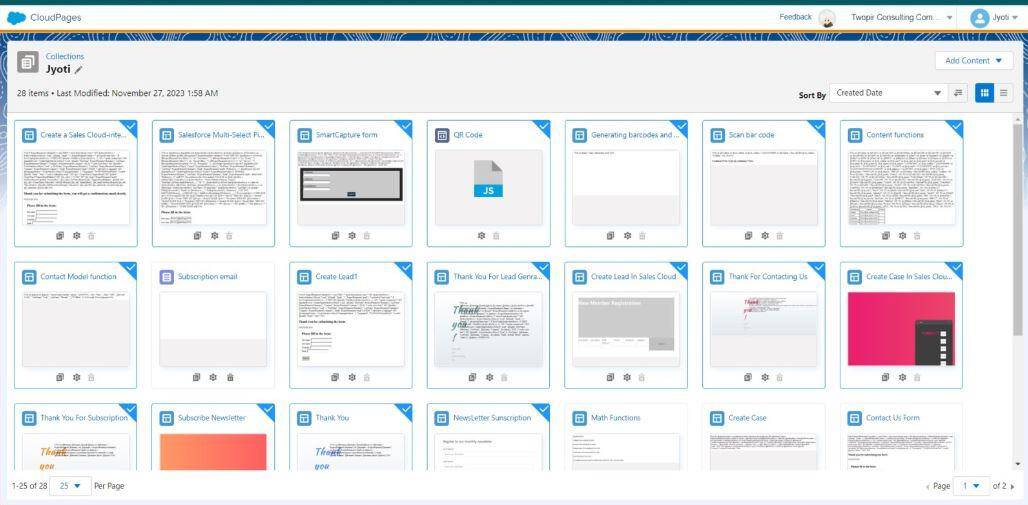
What teams build with CloudPages
Campaign landing pages
Promotion and sign-up pages linked from emails, SMS and ads, with a Smart Capture form that feeds a journey.
Preference centers
A custom page that combines Marketing Cloud's standard profile page and subscription center, so subscribers manage topics and frequency in one place.
In-inbox forms
Interactive email pages that receive reviews, surveys and lead forms submitted inside the email itself.
Personalized and gated content
Pages that show a subscriber's own profile or preferences, or gate content behind a login built with AMPscript.
Salesforce's CloudPages overview lists these uses. The preference center pattern is taught step by step in Trailhead's custom preference center module.
Should You Use CloudPages or Marketing Cloud Next Landing Pages in 2026?
Use CloudPages if you run Marketing Cloud Engagement; it remains that product's page builder. Salesforce now recommends Marketing Cloud Next as the starting point for new customers, and Next builds landing pages and forms on the core Salesforce platform instead. Account Engagement, formerly Pardot, has its own landing pages. Confirm which product you own before you plan any page.
The three products share the "Marketing Cloud" name, which causes real confusion. Salesforce says Marketing Cloud Engagement and Account Engagement are still sold, and that the "Engagement+" and "Account Engagement+" bundles add access to Marketing Cloud Next without a platform switch, so existing journeys stay intact. Source: Salesforce's Marketing Cloud guide.
| Product | Where pages are built | What happens on submit | Best fit |
|---|---|---|---|
| Marketing Cloud Engagement | CloudPages: Content Builder blocks, AMPscript and SSJS | Data written to a data extension; a journey can start from the CloudPages Form Submit Event | Teams already on Engagement who need data-extension-driven, highly customized pages |
| Marketing Cloud Next (Growth and Advanced) | An auto-generated Experience Cloud site called Marketing Landing Pages | A form connected to a campaign and a Salesforce Flow, which can create the lead and a consent record | New buyers, and teams that want pages, forms and CRM records on one platform |
| Account Engagement | Account Engagement's own landing page builder; pages sync to Salesforce's LandingPage object | Handled by Account Engagement forms and prospects | B2B lead generation already running on Account Engagement |
Sources: Marketing Cloud Next landing pages, Trailhead's Marketing Cloud Next lead generation module and the LandingPage object reference. Salesforce lists Marketing Cloud Next Growth at US$1,500 per org per month, billed annually, with forms and landing pages included; pricing is subject to change.
Stay on CloudPages when your subscribers, data extensions and journeys live in Marketing Cloud Engagement, your pages need AMPscript logic such as preference centers or encrypted personalized links, or you rely on Interactive Email Forms. The CloudPagesURL function and most AMPscript site functions exist only in Engagement.
Look at Marketing Cloud Next when you are buying Marketing Cloud for the first time, or when most of your work is B2B lead capture that should create Salesforce leads and consent records directly. Next offers Google reCAPTCHA v2 on forms hosted on its landing pages and honeypot fields in its form handlers, and it has no separate domain SKUs.
Our marketing automation platform comparison covers the wider choice, and our Marketing Cloud Next consulting page explains what a move to the newer platform involves. The rest of this guide covers CloudPages in Marketing Cloud Engagement.
How Do You Create a Landing Page in CloudPages?
Create a folder, add a landing page, choose its URL and HTTPS setting, build it from a layout and blocks, then publish it now or on a schedule. Changes autosave as you work. The order below adds the checks that prevent most launch-day problems: permissions first, and a live test of the published URL last.
Steps and settings come from Salesforce's articles on creating landing pages, microsites, CloudPages permissions and the Reference block. For coded pages, Trailhead suggests developing in a Content Builder code snippet pulled in with AMPscript, then pasting the final code directly into the page for the fastest rendering. A page coded directly in CloudPages must be republished after every change.
How Do Smart Capture Forms Start a Journey in Journey Builder?
A Smart Capture form saves each submission to a sendable data extension, and Journey Builder's CloudPages Form Submit Event entry source admits that person to a journey. From there the journey does the work: a confirmation email, a wait, a decision, and, if you connect Sales Cloud, a new lead or contact. You configure the form in CloudPages and the entry source in the journey.
Sources: Create a Smart Capture form, Use a Smart Capture form in Journey Builder and Use CloudPages to admit contacts into Journey Builder.

Two rules that catch teams out
Smart Capture is the quickest way to build a simple form. For forms that change by visitor, such as progressive profiling, teams code the form with AMPscript instead; our progressive profiling guide shows that build, and our Journey Builder consulting covers the journeys behind it.
How Do You Personalize CloudPages with AMPscript and Salesforce Data?
Link to the page from your emails with CloudPagesURL, read the values on the page with AMPscript, and use the Salesforce functions when the page must read or write CRM records. CloudPagesURL encrypts the query string, so the page knows which subscriber and email sent the visitor without exposing their details in the address bar. Server-side JavaScript handles heavier logic.
| Function | What it does on a CloudPage | Watch out for |
|---|---|---|
| CloudPagesURL() | Builds a link to a page with an AES-GCM encrypted query string that references the subscriber and the email | PAGEID, MID, JID, LID, SID, JSB and URLID are reserved names. From SMS or push, the page errors if the subscriber is not in All Subscribers |
| QueryParameter(), RequestParameter() | Read values passed to the page or posted by a form | Validate every value on the server before using it |
| IsNullDefault() | Sets default values for empty Smart Capture fields | Defaults can hide missing data in reports |
| RetrieveSalesforceObjects() | Reads Sales Cloud or Service Cloud records | Needs Marketing Cloud Connect; returns at most 1,000 rows |
| CreateSalesforceObject(), UpdateSingleSalesforceObject() | Create or update a Salesforce record and return its ID or a success flag | Need Marketing Cloud Connect. Previewing content that calls the update function performs a live update |
Sources: Salesforce developer documentation for CloudPagesURL, AMPscript site functions, RetrieveSalesforceObjects, CreateSalesforceObject and UpdateSingleSalesforceObject. RetrieveSalesforceObjects issues a SOAP request, and Salesforce notes that SOAP API requests are not subject to your org's API usage limits.
Server-side JavaScript. SSJS runs on Marketing Cloud's servers, and Salesforce reserves its Core library for landing pages and applications. It cannot work with the browser's Document Object Model or load external libraries, so any client-side behaviour still needs ordinary JavaScript in the page. See Salesforce's SSJS guide and our AMPscript vs SSJS page for when to use each.
What Domain and SSL Setup Do CloudPages Need?
Pages can run on a public domain Marketing Cloud provides, but branded URLs need a private domain or a Sender Authentication Package, plus an SSL certificate licence for every hostname. SSL is not included with the Sender Authentication Package. Order domains and certificates early: setup can take up to five business days, and a Salesforce-supplied certificate up to ten days.
| You want | You need |
|---|---|
| Pages live quickly | The public domain Marketing Cloud Engagement provides |
| Pages on your own brand's domain | A private domain (an add-on from your account executive) or a Sender Authentication Package. Salesforce serves CloudPages from a cloud. subdomain of your custom domain |
| HTTPS on that domain | One SSL licence per hostname. New customers need four SSL SKUs for a Sender Authentication Package and one for each additional CloudPages domain |
| Friendly or personalized URLs | A private domain with an SSL certificate configured for CloudPages |
| A root page and custom error pages | At least one private domain; each gets one root page and one page per error type |
Two details matter for older accounts. All Marketing Cloud Engagement domains are now secured with SSL before use, but pages created before SSL was in place are not redirected from HTTP to HTTPS automatically; Page Details has an option to update them. And if you supply your own certificate, upload it as .p7b or .pem and allow up to 72 hours for verification. Salesforce renews the certificates it supplies.
Sources: Marketing Cloud Engagement SSL certificates overview, SSL certificates for custom domain security, configuring a Sender Authentication Package or private domain and personalized URLs for landing pages.
Do CloudPages Page Views Use Super Messages?
Yes. Every successful request for a published landing page, microsite, MobilePush page or interactive email page is a CloudPages impression, and a Salesforce knowledge article states that a standard landing page charges one Super Message per impression. Code resources are not currently counted. Your contract sets the exact billing, so check it before launching a high-traffic page.
Salesforce defines an impression as a request that returns 200 OK, in its types of data usage article. Three consequences follow. Every visit to a preference center logs an impression, which Trailhead points out when planning one. Interactive Email Forms consume Super Messages in every edition: an email with the form sent to 100 subscribers counts as 100 interactive email impressions plus 100 emails. And automated traffic counts too.
Bots and AI crawlers are billed like people
In May 2026 Salesforce published guidance on reducing the billing impact of LLM crawlers on CloudPages. A noindex tag or a client-side redirect does not help, because the server has already recorded the impression by the time the page responds. Salesforce's suggested defences:
How Do You Keep CloudPages Forms and Subscriber Data Secure?
Validate everything on the server, identify subscribers only through encrypted CloudPagesURL links, refuse requests that lack the parameters a page expects, and add security headers. A CloudPage is a public web page that can read and write subscriber data and, with Marketing Cloud Connect, Salesforce records. Treat it like any other application on the internet.
Salesforce's CloudPages security best practices, published in February 2026, translate into this checklist:
- Server-side processing only. Do all processing and validation in AMPscript or SSJS, not in client-side JavaScript or Ajax calls a visitor can tamper with.
- Verify identity with at least two parameters, and wrap public pages in a global condition that shows nothing useful unless the required parameters are present.
- Never put subscriber IDs in plain or lightly encoded links. Use CloudPagesURL, not Base64 or StringToHex, for the subscriber ID or key.
- Add security headers with SSJS: HSTS, X-Frame-Options, X-Content-Type-Options, Referrer-Policy and Content-Security-Policy.
- Keep personal data out of URLs. For Interactive Email Forms, Salesforce recommends against personal information in the URL, even with HTTPS, because form data travels to the page in the URL string.
- Review regularly. Schedule security reviews of live pages, and retire pages that no longer serve a campaign.
The CloudPages documentation we reviewed does not describe a built-in CAPTCHA for Smart Capture forms, so bot protection on Engagement pages is something you design, using the server-side checks above and the edge filtering in Section 07. If spam on lead forms is your main problem, the reCAPTCHA option on Marketing Cloud Next landing pages is one reason to compare the two products.
How Do You Measure CloudPages Performance?
CloudPages shows page views for the past 90 days; for anything more, build Analytics Builder reports on impressions, microsite traffic and Smart Capture submissions. Conversion rate is a figure you calculate, submissions divided by impressions, rather than one CloudPages reports. Export the figures monthly if you need trends longer than 90 days.
| Question | Where to answer it |
|---|---|
| How many people viewed the page? | Built-in CloudPages analytics (90 days), or the CloudPages Impressions report in Analytics Builder |
| How many submitted the form? | The CloudPages Smart Capture Submissions report, or a count of rows in the target data extension |
| Which microsite pages get traffic? | The Microsite Tracking report |
| What did visitors do next? | The journey the form starts, and the Google Analytics integration where licensed |
Sources: Review CloudPages analytics and Google Analytics integration for Marketing Cloud Engagement. That integration needs the Google Analytics Audiences SKU and at least a Marketing Cloud Engagement Enterprise 2.0 account, supports GA4, and expects you to add the tracking code to your pages yourself. If it appends tags to CloudPagesURL links, Salesforce advises wrapping them with RedirectTo() and Concat() to avoid broken links.
Can you A/B test a CloudPage? Not with a built-in page test. Salesforce documents its Einstein Content Testing block for emails, not for CloudPages. To compare two page versions, publish both, send equal audiences to each, and compare submissions per impression in Analytics Builder.
What Does a Good CloudPages Implementation Look Like?
It starts with data and identity, not page design. Decide which data extension each form writes to, how a visitor is recognized, which journey each submission starts and what reaches Sales Cloud. Then settle domains, security and the Super Message budget. The pages themselves are the quick part once those decisions are made.
| Phase | Decisions and work | Done when |
|---|---|---|
| 1. Fit | Confirm Engagement, Engagement+ or Marketing Cloud Next; list the pages and forms you need | Every page has a product, an owner and a purpose |
| 2. Data model | Sendable data extensions keyed on subscriber key; hidden source fields; consent fields; Marketing Cloud Connect if CRM writes are needed | A signed-off field map per form |
| 3. Domain and security | Private domain or Sender Authentication Package, SSL licences, HTTPS-only pages, security headers, bot handling | Pages serve over HTTPS on your domain |
| 4. Build and connect | Pages, Smart Capture or coded forms, CloudPagesURL links, journeys and CRM activities, tested on an unpublished page or in a non-production business unit first | Test submissions reach the data extension, the journey and Sales Cloud |
| 5. Run | Monthly impression and submission review, Super Message tracking, crawler checks, security reviews, retirement of old pages | No surprise bills, and every live page still has a job |
Twopir Consulting delivers this as part of our Salesforce Marketing Cloud implementation services, with Marketing Cloud integration for the Sales Cloud side. In a published Marketing Cloud case study for an e-commerce company, we set up Mobile Studio, built automations and journeys for multiple customer paths, and implemented analytics to monitor click-through rates on new campaigns.
The Bottom Line
Salesforce CloudPages is still the right page builder for teams on Marketing Cloud Engagement, because it sits next to their data extensions and journeys. The pages are easy to build. Getting data into the right place, protecting it and keeping the Super Message bill predictable takes planning. We implement, rescue, optimize, and integrate complex CRM and revenue systems, including Marketing Cloud pages, journeys and their link to Sales Cloud.
- 1
Confirm whether you are on Marketing Cloud Engagement or Marketing Cloud Next before planning pages.
- 2
Point every Smart Capture form at a sendable data extension and a journey with a clear purpose.
- 3
Connect Marketing Cloud Connect if submissions must become Sales Cloud leads or contacts.
- 4
Use CloudPagesURL links, server-side validation and security headers on every page that touches subscriber data.
- 5
Budget Super Messages for impressions, block unwanted crawlers, and review page performance monthly.
Make Every CloudPage Feed the Right Journey
Tell us which pages and forms you run in Marketing Cloud today and where the data needs to go. We will map the data extensions, journeys, domains and Sales Cloud connection your account needs.
Schedule a Discovery CallFrequently Asked Questions
CloudPages builds and hosts web content in Marketing Cloud Engagement: landing pages, microsites, interactive email pages and code resources. Teams use it for campaign landing pages, sign-up and opt-in forms, preference centers, pages that receive Interactive Email Form data, and personalized or gated content built with AMPscript.
No. CloudPages belongs to Marketing Cloud Engagement. Marketing Cloud Next builds landing pages on an Experience Cloud site called Marketing Landing Pages, with forms connected to a campaign and a Salesforce Flow. Engagement customers with Engagement+ keep CloudPages and their existing journeys.
Yes. Each successful load of a published landing page, microsite, MobilePush page or interactive email page is a CloudPages impression, and Salesforce states that a standard landing page charges one Super Message per impression. Code resources are not currently counted. Bot traffic is billed too, so block unwanted crawlers.
A Smart Capture form is a CloudPages block that builds a form without code and saves each submission to a sendable data extension. Set as a journey's entry source through the CloudPages Form Submit Event, it admits each person who submits to a multistep journey. Each form can be used once per journey.
Not automatically. Submissions land in a Marketing Cloud data extension. To create a lead or contact, add a Sales Cloud activity to the journey the form starts, or call AMPscript functions such as CreateSalesforceObject on the page. Both need Marketing Cloud Connect configured between Marketing Cloud and your Salesforce org.
Yes, with a private domain or a Sender Authentication Package. HTTPS on that domain needs an SSL certificate licence for each hostname, which the Sender Authentication Package does not include. Friendly and personalized URLs, a root page and custom error pages all require a private domain.
There is no built-in page test. Salesforce documents its Einstein Content Testing block for emails, not CloudPages. To test a page, publish two versions, send equal audiences to each, and compare form submissions per impression using the CloudPages Impressions and Smart Capture Submissions reports in Analytics Builder.
A landing page is a visible web page built from Content Builder blocks. A code resource is a published file of CSS, JSON, JavaScript, RSS, XML or text, used for shared styles, scripts, data endpoints or a robots.txt file. Landing page views count as CloudPages impressions; code resources currently do not.
