
Salesforce Mobile Studio Guide: SMS, Push and WhatsApp in Marketing Cloud
Mobile Studio is how Marketing Cloud Engagement reaches customers on their phones: SMS and MMS through MobileConnect, app messages through MobilePush, and chat apps through GroupConnect and WhatsApp. This guide explains what each app does today, how to choose between them, and what to set up first.
Key Takeaways
- Salesforce Mobile Studio is the mobile messaging part of Marketing Cloud Engagement. It brings together MobileConnect (SMS and MMS), MobilePush (app notifications, inbox and in-app messages) and GroupConnect (LINE and Facebook Messenger), with WhatsApp in the same menu.
- Pick the channel by reach and consent. SMS reaches any phone but needs explicit mobile consent. Push reaches only people with your app who allow notifications. WhatsApp and LINE suit the markets where customers already use them.
- In the US, SMS sending needs registered numbers: plan 1–4 weeks for a 10DLC and 10–12 weeks for a short code. Messages that use a From Name are blocked there.
- Journey Builder, the MobileConnect UI and the API each handle a send blockout differently. Configure all three, or quiet-hours messages can still go out, or be dropped.
- Salesforce's newer platform, Marketing Cloud Next, adds SMS, WhatsApp, RCS and app messaging on Data 360. Existing Engagement customers can run both side by side.
Salesforce Mobile Studio is where Marketing Cloud sends text messages, push notifications and chat-app messages. Marketers use it to reach customers on their phones, with the same data, journeys and reporting as their email program. Used well, a missed email becomes a timely SMS reminder, an app user gets a relevant offer when they open the app, and an opt-out is honoured straight away.
This guide is for marketing operations, CRM and digital leaders at growing and mid-market companies that run, or are planning, Marketing Cloud Engagement. It replaces our 2023 overview with what has changed since then: WhatsApp in Mobile Studio, the renamed Engagement SDK, stricter SMS registration in the US, and Marketing Cloud Next. Product facts come from Salesforce's own documentation, linked throughout.
What Is Salesforce Mobile Studio?
Salesforce Mobile Studio is the set of mobile messaging apps inside Marketing Cloud Engagement. In Salesforce Help it covers three apps: MobileConnect for SMS and MMS, MobilePush for app notifications, and GroupConnect for chat apps. WhatsApp also appears under Mobile Studio. Messages can be sent on their own or as steps in Journey Builder.
| App | Channel | Typical use | What it needs |
|---|---|---|---|
| MobileConnect | SMS · MMS | Alerts, reminders, promotions, keyword opt-ins, one-question surveys | A short code, long code or registered From Name, plus mobile consent |
| MobilePush | Push · inbox · in-app | App engagement, onboarding, location-triggered offers | Your own iOS or Android app with the Salesforce Engagement SDK |
| GroupConnect | LINE · Messenger | Reaching customers on LINE; Messenger through the API | A LINE channel from a LINE agent, or a Facebook page |
| Two-way conversations with approved templates | The WhatsApp-First Business Messaging purchase and Meta Business Manager |
Salesforce's product page sums it up as one place to "create, deploy, and manage mobile marketing and transactional messaging", for SMS, WhatsApp, mobile push and app messaging. The product itself is now called Marketing Cloud Engagement, and the help section is titled "Engagement: Mobile Studio".
Which Mobile Studio Channel Should You Use?
Choose by who you can reach and what they agreed to receive. SMS reaches any mobile number that has opted in, so it suits time-sensitive messages. Push reaches only app users who allow notifications, but it works wherever your app does, with no codes to register. WhatsApp and LINE fit markets where customers already live in those apps. Most programs use two channels, not one.
| SMS (MobileConnect) | Push (MobilePush) | WhatsApp / LINE | |
|---|---|---|---|
| Who you reach | Any opted-in mobile number | People with your app installed and notifications on | People who use the app in your market |
| Consent | Explicit SMS consent, separate from email consent | The device-level notification permission | Opt-in for the channel; WhatsApp templates are approved by Meta |
| Lead time | Weeks to months for codes and sender registration | An app release with the SDK | Account set-up and template approval |
| Best for | Reminders, one-time passcodes, alerts, short offers | Onboarding, app features, location triggers | Rich, two-way conversations and order updates |
| Watch for | Character limits, carrier filtering, quiet hours | Users switching notifications off for good | Separate purchase; set-up by business unit |
Salesforce's own Trailhead puts the main point plainly: "A subscriber who consents to receive email is not the same thing as a subscriber who consents to mobile." Plan consent capture before you plan campaigns. Our Marketing Cloud SMS and WhatsApp and Marketing Cloud mobile marketing pages go into each side in more depth.
How Does MobileConnect Handle SMS and MMS?
MobileConnect creates, sends, receives and tracks SMS and MMS messages. It answers incoming texts automatically, manages keywords such as JOIN, STOP and HELP, and sends to lists or data extensions, either on a schedule, through Automation Studio or through the API. Salesforce's MobileConnect overview describes the full feature set.
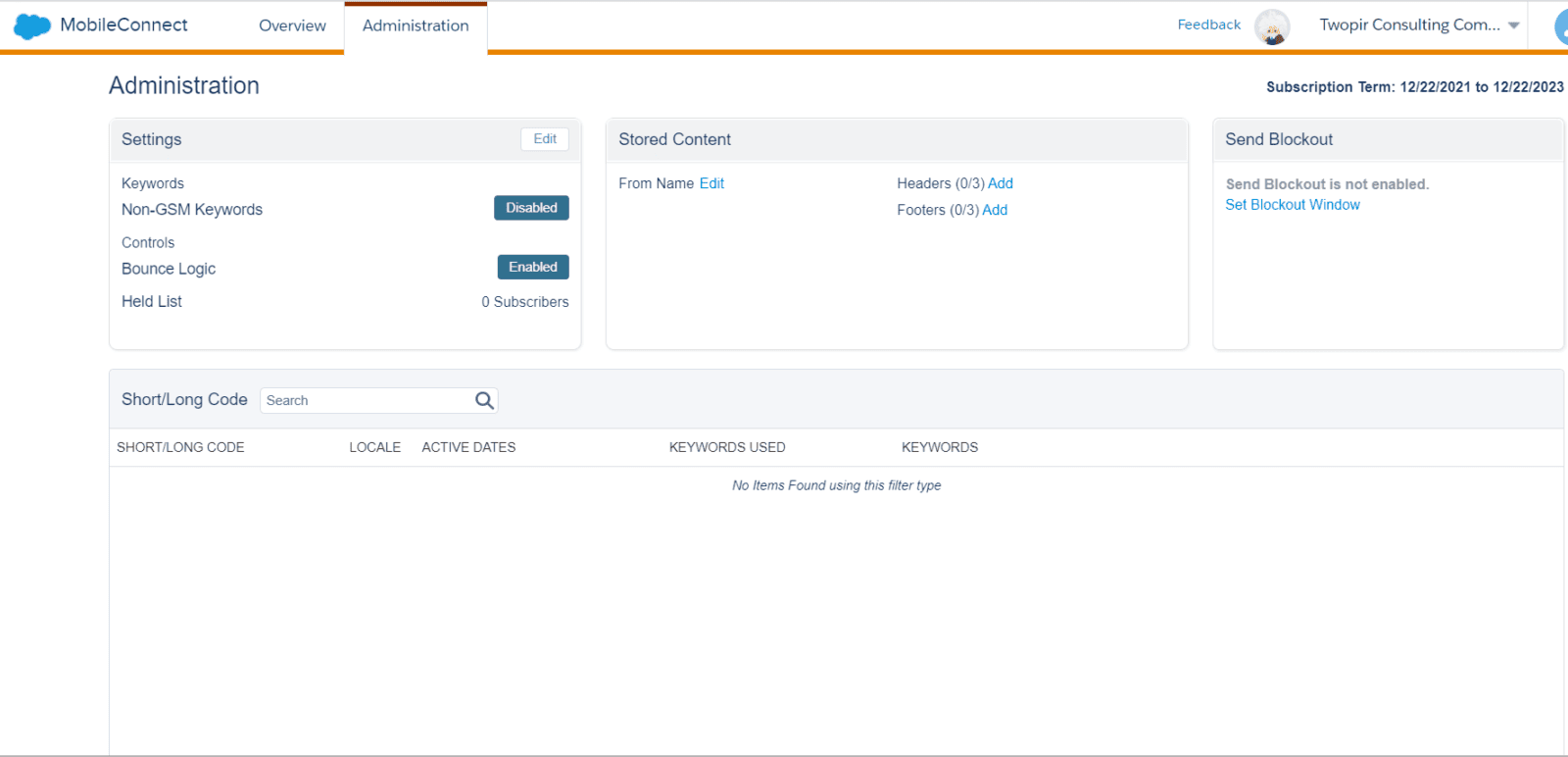
Account settings an admin controls
Admins find these settings by searching for MobileConnect in the Setup app. They apply to every message the account sends:
- Send blockout: a window when the account sends nothing, such as overnight. You choose the hours. Salesforce doesn't fix them.
- From Name: a sender name in place of a number. Recipients can't reply STOP or HELP to it, so you must offer another way to opt out. It must be registered before you send, and your account executive can help with the forms in most countries.
- Headers and footers: standard text added to messages. These are useful for brand recognition where From Names aren't allowed.
- Keywords, short codes and long codes: the numbers assigned to the account and the keywords on each.
- Subscription details: the account's subscription term.
The Overview page
The Overview page is where most day-to-day MobileConnect work happens. It shows outbound and inbound message counts for the last day, week or month, the most active keywords, total mobile opt-ins and their growth over the last 30 days, and every message with its template, status, code, keyword and schedule. Contacts can be added by hand, imported from a file or added through the API, as long as each person has already opted in to mobile messages.

Message templates
Each MobileConnect message starts from a template. If one you need is missing, your Salesforce account representative can enable it.
| Template | What it does |
|---|---|
| Outbound Message | Sends an SMS to a list or data extension: promotions, alerts, reminders |
| Outbound Media | Sends an MMS with an image or other media (United States and Canada only) |
| Text Response / Media Response | Replies automatically when someone texts a keyword |
| Mobile Opt-in | Subscribes someone to SMS when they text a keyword |
| Email Opt-in | Uses a text message to opt someone in to email |
| Vote / Survey | Runs a one-question survey by SMS |
| Info Capture | Stores replies, such as a member number, as contact attributes |
| Send Email | Sends a triggered email in response to a text |
Sender IDs: short code, long code or From Name
The type of number you send from decides what you can send and where. Salesforce's SMS codes guide sets out the options:
| Sender ID | Format | Replies? | Typical markets and use |
|---|---|---|---|
| Short code | 5–6 digits | Yes | High-volume two-way messaging in the US and Canada. Needs carrier approval |
| Long code | 10–14 digits | Yes | One- and two-way messaging, common in Latin America and India; 10DLC in the US |
| From Name (alphanumeric) | 3–11 characters | No | One-way messages in Europe and Asia. Needs preregistration; blocked in the US |
Some countries don't allow one code for both transactional and marketing messages, so Salesforce recommends dedicated codes for one-time passcodes and receipts.
Message length
An SMS holds 160 characters in the standard GSM character set, but only 70 if it contains a single non-GSM character, such as an emoji or a curly quote. Longer messages are split, and concatenated messages are billed by the number of segments. Salesforce's pages disagree on whether concatenation is available in the US, so test it on your own account before you rely on it.
For keywords, short-code tiers and a full campaign checklist, see our guide on how to use Marketing Cloud MobileConnect.
How Does MobilePush Work?
MobilePush sends notifications, inbox messages and in-app messages to your own iOS and Android apps. Your developers add the Salesforce Engagement SDK to the app. Marketers then build segments and send from MobilePush, Content Builder or Journey Builder. Salesforce says MobilePush is included in the Corporate and Enterprise editions.
Setting up the app
MobilePush depends on work by the app team, so the app team's release calendar sets the pace. The steps are:
- 1
Provision the platforms. For iOS, configure Apple Push Notification service and create a .p8 key. One key serves production and sandbox, and it can't be downloaded twice, so store it safely. For Android, configure Firebase and download its configuration file.
- 2
Create the app in Setup. All MobilePush administration pages now live in Setup. Creating the app gives you the app ID, access token and app endpoint the SDK needs.
- 3
Integrate the SDK. The Salesforce Engagement SDK (formerly the MobilePush SDK) handles push, in-app, inbox and location messages, plus analytics. It also works with Cordova, React Native and Flutter apps. Its documentation has moved from GitHub to developer.salesforce.com.
- 4
Set account options. Send blockout, stored headers and footers, custom sounds, OpenDirect deep links, custom keys and interactive notifications are all configured in Setup.


Message types
Push notifications
Personalized alerts to a segment. Rich notifications can add an image, video or sound; Android doesn't support video.
Inbox messages
Messages that stay in an in-app inbox until they expire, which suits content with a shelf life.
In-app messages
Full-page, modal or banner messages shown when the app opens. They're built in Content Builder and sent through Journey Builder.
Geofence and beacon
Messages triggered when someone enters or leaves an area, or comes near a Bluetooth beacon. They need location permission from the user.

Our MobilePush implementation guide covers the developer side in more detail.
What Happened to GroupConnect, and Where Does WhatsApp Fit?
GroupConnect is still documented for LINE and Facebook Messenger, but both now come with conditions, and WhatsApp has become a separate, larger offering. LINE needs a channel bought from a LINE agent. Messenger works only through the API. WhatsApp runs on a direct Meta integration that you buy separately and set up for each business unit.
WhatsApp in Engagement supports Meta-approved templates, session messages, call-to-action buttons, catalogue messages, location requests and its own blockout window. Each business unit gets one WhatsApp Business Account, numbers can't be shared across business units, and connecting an account can take up to 24 hours. Our WhatsApp integration guide and GroupConnect LINE tactics cover each channel in depth.
How Does Mobile Studio Work With Journey Builder and Automation Studio?
Journey Builder treats SMS, push, in-app and WhatsApp as activities, alongside email, in the same journey. Automation Studio handles bulk SMS imports and scheduled sends. The Transactional Messaging API sends instant one-to-one messages, such as passcodes. Each route behaves slightly differently, so choose one per use case.
| Route | Best for | Key details |
|---|---|---|
| Journey Builder | Multi-step, multi-channel journeys: welcome series, re-engagement, abandoned cart | The SMS/MMS activity needs MobileConnect, Content Builder and Journey Builder enabled. It personalizes from entry-source data first, then MobileConnect demographics. Push and inbox activities need MobilePush |
| Automation Studio | Scheduled batch work | Three MobileConnect activities: Import Mobile Contacts, Refresh Mobile Filtered List and Send SMS Contacts |
| MobileConnect API | Sends triggered by your systems | /sms/v1 sends to up to 250 contacts per call, and a queued inbound message can stand in for a JOIN keyword from a web form |
| Transactional Messaging API | Instant messages after an action: passcodes, receipts, order updates | Uses a send definition per use case for SMS, email or push. It doesn't support suppression lists or exclusion scripts |
Send blockouts behave differently on each route
This is the setting most often misunderstood. According to Salesforce's send blockout article:
- In MobileConnect, the blockout prevents scheduling or starting a send during the window. A send already running doesn't pause when the window opens.
- Through the API, the app blockout doesn't apply. You pass a blockout window on each call, and messages inside it wait until just after it closes.
- In Journey Builder, the SMS activity has its own blockout, which ignores the MobileConnect setting. Messages that fall inside it are not sent at all, rather than queued.
So a contact who reaches an SMS step at night may never get that message. Add a wait step or a time-of-day decision before SMS steps in journeys that run around the clock. Our Journey Builder services page explains how we design those journeys.
For timing, Einstein Send Time Optimization can pick the best time for each contact to receive a push notification or email, based on 90 days of engagement data.
What SMS Compliance Rules Apply to Mobile Studio?
Explicit consent, an instant opt-out and registered numbers. Salesforce's compliance guidance cites TCPA in the US and GDPR in Europe, and asks for double opt-in, "Text STOP to unsubscribe" in every message, and opt-outs processed immediately. Your legal team sets the obligations; Mobile Studio carries them out.
Salesforce Mobile Studio vs Marketing Cloud Next
Mobile Studio is the mobile messaging layer of Marketing Cloud Engagement. Marketing Cloud Next is Salesforce's newer marketing platform built on Data 360, with its own SMS, WhatsApp, RCS and app messaging. Existing Engagement customers don't have to choose today: Salesforce offers an "Engagement+" option to use Next capabilities alongside their current products.
| Mobile Studio (Engagement) | Marketing Cloud Next | |
|---|---|---|
| Channels | SMS and MMS, push, inbox, in-app, LINE, Messenger (API), WhatsApp | SMS and MMS, RCS, WhatsApp, push and in-app |
| Data | Contacts, lists and data extensions in Marketing Cloud | Unified profiles and data graphs in Data 360 |
| US code registration | Short codes through a Mobile Approved Partner | Self-service short code and 10DLC requests |
| Conversations | Keyword replies and WhatsApp sessions | Replies can pass to an AI agent or a service rep in the same thread |
| App SDK | Salesforce Engagement SDK | Mobile App Messaging SDK (first released November 2025) |
| Pricing | Through your Salesforce account team | Published editions and add-ons, including SMS credits from $2 per 1,000 (list prices, subject to change) |
If your mobile program runs well in Engagement today, there is no reason to rebuild it in a hurry. Marketing Cloud Next is worth evaluating when you need RCS, AI-assisted conversations, or mobile messages driven by unified Data 360 profiles. Our Marketing Cloud Next services page covers that decision.
How Do You Implement Salesforce Mobile Studio?
Settle consent and sender numbers first, because they take the longest; then load contacts, build templates and journeys, and test inside the quiet-hours rules. Most delays come from code registration and the app team's release cycle, not from building messages, so start those in week one.
- 1
Agree the consent model. Define where SMS, push and WhatsApp consent is captured, how it is stored, and how a STOP reaches every system that sends messages.
- 2
Order codes and sender IDs. Request short codes, 10DLCs or From Names for each country, and keep transactional and marketing traffic apart where local rules require it.
- 3
Prepare contact data. Store mobile numbers normalized with the country code and no punctuation, add the country or locale, and use a stable contact key. If you send to data extensions, mark them as sendable.
- 4
Configure the accounts. Create HELP keywords, review the STOP keywords, set the send blockout, and add headers and footers. For push, provision the platform credentials and create the app.
- 5
Build and test. MobileConnect's test option activates a keyword and its confirmation message for 60 minutes. Test non-GSM characters, links and MMS media on real handsets.
- 6
Put mobile into journeys. Add SMS or push steps to existing email journeys with wait steps around the blockout, and set a campaign name on SMS activities so they appear in tracking.
How Do You Measure Mobile Studio Performance?
Use the standard reports in Analytics Builder, then track opt-outs as closely as clicks. MobileConnect and MobilePush each come with summary and detail reports, and SMS link clicks are tracked when you use the Engagement link shortener. A rise in opt-outs or disabled notifications is the earliest sign that a program sends too often.
| Channel | Standard reports | Watch |
|---|---|---|
| SMS | SMS Account Summary, Message Detail, Message Summary, Link Clicks, plus the SMS Deactivation Summary | Delivery rate, clicks, STOP replies per send |
| Push | Push Account Summary, Message Detail, Message Summary, and the MobilePush Detail Extract (unique opens) | Opens, opt-in growth, notifications switched off |
| Journeys | Journey Builder activity tracking, by campaign and activity name | Conversion by step and by channel |
The Bottom Line
Salesforce Mobile Studio gives Marketing Cloud Engagement one place for SMS, push, LINE, Messenger and WhatsApp, connected to the same journeys as email. The tools are mature. The work that decides success is consent, sender registration and the app team's roadmap, and that should start before anyone writes a message.
- 1
Choose channels by reach and consent, and use SMS and push together rather than one in place of the other.
- 2
Order short codes, 10DLCs and From Names first; they take weeks.
- 3
Treat SMS consent as separate from email consent, with STOP and HELP working from day one.
- 4
Configure the send blockout in MobileConnect, the API and Journey Builder separately.
- 5
Review GroupConnect and WhatsApp set-ups against Salesforce's current terms, and evaluate Marketing Cloud Next when you need RCS or AI-assisted conversations.
Plan Your Mobile Messaging Program
On a 30-minute discovery call, a Twopir Marketing Cloud consultant will review your consent capture, sender numbers and journeys, and recommend which Mobile Studio channels to switch on first.
Schedule a Discovery CallFrequently Asked Questions
Mobile Studio is used to send marketing and transactional messages to phones from Marketing Cloud Engagement. MobileConnect sends SMS and MMS, MobilePush sends notifications and in-app messages to your own app, and GroupConnect and WhatsApp reach customers in chat apps. All of them can run as steps in Journey Builder alongside email.
Partly. Salesforce documents MobilePush as included in the Corporate and Enterprise editions of Marketing Cloud Engagement. Other features, templates and WhatsApp are enabled through your Salesforce account team, and WhatsApp-First Business Messaging is a separate purchase. Pricing for Engagement is quoted by Salesforce sales.
MobileConnect sends SMS and MMS to any opted-in phone number through carriers, using short codes, long codes or sender names. MobilePush sends notifications, inbox and in-app messages only to people who have installed your app with the Salesforce Engagement SDK and allowed notifications.
Yes. Marketing Cloud Engagement offers WhatsApp-First Business Messaging, a direct Meta integration purchased separately. It sends Meta-approved templates and session messages from Journey Builder. Buying it stops messages on the older Sinch-based WhatsApp app, so existing templates and journeys must be rebuilt first.
Yes, with conditions. LINE needs a channel and message volume bought from a registered LINE agent, on Salesforce's LINE Transactional package, because the LINE API product sold through Salesforce was retired in March 2020. Facebook Messenger is available only through the GroupConnect Chat Messaging API.
Salesforce estimates 1–4 weeks for a 10-digit long code (10DLC) and 10–12 weeks for a short code. Both need registration: a 10DLC needs brand, campaign and code requests, and a short code needs carrier approval. Messages sent with a From Name are blocked in the US.
Not urgently, if your Engagement program works. Mobile Studio remains documented and supported. Evaluate Marketing Cloud Next when you need RCS, conversations that hand off to an AI agent or service rep, or messages built on Data 360 profiles. Salesforce's Engagement+ option lets existing customers use Next alongside Engagement.
