
Salesforce Email Studio Guide: Features, Setup and Best Practices
Email Studio is where Marketing Cloud Engagement builds, sends and tracks email. This guide explains how it works in 2026: the data model, the five ways to send, personalization, A/B tests, Einstein, tracking, and the authentication and compliance settings that decide whether your email reaches the inbox at all.
Key Takeaways
- Salesforce Email Studio is the email application inside Marketing Cloud Engagement (the product formerly called Marketing Cloud). It builds, sends and tracks promotional, transactional and triggered email.
- Store subscribers in data extensions once you pass 500,000 records or need triggered sends and APIs, and use a stable subscriber key such as your CRM ID, never the email address.
- Pick the send type by trigger: Send Flow for one-off campaigns, triggered sends for API events, Journey Builder for multi-step programs, Automation Studio for scheduled data-driven sends.
- Deliverability is set up, not hoped for: senders above 250,000 emails a month must use the Sender Authentication Package, and Gmail and Yahoo now require authentication, one-click unsubscribe and low complaint rates.
- Open rates are unreliable because Email Studio cannot tell human opens from automated ones. Judge campaigns on clicks, conversions and unsubscribes.
What is Salesforce Email Studio? Salesforce Email Studio is the email marketing application in Salesforce Marketing Cloud Engagement. Marketers use it to build emails from reusable content, store and segment subscribers in lists and data extensions, send campaigns and automated messages, run A/B tests, and track opens, clicks, bounces and unsubscribes. It connects to Salesforce CRM through Marketing Cloud Connect.
We first published this Salesforce Email Studio guide in 2023. This version is rebuilt from Salesforce's current Help documentation, Trailhead, the Winter '27 release notes and the published sender rules of Gmail, Yahoo and the US Federal Trade Commission, all checked in October 2026. It is written for marketing operations teams, Marketing Cloud admins and marketing leaders at growing and mid-market companies, and it covers what most Email Studio guides skip: the data decisions, deliverability and compliance settings that decide whether a well-designed email ever reaches the inbox.
What Is Salesforce Email Studio, and Where Does It Fit in Marketing Cloud?
Email Studio is the email channel of Marketing Cloud Engagement, Salesforce's dedicated marketing platform. Salesforce describes it as the place to build and send personalized email, "from basic newsletters to the most complex campaigns", including promotional, transactional and triggered messages. It sits beside Content Builder, Contact Builder, Journey Builder and Automation Studio, which share its data and content.
The naming has changed, so it helps to be precise. Salesforce now calls the product Marketing Cloud Engagement; older Help pages and most of the market still say "Marketing Cloud" or "SFMC". Salesforce also sells Marketing Cloud Next (Growth and Advanced editions), a newer product built directly on the Salesforce Platform with Data 360 and Agentforce. Email Studio belongs to Engagement. Next sends email through its own builder, not through Email Studio.
| Topic | Marketing Cloud Engagement (Email Studio) | Marketing Cloud Next (Growth, Advanced) |
|---|---|---|
| Platform | Dedicated marketing platform, connected to Salesforce CRM by the Marketing Cloud Connect managed package | Built on the Salesforce Platform, with Data 360 as the data layer |
| Email building | Classic Email Studio and Content Builder, with AMPscript and server-side JavaScript | Lightning App Builder framework with Handlebars markup and AMPscript |
| Segmentation | SQL queries and filters on data extensions, in Automation Studio | Drag-and-drop segment builder in Data 360 |
| Orchestration | Journey Builder | Salesforce Flow |
| Typical fit | Primarily B2C, high-volume and code-based personalization | B2B, B2C and hybrid |
The comparison follows Salesforce's Trailhead module on Marketing Cloud Next channel marketing. Salesforce's current Engagement pricing packages both: the Pro+, Corporate+ and Enterprise+ editions of Engagement+ include access to Marketing Cloud Next. If you are choosing a platform rather than learning one, our HubSpot vs Marketing Cloud vs Account Engagement comparison covers that decision.
What Can You Do in Each Area of Email Studio?
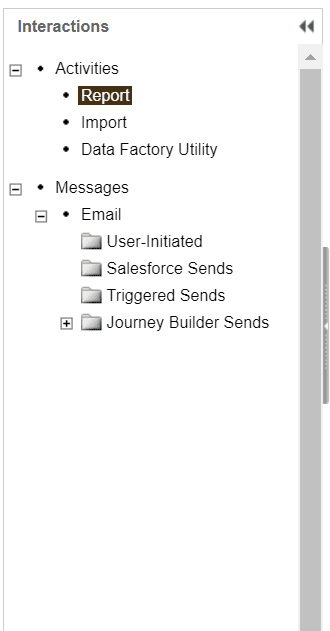
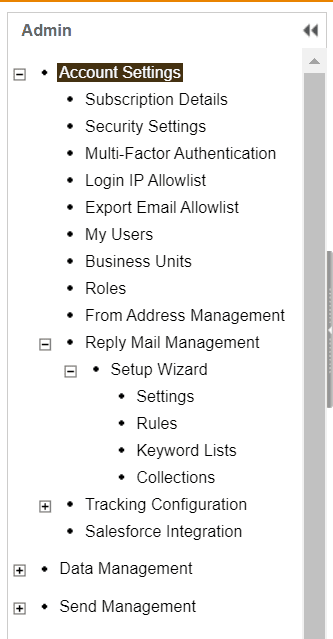
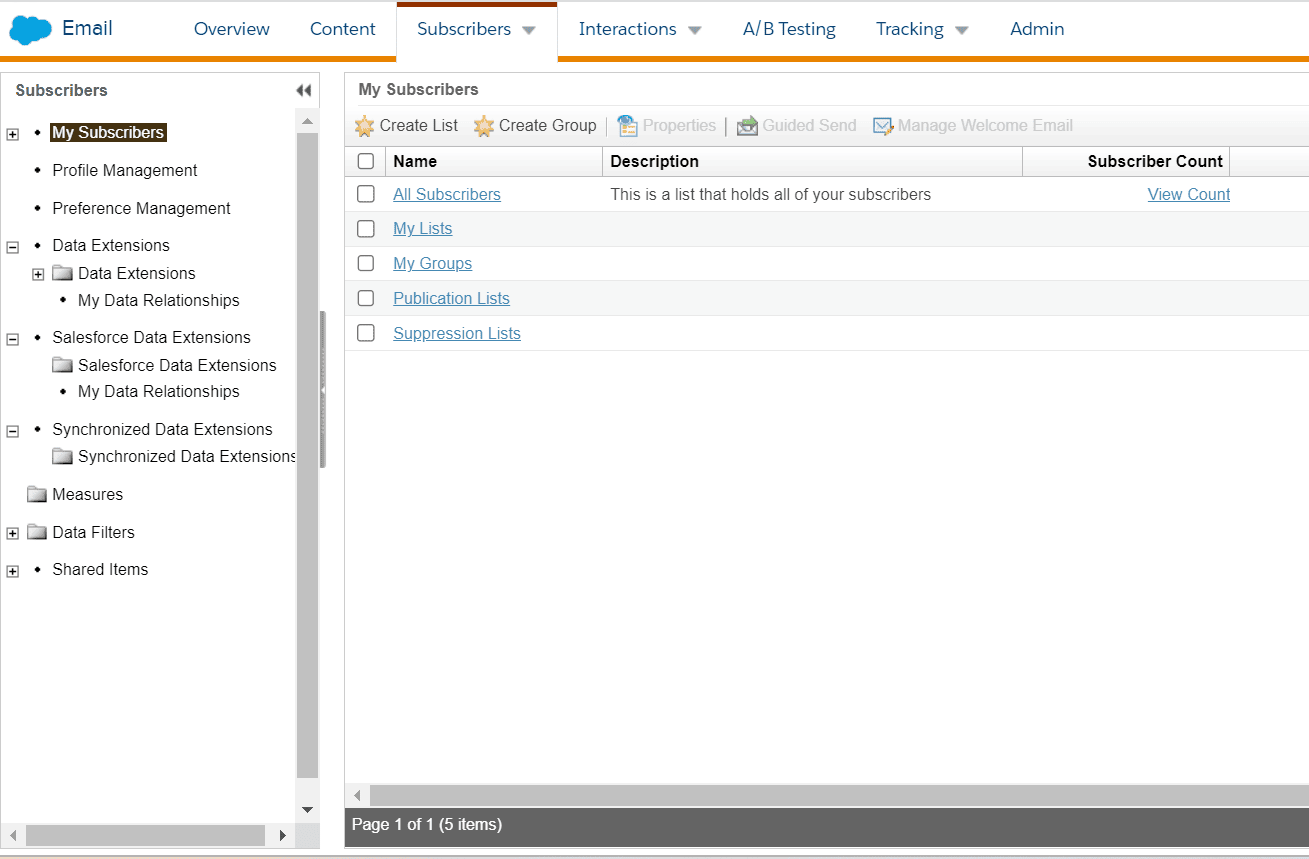
Email Studio is organized into a handful of work areas: Overview, Content, Subscribers, Interactions, A/B Testing, Tracking and Admin. Content holds the emails and reusable blocks, Subscribers holds the audience and opt-in data, Interactions holds the sends and data processes, and Tracking holds results. Admin controls the account settings that make sending safe.

Content
Emails and templates built in Content Builder from reusable blocks: text, HTML, images, buttons and dynamic content. You can build without HTML, and Einstein can draft subject lines and body copy.
Subscribers
Lists, groups and data extensions, plus All Subscribers, publication lists, suppression lists and the profile and preference centers.
Interactions
The communications and data processes behind each program: user-initiated, triggered, Salesforce and Journey Builder sends, plus imports, reports and other activities.
A/B Testing
Two versions of a subject line, email, content area, from name, send time or preheader, sent to test groups before the winner goes to everyone else.
Tracking
Opens, clicks, bounces, unsubscribes, forwards and conversions for each send, with standard reports delivered to your inbox or FTP.
Admin
Users and roles, business units, send classifications, sender and delivery profiles, reply mail management, auto-suppression and send logging.
Salesforce's Email Studio documentation lists a few lesser-known tools worth using. List Detective blocks addresses and domains known to cause deliverability problems, including known spam traps. Transactional Reconciliation confirms the final delivery status of transactional emails. And in accounts with several business units, shared items let you control which units can use an email, template or data extension.
Should You Store Subscribers in Lists or Data Extensions?
Use data extensions for almost every program that will grow; keep lists for small, simple audiences. Salesforce recommends lists only up to 500,000 subscribers with few attributes. Data extensions are database tables: they import far faster, hold several related datasets, and are required for triggered sends and API-driven programs. Lists keep one advantage: the standard profile and subscription centers work only with lists.
| Question | List | Data extension |
|---|---|---|
| Recommended size | 500,000 subscribers or fewer | Any size, and above 500,000 |
| Import speed | Around 500,000 rows an hour | Around one million rows in 10 minutes |
| Triggered sends and APIs | Limited | Yes |
| Profile and Subscription Center | Supported | Not supported |
| Opt-out handling | Built into the list | Needs a publication list |
| Data retention and automated export | No | Yes |
Source: Salesforce's list versus data extension guide. For relational data, such as orders linked to customers, Contact Builder's Data Designer links data extensions to the contact model so Journey Builder and personalization can use them.
Choose the subscriber key before the first import
The subscriber key is the value that uniquely identifies each subscriber, up to 254 characters. It decides whether a subscriber already exists, how a send is de-duplicated, which record a preference center updates and which record an unsubscribe applies to. Salesforce advises against using email addresses as keys. A stable ID, such as your Salesforce Contact or Lead ID, lets one person change their address without becoming a new subscriber, and lets tracking data join straight back to CRM. Changing the key strategy after launch is a migration, so decide it first.
Opt-ins: All Subscribers, publication lists and suppression lists
- All Subscribers is the master record of every subscriber in the account. Unsubscribing there removes a person from all lists and groups. Data extension subscribers are added to it when they receive their first email.
- Publication lists manage opt-outs for sends to data extensions. Salesforce recommends one publication list per content type, such as newsletters, offers and alerts. With a single list, opting out of one publication opts the person out of everything.
- Suppression lists act as "do not contact" lists for guided, user-initiated and triggered sends. When someone uses one-click unsubscribe, they are added to the suppression list. Auto-suppression lists apply automatically: created in a child business unit they cover that unit; created in the Enterprise unit they cover the whole account.
Which Email Studio Send Type Should You Use?
Choose by what starts the email. A person pressing send is a user-initiated send, built with Send Flow. A system event or API call is a triggered send. A multi-step program that reacts to behaviour belongs in Journey Builder. A schedule or a file arriving belongs in Automation Studio. A Salesforce report or campaign as the audience means a Salesforce send through Marketing Cloud Connect.
| Send type | Started by | Best for | Watch out for |
|---|---|---|---|
| User-initiated (Send Flow) | A marketer, now or scheduled | Newsletters, announcements, one-off campaigns | Send Flow replaces Guided Send for Content Builder emails; audience is lists and groups, or one data extension |
| Triggered send | An API call or system event | Receipts, password resets, form confirmations | Best run on a data extension; with no associated list it cannot track unsubscribes |
| Journey Builder | Entry into a journey | Welcome, onboarding, nurture and win-back series | Overlapping journeys send conflicting messages; govern them as one program |
| Automation Studio | A schedule or a file drop | Daily or weekly sends after an import and a query | Failed imports send to stale audiences unless you add checks |
| Salesforce send | A marketer, using a Salesforce report or campaign | Sales-aligned sends to CRM leads and contacts | Requires Marketing Cloud Connect and the default send classifications |
Salesforce documents each one: Send Flow, user-initiated and triggered email messages, Journey Builder and Automation Studio. For multi-step programs, our Journey Builder service page explains how we design journeys so they do not compete for the same customer.
User-initiated sends have options that prevent common mistakes: exclusion lists, a domain exclusion list, an AMPscript exclusion script, and de-duplication by email address or subscriber key. Email Studio also warns you before you resend the same email to the same recipients. Winter '27 added email de-duplication in Journey Builder as well, which stops one address receiving the same journey email twice.
How Does Email Studio Work with Salesforce CRM?
Through Marketing Cloud Connect, a managed package that links a Marketing Cloud Engagement account to a Salesforce org. It lets marketers send to Salesforce reports, campaigns, leads and contacts, fire triggered emails from record changes, and write individual tracking results back to each lead and contact. It needs Salesforce Enterprise Edition or higher; Professional Edition is not supported.
What it gives you. Sends to Salesforce reports and campaigns from Email Studio, synchronized data extensions that copy CRM objects into Marketing Cloud for segmentation, and tracking (sends, deliveries, bounces, opens, clicks and unsubscribes) on the lead and contact record, so sales can see who engaged.
What to plan for. Its Salesforce tabs open in Classic, not Lightning. CRM-triggered sends run on Apex, don't support bulk updates and allow 50 per transaction. Data extensions created from report and campaign sends are kept for only 5 days. And when a lead converts, its new contact gets a new subscriber key, without the lead's tracking, opt-out or preferences.
The details are in Salesforce's pages on Marketing Cloud Connect features, sending to Salesforce data and CRM-triggered sends. The lead conversion gap is the one that hurts most in B2B: unless you carry consent across in your own process, a person who unsubscribed as a lead can become mailable again as a contact. It is one of the first things we check in a Marketing Cloud implementation.
How Do You Personalize Emails in Email Studio?
With three layers, used in order of simplicity. Personalization strings insert a subscriber's attribute, such as a first name. Dynamic content swaps whole blocks by rules, such as region or product interest, without code. AMPscript handles logic the first two cannot express: lookups to other data extensions, calculations and formatting. Each layer needs a fallback for missing data.
1. Personalization strings
No codeBest for: names, account details and other single values in the subject line, preheader or body.
Strings are written between double percent signs, for example %%FirstName%%, and are case-insensitive. If the value is empty, the string renders blank, so Salesforce advises a default value for every attribute. It also warns never to put personal data such as an email address into email links. See personalization strings.
2. Dynamic content
No codeBest for: rule-based variation, such as a different hero image or offer by segment.
A dynamic content block shows content by rules on subscriber attributes or data extension columns, with default content when no rule matches. A subscriber who matches several rules receives the first one, so order rules from most to least specific. It works in every email type except text-only, and in subject lines and preheaders. See dynamic content.
3. AMPscript (and, rarely, SSJS)
CodeBest for: values calculated at send time, data outside the sending data extension, and formatting or fallback logic.
AMPscript is Marketing Cloud's scripting language for email, landing pages and messages. Server-side JavaScript (SSJS) also runs on Marketing Cloud servers, but Salesforce recommends AMPscript for email and says most users can do what they need with it. Our AMPscript vs SSJS guide explains when each one fits, and Salesforce's developer docs list the built-in AMPscript variables.
A simple rule keeps personalization maintainable: if a marketer could not read a block and say what it does, check whether the requirement really needs code. Put reusable logic in a shared content block rather than pasting it into forty emails, and test every personalized email against a record with missing data, not only a tidy one.
How Does A/B Testing Work in Email Studio?
Email Studio sends two versions of an email to two test groups, picks a winner by unique open rate or unique click-through rate, and sends the winning version to the rest of the audience. You can test the subject line, the whole email, a content area, the from name, the send time or the preheader. Salesforce recommends waiting at least 24 hours before declaring a winner.
Three limits from Salesforce's A/B test setup guide are worth knowing. You cannot A/B test to a Salesforce campaign or report. A/B sends compile more slowly, so Salesforce suggests a standard send above 1 million subscribers. And when both test emails use dynamic subject lines, the default subject line is always used, so use AMPscript in the subject line instead (A/B testing overview).
Which Einstein and Agentforce Features Work with Email Studio?
Einstein adds prediction and generation to Email Studio sends: the best send time per contact, how often to email each contact, engagement scores, subject-line insights, content selection and generative copy. Each predictive feature learns from your own engagement history, so it needs enough sending data before it helps. A new account, or one that has just moved to new sending infrastructure, should plan for that wait.
| Feature | What it does | Data it needs |
|---|---|---|
| Send Time Optimization | Picks the best time within the next 24 hours to send to each contact; used in Journey Builder and Automation Studio sends | 90 days of engagement data; retrains weekly |
| Engagement Frequency | Shows which contacts are over- or under-emailed; requires Journey Builder | At least five sending patterns in the past 28 days |
| Engagement Scoring | Predicts how likely each contact is to engage with email and push messages; scores refresh weekly | At least 1,000 events in the 90 days before activation |
| Copy Insights | Analyzes which words and phrases in commercial subject lines drive engagement | At least 10 subject lines sent to at least 30 subscribers in 30 days |
| Content Selection | Chooses the best content for each contact from their profile and category affinity | Contact profile and category affinity |
| Generative AI | Drafts subject lines and body copy in Content Builder in seven languages; not enabled by default | Brand personality settings; capped at 10,000 generations per Enterprise account |
Sources: Salesforce's Einstein feature overview, Send Time Optimization, Engagement Frequency, Engagement Scoring, Copy Insights and generative AI. Most are included in Corporate and Enterprise editions and available as add-ons to Pro; check your contract.
Two Winter '27 changes point to where email is heading. Engagement+ customers can enable two-way conversational emails handled by Agentforce agents, and Salesforce added 40 tools to the Marketing Cloud Engagement MCP server, so MCP-compatible AI assistants can query data extensions, manage Content Builder folders, run Automation Studio activities and retrieve email tracking events (Winter '27 release notes). Both deserve the same governance as any other sender: named owners, review rules and limits on what an agent may send.
How Should You Measure Email Studio Performance?
Use deliveries and bounces for health, clicks and conversions for engagement, and unsubscribes and complaints as warning signs. Email Studio tracks opens, clicks, bounces, unsubscribes, forwards and conversions for every send. Opens are the weakest of these: Salesforce states that Email Studio records every open because there is no clear way to tell a person from an automated program.
The cause is privacy tooling. Mail clients such as Apple Mail can load images, including the tracking pixel, on the reader's behalf. Salesforce's guidance on Apple Mail Privacy Protection (written for Account Engagement, but the mechanism is the same) warns of inflated open rates and recommends moving away from opens as an engagement measure. Google adds that low open rates are not a reliable sign of a deliverability problem.
See Salesforce's tracking overview, send logging and the list of Email Studio reports. With Marketing Cloud Connect, individual results also appear on the Salesforce lead and contact record.
How Do You Get Email Studio Emails into the Inbox?
Authenticate your sending domain, send from the right IP, warm new infrastructure, and keep complaints low. In Email Studio, authentication comes from the Sender Authentication Package (SAP) or a Private Domain, which set up SPF, DKIM and DMARC. Senders above 250,000 emails a month must use SAP. Gmail and Yahoo now require bulk senders to authenticate, offer one-click unsubscribe and keep spam complaints low.
Sender Authentication Package, IPs and warming
- What SAP includes: a branded, authenticated private domain (so tracking links and images use your domain), a dedicated IP address and reply mail management. Every Engagement edition includes SAP licences: one with Pro and Corporate, five with Enterprise (SAP documentation).
- Shared or dedicated IP: Salesforce suggests a shared IP below 100,000 emails a month and a dedicated IP above 250,000. A dedicated IP needs at least 100,000 emails a month to stay warm (dedicated IP guide).
- Warming: a new dedicated IP starts with no reputation. Trailhead's deliverability module is blunt: "there is no such thing as a pre-warmed IP". Ramp volume to your most engaged subscribers first, over at least 30 days of sending history.
- Setup time: domain configuration in Setup can take up to five business days, so it belongs at the start of the project, not launch week (configure SAP and Private Domain).
Gmail and Yahoo bulk sender rules
| Requirement | Gmail | Yahoo | In Email Studio |
|---|---|---|---|
| Authentication | SPF, DKIM and DMARC for bulk senders | SPF, DKIM and DMARC (at least p=none) | Met by sending through SAP or a Private Domain; registering a From address alone does not authenticate it |
| One-click unsubscribe | Required above 5,000 messages a day | Required; honour within 2 days | Added to commercial sends by default; needs an HTTPS click subdomain and DKIM signing |
| Spam complaint rate | Below 0.10%; never 0.30% or higher | Below 0.3% | Watch the Spam Complaints Over Time report and Gmail Postmaster Tools |
Sources: Google's email sender guidelines, Yahoo's sender best practices and Salesforce's bulk sender guidelines for Marketing Cloud Engagement. Yahoo complaints are fed back into the _Complaint data view automatically for authenticated domains; Gmail does not share individual complaints, so Postmaster Tools is your only view of them. Our guide to SPF and DKIM for Salesforce email goes deeper on the DNS side.
Authentication is necessary but not sufficient. The most common self-inflicted problem we see is mailing addresses that have not engaged for a year or more: a deliberate sunset policy, bounce hygiene and suppression of complainers protect the reputation your engaged subscribers depend on.
How Does Email Studio Handle CAN-SPAM, GDPR and Unsubscribes?
Through send classifications, unsubscribe handling and the data you choose to keep. Every send has a classification that marks it Commercial or Transactional and attaches a sender profile and a delivery profile. Commercial sends are checked for an unsubscribe link and honour opt-outs; transactional sends are not checked and reach people who unsubscribed. Salesforce requires every Engagement message to comply with CAN-SPAM, wherever the recipient lives.
- Classify honestly. Salesforce's advice in its send classifications guide is: if you are unsure, choose Commercial and include an unsubscribe link. A promotion sent as Transactional reaches people who opted out.
- Mind the unsubscribe gaps. Triggered sends with no associated list cannot track unsubscribe requests, and neither can Journey Builder sends whose publication list is All Subscribers.
- Put the address in the footer. The delivery profile's footer carries your physical mailing address and unsubscribe link, both CAN-SPAM requirements (delivery profiles).
- Handle replies. Reply Mail Management processes replies, auto-replies and "unsubscribe me" emails by rule, so opt-outs sent by reply are not lost (reply mail management).
The law sets the floor. The US Federal Trade Commission's CAN-SPAM compliance guide for business requires opt-outs to be honoured within 10 business days, makes no exception for business-to-business email, and sets penalties of up to $53,088 for each email in violation. Salesforce summarizes the same rules in its CAN-SPAM requirements for Marketing Cloud Engagement. In the EU and UK, the GDPR requires consent to be freely given, specific, informed and unambiguous, makes withdrawing consent as easy as giving it, and gives people an absolute right to object to direct marketing. Email Studio gives you the tools; your consent capture, preference center and data retention decide whether you comply. This is general guidance, not legal advice.
What Does a Good Email Studio Setup Look Like, Step by Step?
Set up the foundations in the order Salesforce recommends: access and security, users and roles, domain and IP, then data, then content, then a warmed first send. Design the data model and consent rules before anyone builds an email. Most Email Studio accounts that struggle later made the subscriber key, publication list and sending domain decisions in a hurry.
The order follows Salesforce's Email Studio get-started checklist. On our Marketing Cloud email marketing engagements we add two things to it: a written pre-send checklist that runs before every campaign, and a governance owner for templates and journeys, so the account stays clean after go-live. Our Marketing Cloud case study shows the same approach for an e-commerce company, with journeys, dynamic content and AMPscript.
The Bottom Line
Salesforce Email Studio is a capable email engine, and still the core of Marketing Cloud Engagement in 2026. Results depend less on the editor and more on the decisions underneath it: how subscribers are keyed and stored, which send type fits each message, how consent is tracked, and whether the sending domain is authenticated and warm. Twopir Consulting implements, rescues and optimizes Marketing Cloud for growing and mid-market companies, as well as for enterprise teams.
- 1
Use data extensions and a stable, non-email subscriber key from day one.
- 2
Match the send type to the trigger, and keep journeys governed as one program.
- 3
Personalize with strings and dynamic content first, AMPscript only where needed, with fallbacks everywhere.
- 4
Authenticate with SAP or a Private Domain, warm new IPs, and keep complaints under 0.10%.
- 5
Classify sends honestly, close the unsubscribe gaps, and measure on clicks and conversions.
Get More from Email Studio
Tell us whether your team struggles to build and send, or your email is not arriving. We will review your data model, sending setup and compliance settings and tell you what to fix first.
Schedule a Discovery CallFrequently Asked Questions
Salesforce Email Studio is used to build, send and track email in Marketing Cloud Engagement. Teams create emails from reusable content blocks, store subscribers in lists or data extensions, send newsletters, triggered and journey emails, run A/B tests, and report on clicks, bounces, unsubscribes and conversions. It connects to Salesforce CRM through Marketing Cloud Connect.
Not exactly. Email Studio is one application inside Marketing Cloud Engagement, the product Salesforce previously called Marketing Cloud. Engagement also includes Content Builder, Contact Builder, Journey Builder, Automation Studio and other channels. Marketing Cloud Next, sold as Growth and Advanced editions, is a separate product on the Salesforce Platform that sends email without Email Studio.
Email Studio creates and sends individual emails and manages subscribers, content and tracking. Journey Builder orchestrates multi-step programs, such as a welcome or onboarding series, that send emails and other messages over time based on entry events, waits and decisions. Journey emails are built with the same content and appear under Journey Builder Sends in Email Studio.
Use data extensions for most programs. Salesforce recommends lists only for audiences of 500,000 subscribers or fewer with few attributes. Data extensions import much faster, hold related datasets and support triggered sends and APIs. Lists keep one advantage: the standard profile and subscription centers work with lists, while data extensions need a publication list for opt-outs.
Use a stable, unique ID that never changes, such as your Salesforce Contact or Lead ID, not an email address. Salesforce advises against email addresses as keys. A stable key lets people change their address without becoming a new subscriber and lets tracking data join back to CRM. Decide it before the first import, because changing it later is a migration.
If you send more than 250,000 emails a month, yes: Salesforce requires it. Every Engagement edition includes at least one SAP licence. SAP authenticates and brands your sending domain and includes a dedicated IP and reply mail management. Smaller senders can authenticate with a Private Domain, which also meets the Gmail and Yahoo authentication requirements.
Yes. Salesforce adds one-click List-Unsubscribe headers to commercial messages by default, with no extra configuration. For them to work, your SAP click subdomain must be secured with HTTPS and messages must be DKIM-signed. Mailbox providers decide whether to show the link, and a brand-new sending domain may not show it until it builds volume and engagement.
Usually because of privacy features such as Apple Mail Privacy Protection, which load images, including the open-tracking pixel, without a person reading the email. Salesforce states that Email Studio cannot tell whether an open came from a human or an automated program. Judge campaigns on clicks, conversions, unsubscribes and complaints, and use opens only as a rough trend.
