
Simplify Data Collection With Formstack Forms: The Complete Guide
Formstack Forms is a no-code form builder for collecting clean, validated data and sending it where your team works. This guide explains what it does, how it differs from Forms for Salesforce, how to connect it to Salesforce without creating duplicates, and what it costs and protects, so you can choose and build with confidence.
Key Takeaways
- Formstack Forms is a no-code form builder with conditional logic, built-in field validation, save and resume, payments, approvals and data routing. Submissions are stored in Formstack and can be sent on to Salesforce, HubSpot and other tools.
- Forms for Salesforce is a different product: a native app where forms are built, and data is processed and stored, inside your Salesforce org, with dynamic prefill from existing records.
- Choose by where the data must live. Data that belongs 100% in Salesforce suits Forms for Salesforce. Forms owned by marketing or operations, feeding several systems, suit Formstack Forms. Many teams use both.
- Clean data is a design decision: picklists instead of free text, upsert on a reliable key, a defined record owner, and validation at the point of entry.
- Compliance is configured, not automatic. HIPAA needs a BAA and an add-on account on the Forms and Suite plans; PCI needs the compliant card fields and processors.
What Is Formstack Forms?
Formstack Forms is a no-code online form builder for collecting data through web forms and automating what happens after someone submits. You drag fields onto a form, add logic and validation, publish it by link or embed code, and route each submission to people, documents or connected systems such as a CRM, with no developer required.
Formstack describes the product as automating "data collection to data workflows", with form prefill, AI form creation and multi-step workflows as headline features. Typical forms include lead capture, applications, registrations, patient intake, internal requests and feedback surveys.
Two naming points prevent confusion. First, the company rebranded from Formstack to Intellistack in June 2025 and said Formstack products would continue to be sold and supported, so the product is still called Formstack Forms. Second, "Formstack Forms" and "Forms for Salesforce" are separate products with different architectures, covered in section 3.
Build
A drag-and-drop builder with field types, sections, themes and multi-page layouts. No code.
Guide
Conditional logic shows only relevant questions; validation blocks badly formatted entries before submit.
Route
Email logic, approvals, webhooks and integrations send each submission to the right person or system.
Protect
SSL on every form, optional data encryption, PCI card fields, and HIPAA and GDPR options.
Which Formstack Forms Features Improve Data Quality?
The Formstack Forms features that most improve data quality are field validation, conditional logic, save and resume, partial submissions and data routing. Validation stops bad formats at entry, logic hides irrelevant questions, save and resume rescues long forms, partial submissions show where people quit, and routing gets each response to its owner.
Feature lists are long, so the table below groups the ones that change data quality and process speed, with what each is best used for. Availability varies by plan, so confirm your plan's inclusions before you design around a feature.
| Feature | What it does | Use it for |
|---|---|---|
| Field validation | Email, phone, credit card, address and date fields check their format automatically; a badly formatted entry blocks the submission with a message | Contact data you will email, call or sync to a CRM |
| Conditional logic | Shows or hides fields and sections based on earlier answers | One form serving several request types without irrelevant questions |
| Save and resume | On multi-page forms, emails the respondent a personal link and gives them 30 days to finish | Applications, onboarding and intake forms that need documents to hand |
| Partial submissions | Captures data entered by people who leave before submitting, with notification emails every 6, 12 or 24 hours (part of the Conversion Kit) | Finding the field that makes people quit, and following up on abandoned leads |
| Data routing | Email logic sends submissions to different people; redirects, webhooks and APIs pass data onward | Sending each region, product or request type to its owner |
| Approvals | Approvers approve or deny from email, in the order you set | PTO, purchase, proposal and hiring requests |
| Payments and calculating fields | PayPal, Stripe and Authorize.Net; recurring payments, quantities, discounts and automatic totals | Registrations, orders, fees and donations |
| File uploads | Collects documents and images, with file-type limits and storage in Formstack or Box, Dropbox, Google Drive, Amazon S3 or OneDrive | Resumes, IDs, inspection photos and supporting documents |
| Field prefill (SSO) | Prefills fields from a single sign-on provider such as Google SSO, LDAP, Active Directory, SAML 2.0 or CAS | Employee and portal forms where people are already logged in |
Features as described on formstack.com feature pages in November 2026. Some, such as partial submissions and field prefill, depend on your plan or an add-on.
For developers, the Formstack API exposes forms, fields, submissions and prefill endpoints, which is the route for custom integrations the standard connectors do not cover.
Formstack Forms Or Forms For Salesforce: Which Should You Use?
Use Forms for Salesforce when the data belongs entirely in Salesforce and you need to prefill or update existing records. Use Formstack Forms when marketing or operations own the forms, the data feeds several systems, or Salesforce is only one destination. Formstack's own comparison says it need not be either/or: many customers run both.
The difference is architectural. Formstack Forms stores each submission in Formstack and syncs it to Salesforce through an integration. Forms for Salesforce is built inside your org, so submissions are processed and stored there under Salesforce's security model. The table follows Formstack's comparative guide and Forms for Salesforce product page.
| Question | Formstack Forms | Forms for Salesforce |
|---|---|---|
| Where are forms built? | In Formstack; no Salesforce login needed | Inside Salesforce; a Salesforce login is needed |
| Where does submission data live? | In Formstack, then synced to Salesforce | Only in your Salesforce org |
| Who usually owns the forms? | Marketing and business users | Salesforce admins and power users |
| Update existing records with prefilled data? | No dynamic Salesforce prefill (upsert can update matched records) | Yes: dynamic prefill through encrypted links, plus upsert |
| Experience Cloud forms | No | Yes |
| File uploads go to | Formstack storage or a cloud storage integration | Salesforce Files, Chatter or Attachments, plus Dropbox, AWS S3 or Azure |
| Other destinations | 300+ integrations, webhooks and API | Salesforce first; payment and storage integrations |
| How you buy it | Published plans, starting with Forms | Salesforce Solutions plan with custom pricing, via a sales order |
Choose Forms for Salesforce if every answer ends up on a Salesforce record, you send forms to known customers who should confirm rather than retype what you hold, you need forms in an Experience Cloud site, or your policy is that this data must never be stored outside the org.
Choose Formstack Forms if non-Salesforce users build and change the forms, submissions also go to email, storage, marketing or payment tools, or the form is public and only some answers should reach Salesforce. You can still upsert into Salesforce through the integration.
How Do You Connect Formstack Forms To Salesforce?
You connect Formstack Forms to Salesforce from the form's Settings, under Integrations. Add the Salesforce integration, sign in with a Salesforce user and security token, choose the objects to create, map each form field to a Salesforce field, and tick Upsert on a matching field such as Email so returning people update their record instead of duplicating it.
Formstack positions this integration as a replacement for Salesforce Web-to-Lead and Web-to-Case forms, with more control, spam prevention and client-side validation. The steps below follow Formstack's Salesforce integration setup guide.
Know the limits before go-live. If more than one Salesforce record matches the upsert field, Salesforce returns an error, so clean duplicates first. Files only transfer if they are stored in the Formstack database, and Formstack notes that attachments over 5MB fail because of the Salesforce API file cap. Heavy volumes can hit the org's daily API request limit, and an expired password on the integration user stops the sync until someone signs in again, per Formstack's common errors article.
If you are comparing form tools for Salesforce more broadly, our Formstack Salesforce integration page covers native and standalone set-ups, and our Formstack integration services page compares connector, webhook, API and middleware patterns.
How Do You Build Your First Form In Forms For Salesforce?
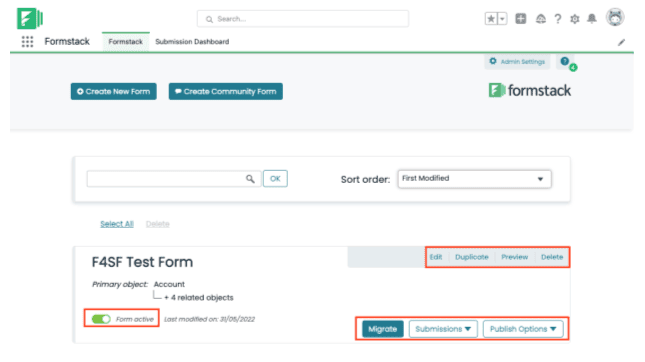
To build a form in Forms for Salesforce, install the app from AppExchange, open Formstack from the App Launcher and authorise it, create a form and choose its primary object and any related objects, drag in fields, add rules, then publish. Fields that Salesforce requires are added to the form automatically and cannot be removed.
The steps below are a refreshed version of the walkthrough in our original post. The screenshots come from an earlier release of the app, so labels and styling in your org may differ slightly.



Is Formstack Forms Secure And Compliant For Sensitive Data?
Formstack Forms supports HIPAA, PCI and GDPR requirements, but compliance depends on configuration and plan, not the product alone. Every form uses 256-bit SSL. For sensitive data you turn on database encryption, sign a Business Associate Agreement for health data, and use the PCI-compliant card fields and processors for payments.
The old version of this post said Formstack "ensures compliance" with HIPAA and GDPR. That overstated it. A vendor can support your obligations; your configuration, your agreements and your processes decide whether you meet them.
| Requirement | What Formstack provides | What you still have to do |
|---|---|---|
| HIPAA | A standard or custom BAA, and a dedicated or converted account with data encryption, SMTP options, field and folder security, audit logging and user permissions | Sign the BAA, buy the HIPAA add-on on Forms or Suite plans, and keep health data out of plain email notifications |
| PCI | PCI-compliant credit card fields paired with processor integrations such as Stripe and PayPal | Use those fields only; never collect card numbers in a text field |
| GDPR | Unchecked opt-in checkboxes, privacy policy text on the form, and workflow forms for erasure requests | Record what each person consented to and when, and set retention for partial and saved submissions |
| General security | 256-bit SSL on all forms, optional data encryption, PGP email encryption, Invisible reCAPTCHA, password-protected forms | Enable encryption, require strong passwords and multi-factor authentication, shorten timeouts |
For Salesforce-heavy organisations, Forms for Salesforce takes a different route: data never leaves the org, it follows Salesforce's security model, and Formstack lists the Native Professional plan as compatible with Salesforce Shield. That makes it the simpler answer when policy says customer data must stay in Salesforce.
How Much Does Formstack Forms Cost?
Formstack Forms starts at $83 per month, paid annually, for one builder user, 25 forms, 1,000 submissions per form and 2GB of storage. The Suite, which adds Documents and Sign, starts at $250 per month. Salesforce Solutions and Enterprise plans have custom pricing, and HIPAA compliance is an add-on on the Forms and Suite plans.
| Plan | Starting price | What's included | Best for |
|---|---|---|---|
| Forms | $83/month, paid annually | 1 builder user, 25 forms, 1,000 submissions per form, 2GB storage, 300+ integrations | One team replacing paper or basic web forms |
| Suite (Forms + Documents + Sign) | $250/month, paid annually | 3 builder users, 100 forms, 5,000 submissions per form, 10GB, 250 document deliveries a month, unlimited e-signatures | Processes that end in a generated, signed document |
| Salesforce Solutions | Custom | Salesforce-native forms, documents from Salesforce data, Experience Cloud integration, Shield compatibility, dynamic prefill | Data that must live in Salesforce |
| Enterprise | Custom | SSO and advanced security, unlimited users and submissions, API access, custom SLAs | Many teams, high volume, strict security |
From formstack.com/pricing on November 6, 2026. Formstack says annual plans save two months against monthly billing. Prices and limits change, so confirm them with Formstack before you budget.
There is also a free edition of Forms for Salesforce, limited to two forms that write to Accounts, Leads, Contacts or Cases. According to Formstack's Forms for Salesforce FAQ, it excludes related objects, lookups, prefill, upsert, the rule editor, payments and file uploads, so treat it as a trial rather than a production option.
What Can Teams Collect With Formstack Forms?
Teams use Formstack Forms wherever information arrives from people outside the CRM: lead and enquiry forms, applications, registrations with payment, patient and client intake, customer detail updates and internal requests. The right setup depends on who fills in the form and where the answer must end up, not on the industry.
| Use case | Feature set that fits | Where the data should land |
|---|---|---|
| Website lead and enquiry forms | Formstack Forms with validation, reCAPTCHA, email routing and Salesforce upsert on Email | Lead or Contact, owned by the right rep from the first minute |
| Patient or client intake | HIPAA-enabled account with encryption, save and resume, file uploads; or Forms for Salesforce if the data must stay in the org | The patient or client record, never an inbox |
| Applications and admissions | Multi-page form, save and resume, file uploads, approvals | An application record with documents attached |
| Event registrations and fees | Payment processor, calculating fields, discount codes, confirmation emails | Contact plus a payment or registration record |
| Customer detail updates and renewals | Forms for Salesforce with dynamic prefill | The existing Account, Contact or custom record, updated in place |
| Internal requests (PTO, purchases, access) | SSO field prefill, approvals, data routing | The approving manager, then the system that acts on it |
The earlier version of this post quoted two percentage results for unnamed healthcare and manufacturing clients. We could not trace either figure to a source, so we removed them rather than repeat numbers nobody can verify.
Which Data Quality Mistakes Should You Avoid With Formstack Forms?
The most common Formstack Forms mistakes are design choices, not product gaps: free-text fields that should be picklists, no upsert key so every submission duplicates a record, records owned by whoever installed the app, and files or picklists that silently fail to sync. Each one is cheap to prevent at build time and expensive to clean up later.
Can AI Build A Formstack Form For You?
Yes, as a first draft. Formstack's AI form creation builds a form from a written prompt once an org admin enables it. It cannot yet add show/hide logic, change field settings, update emails or set up integrations, so a person still finishes, connects and tests the form before it goes live.
According to Formstack's AI form creation article, the feature uses Anthropic's Claude in AWS Bedrock, and Formstack says it does not train AI on the forms you create. The older version of this post promised "AI-driven workflows"; today the AI helps you build forms faster, while routing and logic remain rules you design.
How Twopir Helps You Get Clean Data From Formstack
We implement, rescue, optimize, and integrate complex CRM and revenue systems. For Formstack Forms, that starts with the data, not the layout: which object owns each answer, which field is the matching key, who owns the record, and what happens when a submission matches nothing. Then we build the form, the logic and the integration around those decisions.
We help growing and mid-market companies, as well as enterprise teams, with this work. Typical starting points:
- New forms or a rebuild designed as a capture layer: our Formstack Forms implementation service.
- Forms that must write cleanly to Salesforce, natively or through the integration: our Formstack Salesforce integration service.
- An existing form estate with duplicates, failed syncs or forms nobody owns: a Formstack audit and optimization.
- Forms that start a longer process with approvals, documents and signatures: see our Formstack Salesforce workflow guide and Formstack Documents guide.
Review Your Forms With A Salesforce Architect
In a 30-minute discovery call we look at one of your forms, where its data goes and where it duplicates or gets lost, and tell you whether Formstack Forms, Forms for Salesforce or both fit, and what to fix first.
Schedule a Discovery CallThe Bottom Line
Formstack Forms makes collecting data simple: a no-code builder, validation and logic that keep answers clean, and routing that gets them to the right place. The quality of what lands in your CRM still depends on choices you make: which product, which matching key, which owner, and how you test.
- 1
Use Formstack Forms for forms owned outside Salesforce or feeding several systems, and Forms for Salesforce when the data must live and update in the org.
- 2
Design for clean data at entry: picklists, validation, an upsert key and a defined record owner.
- 3
Treat HIPAA, PCI and GDPR as configuration work, with the right plan, agreements and fields.
- 4
Test duplicates, large files, sandbox refreshes and package upgrades before they happen in production.
Frequently Asked Questions
Formstack Forms is used to build online forms without code and automate what happens after submission. Common uses are lead capture, applications, event registrations with payment, patient and client intake, surveys and internal requests such as approvals, with the data routed to people, documents or connected systems like Salesforce.
Formstack Forms stores submissions in Formstack and sends them to Salesforce through an integration. Forms for Salesforce is a native app: forms are built inside Salesforce and data is processed and stored only in your org, with dynamic prefill from existing records. Many organizations use both.
Yes. The Salesforce integration maps form fields to one or more Salesforce objects and can upsert on a matching field such as Email, so returning people update their record. It needs a Salesforce edition with API access, and Formstack recommends a dedicated integration user with a security token.
Formstack offers HIPAA-supporting accounts with a Business Associate Agreement, data encryption, field and folder security and audit logging. On the Forms and Suite plans this is an add-on. Compliance also depends on how you configure forms, notifications and access, so it is not automatic.
Formstack's pricing page lists the Forms plan from $83 per month paid annually, with one builder user, 25 forms and 1,000 submissions per form. The Suite starts at $250 per month. Salesforce Solutions and Enterprise plans are custom-priced. Confirm current prices with Formstack.
Yes, in two ways. Save and Resume lets a respondent save a multi-page form and finish within 30 days from an emailed link. Partial Submissions, part of the Conversion Kit, captures what people typed before abandoning a form. Forms for Salesforce stores partial submissions in your org.
The company rebranded from Formstack to Intellistack in June 2025. It stated that Formstack products continue to be sold and supported, so Formstack Forms and Forms for Salesforce keep their names, and the AppExchange listing now shows Intellistack as the provider.
