
Why Integrate Five9 with Salesforce? The Benefits and Business Case for Call Centres
The Five9 Salesforce integration benefits agents, supervisors, sales teams and IT in different ways. This guide shows where each benefit comes from, which call centres gain the most, how to build a business case from your own numbers, and what to check before you start.
Key Takeaways
- Integrating Five9 with Salesforce puts calls, routing and dialing inside the CRM where customer history already lives, so agents stop switching screens and every call becomes a record the business can act on.
- The benefits land differently by role: shorter calls and less wrap-up for agents, real coaching data for supervisors, call outcomes tied to pipeline and cases for leaders, and one governed system for IT.
- It pays off most in high-volume inbound service, outbound sales and lead response, blended voice and digital teams, and regulated outbound calling.
- Build the business case from your own baseline: seconds saved per call, after-call work removed, and follow-ups that no longer slip, set against licences, build and data clean-up.
- New projects should start on Five9 Fusion for Salesforce (Salesforce Voice), because Salesforce retires Open CTI, the framework under the classic Five9 adapter, on 28 February 2028.
Most call centres already have both pieces: Five9 to answer, route and dial calls, and Salesforce to hold the customer, the case and the opportunity. The trouble starts when the two do not talk. Agents search for records while the caller waits, type notes from memory after the call, and leaders cannot see which calls produced revenue or resolved a case. The Five9 Salesforce integration benefits every one of those moments, and this guide explains how, for whom, and how to prove it.
It is written for contact centre, service, sales operations and IT leaders at growing and mid-market companies, and for the enterprise teams that run larger operations. Product facts come from Five9 and Salesforce documentation, linked inline. Where we suggest numbers, they are worked examples for you to replace with your own, not benchmarks.
Why Integrate Five9 with Salesforce?
Integrate Five9 with Salesforce so every call starts with the customer's record on screen and ends as a logged, reportable outcome. Agents handle calls without switching systems, supervisors coach from real call data, and leaders can finally connect call activity to cases resolved and revenue won, all inside the CRM the business already trusts.
Five9 describes the partnership as more than 15 years old, with over 1,000 joint customers and more than 160,000 agents using the two platforms together every day (Five9, September 2026). That scale matters for you in one practical way: the integration is mature and well documented, so the risk sits in your data and process design, not in whether the products can connect.
Strong case when agents already work cases, leads or accounts in Salesforce; calls need customer context to be resolved; you run outbound campaigns from Salesforce data; or leadership asks questions that need call data and CRM data in the same report.
Weak case when agents rarely open Salesforce, call volume is low and simple, or your customer records are too duplicated for a phone number to find the right one. In that last case, clean the data first; the integration will only expose the mess faster.
What Does a Disconnected Call Centre Actually Cost You?
A call centre running Five9 and Salesforce separately loses time at the start of every call (finding the record), at the end of every call (typing notes and outcomes), and between calls (follow-ups that depend on memory). It also loses visibility, because call data and customer data sit in two systems that no single report can join.
None of these losses looks large on its own. Multiplied by every call, agent and shift, they become the reason handle times creep up and reporting meetings turn into arguments about whose numbers are right. The table maps each leak to what the integration changes.
| Where time or value leaks | What the integration changes | Metric to watch |
|---|---|---|
| Searching for the caller's record | The record opens as the call connects, matched on the caller's number or on an account or case number captured in the IVR | Average handle time |
| Retyping phone numbers | Click-to-dial from any phone field, with the campaign set automatically | Dials per agent hour, misdials |
| Writing call notes and outcomes | The call is logged on the record with timing, campaign and disposition; AI summaries can be added | After-call work |
| Follow-ups that slip | Dispositions trigger Salesforce Flows that create callbacks, tasks or case updates | Follow-up completion |
| Agents offered two jobs at once | Five9 and Omni-Channel share agent presence, so a busy agent is not routed more work | Missed and abandoned work |
| Reports that cannot be joined | Call activity sits on the same records as cases, leads and opportunities | Calls per resolved case, revenue per call |
Capabilities from the Five9 Plus Adapter administrator guide and the Five9 Fusion for Salesforce administrator guide (October 2026). Exact behaviour depends on which integration and version you install.
How Do Five9 and Salesforce Connect in 2026?
Five9 connects to Salesforce in one of two ways. The classic Five9 Plus Adapter is a softphone built on Salesforce Open CTI that logs calls as Tasks. Five9 Fusion for Salesforce plugs Five9 into Salesforce Voice through partner telephony and logs calls on the Voice Call object. Either way, Five9 runs the telephony and Salesforce runs the agent's workspace.

Five9 summarises what each integration offers on its Five9 and Salesforce integration page.
The choice matters for the business case because of a fixed date. Salesforce has scheduled Open CTI for retirement on 28 February 2028, and existing Open CTI implementations stop working after that date (Salesforce Help). A new project built on the Plus Adapter would need a second migration within two years, so new deployments should plan on Fusion, which requires Salesforce Voice licences. Our companion guide, 7 Ways Salesforce and Five9 Integration Transforms Call Centre Efficiency, compares the two integrations feature by feature and covers the migration in depth.
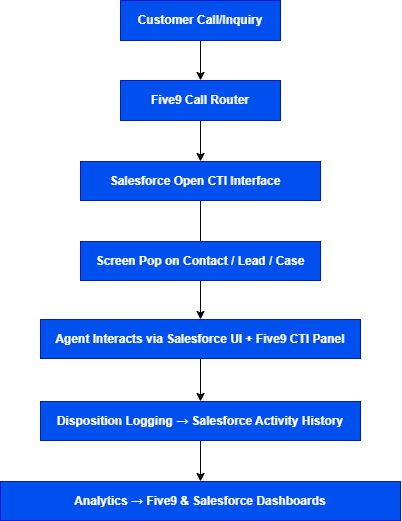
Whichever you choose, the integration works in four layers. Knowing them helps you see where each benefit in the next section comes from.
Five9 answers, routes and dials
Five9 handles the IVR, skills-based routing, queues, outbound campaigns, recording and Five9 AI Agents for self-service. Salesforce data can be passed into Five9 to inform routing, and an IVR script can capture an account or case number before the call reaches an agent.
Agents work in the Salesforce console
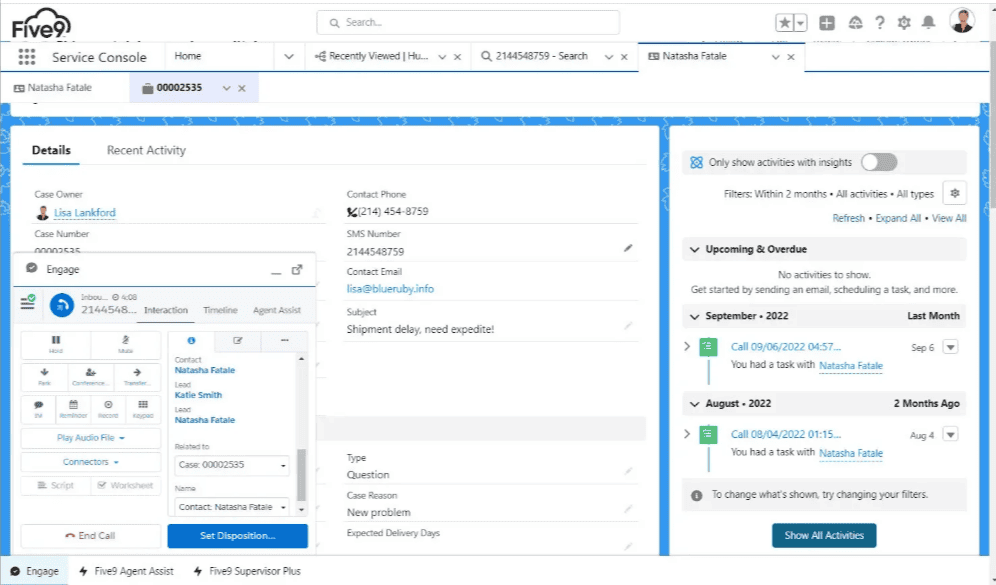
Call controls sit inside Salesforce: the Plus Adapter softphone in Lightning Experience, or the Omni-Channel widget with Fusion. Screen pop opens the matching record, and agents dial from any phone field.
Every call becomes a Salesforce record
Calls are logged as Tasks (Plus Adapter) or Voice Call records (Fusion) with timing, campaign and disposition. Those records drive Salesforce Flows, reports and dashboards, and presence is shared with Omni-Channel so agents are not given a case while on a call.
Transcripts, guidance and summaries
With Fusion, Five9 TranscriptStream feeds live transcripts to Einstein for Service features such as Next Best Actions and Call Summaries, or you can use Five9 Agent Assist. Since May 2026 the Plus Adapter also supports Agent Assist, writing the summary to the call Task (Five9 Agent Assist setup).
What Are the Benefits of the Five9 Salesforce Integration for Each Team?
Agents get one screen, context on every call and far less typing. Supervisors get call outcomes and transcripts they can coach from. Contact centre and revenue leaders get calls tied to cases and pipeline. IT gets one governed system instead of two drifting ones. Customers notice the result: fewer repeats, fewer transfers and faster answers.
Agents
The record opens with the call, numbers dial with one click, and the call logs itself. Time moves from admin to the conversation.
Supervisors and QA
Dispositions, recordings and AI summaries sit on the record, so coaching starts from what was said and what happened next.
Contact centre leaders
Handle time, repeat calls and case outcomes appear in the same Salesforce dashboard, so staffing and process decisions rest on one set of numbers.
Sales and RevOps
Salesforce Campaigns feed Five9 dialing lists, and every call lands on the lead or opportunity, so call effort can be tied to pipeline.
IT and Salesforce admins
A managed package, documented setup and one place for permissions, retention and automation, rather than exports and custom glue.
Customers
They explain themselves once. Information entered in the IVR or given to a Five9 AI Agent reaches the human agent's screen.
The customer point deserves emphasis. With Fusion, when a Five9 Voice AI Agent finishes a self-service conversation, its summary passes into the Salesforce voice call record, so the human agent who picks up does not ask the customer to start again (Five9). On the outbound side, Five9 syncs a Salesforce Campaign to a Five9 dialing list as agents add, change or remove its contacts and leads, which keeps lists current without exports (Five9 list synchronization).
Where Does the Integration Pay Off Most? Five Call Centre Scenarios
The integration pays off fastest where call volume is high and each call depends on CRM context: inbound customer service, outbound sales and lead response, blended teams handling voice and digital work, regulated outbound calling, and multi-brand or multi-region operations. Each scenario leans on a different set of features.
1. High-Volume Inbound Customer Service
InboundBest for: service desks, account support, order and billing queries.
The gain is in the first and last 30 seconds of every call. A caller enters an account or case number in the Five9 IVR, Five9 can validate it against Salesforce, and the exact record opens on the agent's screen when the call connects (Five9 IVR data capture). At the end, the disposition and call details are written to that record, and a Flow can open a follow-up case or schedule a callback.
2. Outbound Sales and Speed to Lead
OutboundBest for: inside sales, lead qualification, renewals and appointment setting.
Sales teams benefit when calling starts from Salesforce, not a spreadsheet. Click-to-dial works from any phone field, and the campaign can be set automatically, either the same for every agent or from a field on the record (Five9 automatic campaign assignment). Campaign-driven lists, call preview and dispositions such as Scheduled Callback keep the next action on the lead. Because every attempt is logged on the lead or opportunity, RevOps can finally see how call effort converts.
3. Blended Teams Working Voice and Digital
RoutingBest for: teams that take calls and also work cases, chats or emails in Salesforce.
When agents juggle calls in Five9 and cases in Salesforce, the classic failure is being offered both at once. Federated routing solves it: when an agent takes a call or accepts Salesforce work, their status changes in the other system so they are not given more work while busy (Five9 federated routing). Salesforce presence statuses can also be mapped to Five9 Not Ready reason codes, so supervisors see the true reason an agent is unavailable.
4. Regulated Outbound Calling
ComplianceBest for: financial services, healthcare, collections and any team calling under the TCPA or Do Not Call rules.
Compliance is easier to enforce in the tool than in a training manual. In Five9 domains with TCPA Manual Touch Mode enabled, agents must enter each number by hand, and click-to-dial, call previews and callbacks follow that rule (Five9 TCPA Manual Touch Mode). Agents with permission can add a number to the contact centre's local Do Not Call list from the softphone or through a Do Not Call disposition. That list is local to your contact centre and does not update the national registry, so your wider compliance process still applies.
5. Multi-Brand and Multi-Region Operations
ScaleBest for: groups running several brands, business units or countries.
Growth often means more than one contact centre. With the Plus Adapter, several Five9 domains can link to one Salesforce instance, or one domain to several instances, although Five9 does not recommend linking more than ten domains (Five9 supported configurations). For Fusion, Five9's October 2026 guide lists US, Canada, UK and EU data centres, an English or Spanish agent interface, and transcripts in six languages, one per subscription. Check those limits against your regions before you commit.
How Do You Build a Business Case for Five9 and Salesforce?
Build the business case from your own baseline, not vendor averages. Measure how long agents spend finding records and doing after-call work today, estimate the seconds the integration removes, multiply by monthly call volume, and add the value of follow-ups that no longer slip. Then set that against licences, implementation, data clean-up and training.
Pull four weeks of data from Five9 reports and Salesforce first, by call type. Then work through the value side with simple arithmetic. The figures in the right-hand column are an illustrative example for a mid-sized team, chosen to show the method. They are not benchmarks; replace every one with your own.
| Value driver | How to calculate it | Worked example (illustrative inputs) |
|---|---|---|
| Record search removed | Seconds saved per call × calls per month ÷ 3,600 | 15 seconds × 30,000 calls = 125 agent hours a month |
| After-call work removed | Wrap-up seconds saved per call × calls per month ÷ 3,600 | 20 seconds × 30,000 calls = about 167 agent hours a month |
| Capacity released | Hours saved ÷ productive hours per agent per month | 292 hours ÷ 120 hours = about 2.4 agents of capacity |
| Follow-ups recovered | Follow-ups missed today × share now automated × value of each | Use your own callback, renewal or case data |
| Outbound productivity | Extra connected calls per agent hour × conversion rate × deal or appointment value | Use your own Five9 campaign reports joined to Salesforce outcomes |
On the cost side, list every item, not only licences: Five9 licences, Salesforce Voice licences for admins and agents if you choose Fusion, the managed package, implementation and testing, data clean-up so screen pops find one record, rebuilding reports and Flows that read call data, recording and transcript retention, and agent training. A business case that ignores the data clean-up usually overstates the speed of the payback.
Two cautions keep the case honest. First, a drop in handle time that comes with more repeat calls is not a gain, so track first contact resolution alongside it. Second, released capacity is only worth money if you use it: to absorb growth without hiring, cut queue times, or move agents to higher-value work. Say which one in the case.
Is Your Call Centre Ready? An 8-Point Readiness Checklist
You are ready when agents already work in Salesforce Lightning, phone numbers and duplicates are under control, the disposition list is agreed with what each one should trigger, licences are budgeted, and someone owns call data retention. Gaps in any of these do not stop the project, but they belong in the plan before the build starts.
- 1
Lightning Experience. Both integrations run in Lightning. Five9 documents the Plus Adapter for Lightning Experience and the Lightning console, and Fusion inside the Omni-Channel widget.
- 2
Clean phone data. Screen pop matches on the caller's number, so consistent formats and few duplicate contacts decide whether one record opens or a list does.
- 3
An agreed disposition list. Map each disposition to the Salesforce action it should trigger. With Fusion, Five9 advises using its own disposition widget rather than Salesforce's.
- 4
The right licences and edition. Fusion needs Salesforce Voice licences and a Five9 domain enabled for it; Five9 lists Professional, Enterprise, Unlimited, Developer and Performance editions as supported.
- 5
Desktop prerequisites. For Fusion, a supported browser (Chrome, Firefox or Edge) and agent PCs synced to the world clock that Salesforce uses.
- 6
A retention decision. Fusion recordings play inside Salesforce but are kept by Five9 for 30 days, and Agent Assist archives do not sync to Salesforce. Decide where long-term records live.
- 7
Reports that read call data. List every report, dashboard and Flow that uses call Tasks. Moving to Fusion changes them to Voice Call records.
- 8
A baseline. Four weeks of handle time, after-call work, transfers and repeat calls by call type, captured before anything changes.
Requirements from the Five9 Fusion for Salesforce administrator guide (October 2026) and the Five9 Plus Adapter supported configurations. Confirm them for the version you install.
Which Five9 and Salesforce Myths Should You Drop?
Five assumptions cause most disappointment: that the integration is a plug-in, that every dialing mode works the same in every integration, that Salesforce keeps every recording, that Agentforce already runs Five9 calls end to end, and that the integration fixes bad data. Each is partly true at best, and the gaps are documented.
How Should You Start? A Pilot That Proves the Value
Start with one queue, not the whole contact centre. Baseline its metrics, build screen pop, click-to-dial and automatic logging in a sandbox, run a pilot with one team, and compare the results. Add automation, AI assistance and wider rollout only once the basics are stable and the numbers support the business case.
How Twopir Consulting Helps With Five9 and Salesforce
We implement, rescue, optimize, and integrate complex CRM and revenue systems. On a Five9 project, our part is the Salesforce side and the joins: the data model and screen pop rules, dispositions and the Flows they trigger, routing and presence, reporting that connects calls to cases and pipeline, and the business case that justifies it. See our Five9 Adapter for Salesforce services, our Salesforce Service Cloud solutions and our wider integration services.
We work with growing, mid-market, and enterprise organizations. Some are installing Five9 with Salesforce for the first time, some are planning their move off Open CTI before 2028, and some have an integration whose call data nobody trusts. In each case we start from your call types and the outcomes you need to report, then build backwards.
Build Your Five9 and Salesforce Business Case With an Architect
In a 30-minute discovery call, a Twopir Salesforce architect will review your call flows and current setup, help you choose the right integration, and outline a pilot that proves the value with your own numbers.
Schedule a Discovery CallThe Bottom Line
Integrating Five9 with Salesforce is less a technology upgrade than a change in what a call is: from a conversation that disappears when the line drops to a record the business can route, report on and act on. The benefits are real, but they come from design and clean data, and they should be proven on one queue before they are promised to the whole floor.
- 1
The biggest gains come from screen pop, click-to-dial, automatic logging and disposition-driven follow-ups.
- 2
Agents, supervisors, leaders, sales teams, IT and customers each benefit in a different way; make the case for each.
- 3
Build the business case from your own baseline, and count data clean-up and report rebuilds as costs.
- 4
Start new projects on Five9 Fusion for Salesforce, because Open CTI retires on 28 February 2028.
Frequently Asked Questions
The main benefits are shorter calls, because the customer's record opens as the call connects; less after-call work, because calls and dispositions are logged automatically; fewer missed follow-ups, because dispositions can trigger Salesforce Flows; and better reporting, because call activity sits on the same records as cases, leads and opportunities.
No. With either Five9 integration, agents answer, dial, transfer and disposition calls inside Salesforce. The Plus Adapter adds a Five9 softphone to Lightning Experience, and Five9 Fusion for Salesforce embeds Five9 call controls in the Salesforce Omni-Channel widget, so agents work from one screen.
Usually, if agents already work in Salesforce and calls depend on customer context. Multiply the seconds saved per call by your monthly call volume to estimate the hours released, then compare that with licences, implementation and data clean-up. A pilot on one queue is the cheapest way to prove the numbers before a full rollout.
New deployments should plan on Five9 Fusion for Salesforce, which runs on Salesforce Voice with partner telephony. Salesforce has scheduled Open CTI, the framework behind the classic Five9 Plus Adapter, for retirement on 28 February 2028, so building new on the Plus Adapter would mean migrating again. Fusion requires Salesforce Voice licences.
Yes. Sales teams dial from any Salesforce phone field, Salesforce Campaigns can sync to Five9 dialing lists, and every call attempt and outcome is logged on the lead or opportunity. That lets RevOps connect call effort to pipeline, and dispositions such as Scheduled Callback keep the next step on the record.
It helps enforce it. Five9's TCPA Manual Touch Mode makes agents enter numbers by hand in enabled domains, including for click-to-dial and callbacks, and agents with permission can add numbers to the contact centre's local Do Not Call list. The local list does not update the national registry, so your wider compliance process still applies.
Capture a four-week baseline before go-live: average handle time, after-call work, transfer rate, repeat calls and, for outbound teams, connected calls per agent hour. Compare the same call types after launch, and track first contact resolution alongside handle time so that faster calls are not hiding more repeat calls.
