
Streamline Your Salesforce Workflows With Formstack: The Complete Guide
Formstack Salesforce workflow automation connects three steps that usually break apart: collecting data on a form, turning a record into a document, and getting that document signed. This guide explains which Formstack products do each job inside Salesforce, when Formstack Workflows or Salesforce Flow should run the process, and what to set up so it keeps working.
Key Takeaways
- Formstack for Salesforce is three products: Forms for Salesforce (native data capture), Documents for Salesforce (document generation from records) and Formstack Sign (e-signature). Formstack Workflows is a separate Suite product that chains steps together.
- Pick one orchestrator per process. Use Salesforce Flow when the trigger is a record change. Use Formstack Workflows when the trigger is a person submitting a form and the next steps are handoffs between people.
- Automate document generation with Flow, not Process Builder. Salesforce stopped supporting Process Builder and Workflow Rules on December 31, 2025. Formstack's Flow action and High-Volume Generation replace the old patterns.
- Plan for two 2025–2026 changes: Forms for Salesforce needs managed package 4.162.1 or later plus a one-time External Client App migration, and Documents for Salesforce v1.339+ needs its permission sets assigned.
- Most failures are design failures: sandbox refreshes that break prefill links, document steps whose data cannot feed later steps, and approvals that live in email instead of a defined step.
What Is Formstack Salesforce Workflow Automation?
Formstack Salesforce workflow automation is the use of Formstack's form, document and e-signature products to run a business process on Salesforce data from start to finish. A form writes to Salesforce records, a document is generated from those records, and the document goes out for signature, with no copying and pasting in between.
The products do the mechanical work. The value comes from how they are connected: which object a form writes to, which record event triggers a document, who signs in what order, and where the signed file lands. A client intake, a service agreement, an onboarding packet or a renewal contract all follow the same pattern. Capture, generate, sign, record.
This guide is the workflow view. If you want depth on one product, our earlier guides cover data collection with Formstack Forms and document generation with Formstack Documents.
Capture
A Forms for Salesforce form creates or updates records directly in your org, optionally prefilled with what Salesforce already knows.
Generate
Documents for Salesforce merges record, parent and child data into a template to produce a PDF, Word, Excel or PowerPoint file.
Sign
Formstack Sign collects signatures by email or SMS, in a set order, with reminders and an audit trail.
Orchestrate
Salesforce Flow or Formstack Workflows decides what happens next: who approves, which path a submission takes, and when the next step starts.
Which Formstack Products Run A Salesforce Workflow Today?
Four products matter for a Salesforce workflow: Forms for Salesforce, Documents for Salesforce, Formstack Sign and Formstack Workflows. Formstack sells the first three together as its Salesforce solution, and Workflows as part of the wider Formstack Suite. The core Formstack Forms product also connects to Salesforce, but it stores submissions in Formstack rather than in your org.
Two naming changes cause confusion. In June 2025 the company rebranded from Formstack to Intellistack and launched a new platform called Intellistack Streamline, while stating that Formstack products continue to be sold and supported. Earlier, in 2019, Formstack Documents was developed from the WebMerge acquisition, which is why the record button and the Flow input in Salesforce still say "WebMerge".
| Product | What it does in the workflow | Where the data lives | How it reaches Salesforce |
|---|---|---|---|
| Forms for Salesforce | Native drag-and-drop forms that create or update any standard or custom object, with dynamic prefill and partial submissions | In your Salesforce org | Managed package from AppExchange |
| Formstack Forms | General-purpose online forms with approvals, conditional logic and 300+ integrations listed on the pricing page | In Formstack | Salesforce integration maps fields to create or upsert records |
| Documents for Salesforce | Merges Salesforce record data into templates on a button click, a mapping rule or a Flow action | Templates in Formstack Documents; output delivered to Salesforce, the cloud or Sign | Managed package plus an API key and secret |
| Formstack Sign | E-signature with signing order, SMS or email delivery, reminders and an audit trail | In Formstack Sign | Receives documents from Documents for Salesforce or a Workflows step |
| Formstack Workflows | Visual builder that chains form, document, sign and approval steps between people | In Formstack | Uses a Forms for Salesforce step as the first or a later step |
Product names, plans and capabilities as listed on formstack.com and the Forms for Salesforce and Formstack Documents AppExchange listings in October 2026. Confirm plan inclusions with Formstack before you buy.


What Does An Intake-To-Signature Workflow Look Like In Salesforce?
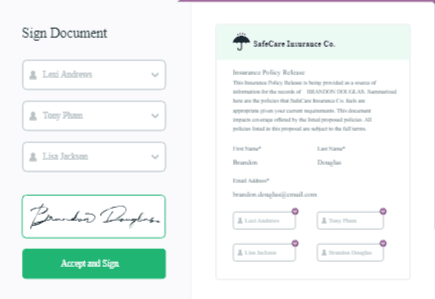
A typical Formstack workflow on Salesforce has five steps: a prefilled form updates the record, a record change triggers a document, the document goes to Formstack Sign, an approver signs off where policy requires it, and the documents are kept against the record. Each step has a clear owner and a clear trigger.
Formstack Workflows Or Salesforce Flow: Which Should Run The Process?
Use Salesforce Flow when a change to a Salesforce record should start the work, such as an Opportunity reaching Closed Won. Use Formstack Workflows when a person submitting a form starts the work and the next steps are handoffs between people, such as a request that needs a manager's approval before a document is signed.
The two can work together, but one of them should own each process. When both try to react to the same event, you get duplicate documents and steps that are hard to trace.
| Question | Formstack Workflows | Salesforce Flow |
|---|---|---|
| What starts it? | A Formstack Form, Forms for Salesforce or API step: every workflow must begin with one | A record being created or updated, a schedule, a screen or another flow |
| Approvals | Approval steps with any-or-all approvers, including people who are not Formstack users (Suite Teams plan) | Decision elements and Salesforce approval processes, run by Salesforce users |
| Branching | Step logic to stop, skip ahead or go back; Forms for Salesforce steps cannot be used in conditional logic | Full decision logic on any field, related record or formula |
| Documents | Document step mapped from earlier form fields; its data cannot feed later steps yet | "Generate Document" action using a Documents for Salesforce mapping ID, for one record or a collection |
| Signatures | Sign step by email, SMS or in the same browser session after a form | A Formstack Sign delivery set up for the generated document |
| Who builds it | Business users in a drag-and-drop canvas | Salesforce admins in Flow Builder, with sandbox testing and deployment |
| Best for | Requests, onboarding packets and service agreements that pass between people | Record-driven automation, bulk runs and anything that must update related records |
Sources: Formstack's Building a Workflow Overview, conditional logic and approvals and Workflows FAQ; Automatically Generate Documents with Flow.
Know the Workflows limits before you design around them. Steps cannot be rearranged once built: you delete and add them again. A form completed outside the workflow URL does not trigger the next step. Going back to an earlier form step creates a new submission instead of updating the first one. Forms for Salesforce steps in Workflows do not support dynamically prefilled forms or Community forms. None of these is a reason to avoid Workflows, but each one changes how you design the process.
How Do You Set Up Formstack Documents For Salesforce?
Setting up Formstack Documents for Salesforce comes down to five jobs: install the managed package from AppExchange, assign its permission sets, connect your Formstack Documents account with an API key and secret, build a mapping from a Salesforce object to a template, and add the Formstack Documents button to page layouts.
The steps below follow Formstack's Documents for Salesforce full setup guide. The screenshots come from an earlier release of the app, so some labels may differ slightly in your org.
- 1
Install and grant access. Install "Formstack Documents" from AppExchange as a System Administrator. Since version 1.339 the package uses permission sets: assign them to every user who generates documents, or those users get an error.
- 2
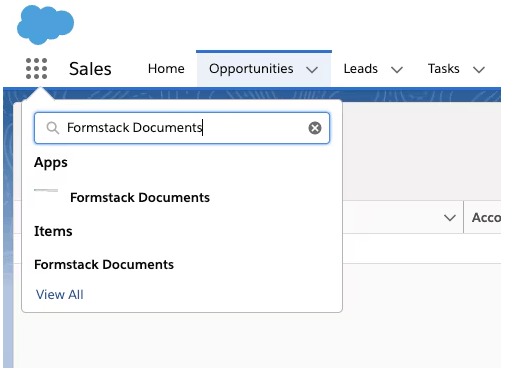
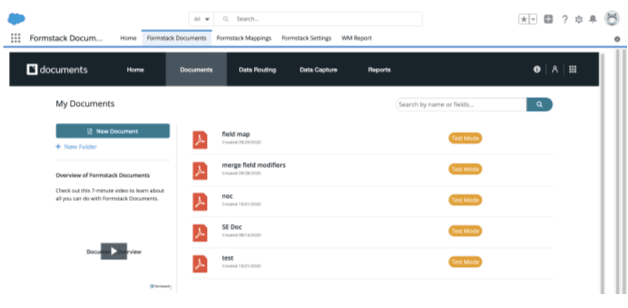
Open the app. Search for Formstack Documents in the App Launcher. The app adds three tabs: Formstack Documents, Formstack Mappings and Formstack Settings.
- 3
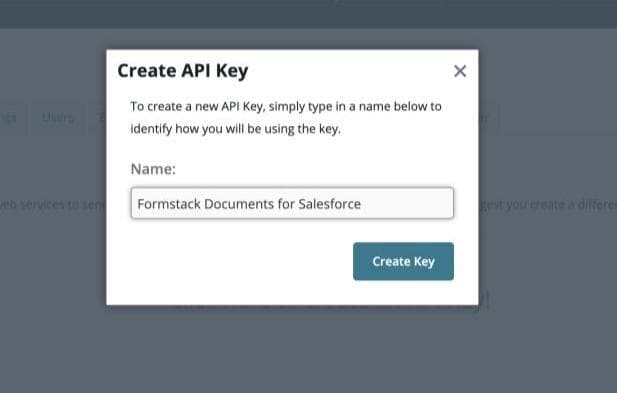
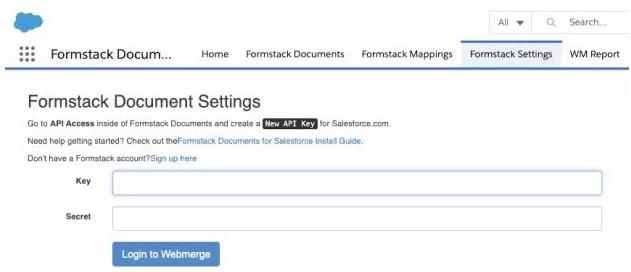
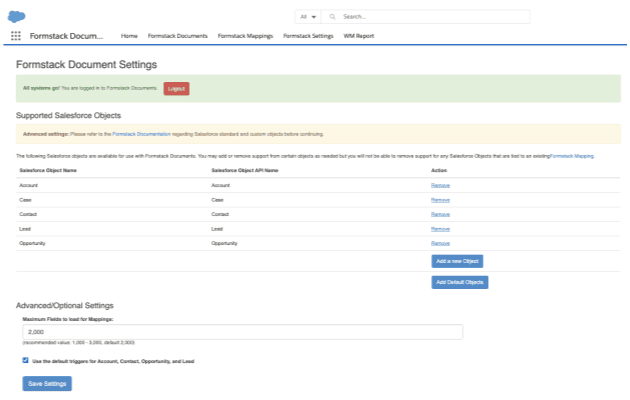
Connect your account. In Formstack Documents, open API Access under your profile, create and name an API key, then paste the key and secret into Formstack Settings in Salesforce and log in. Treat the secret like a password, and never put it in a screenshot or a shared document.
- 4
Choose objects. Account, Contact, Lead, Opportunity and Case are supported by default, and Formstack's guide explains how to add custom objects.
- 5
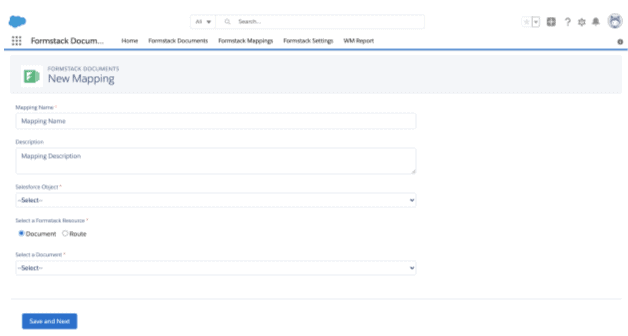
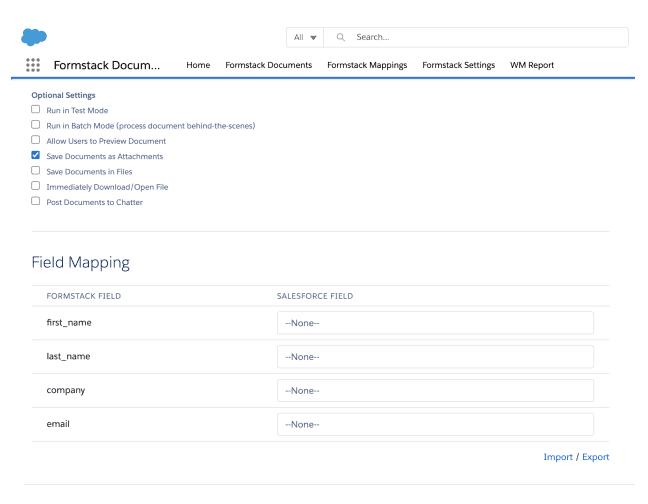
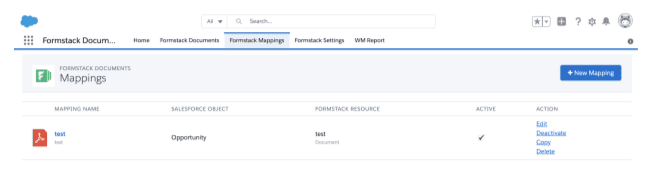
Create the mapping. Click New Mapping, name it, pick the Salesforce object, choose Document or Data Route as the resource, select the template, then match each template field to a Salesforce field.
- 6
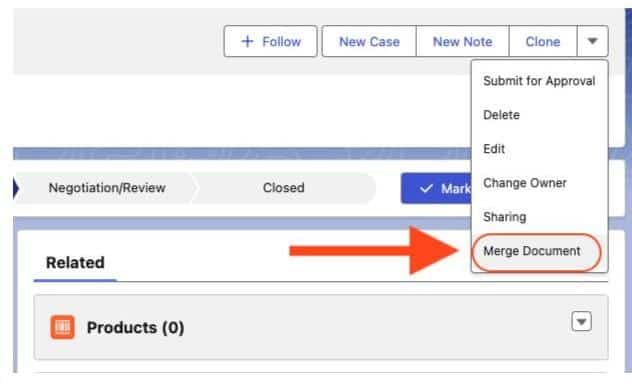
Activate and expose it. Save & Activate the mapping, then add the Formstack Documents button to the page layout so users can merge a document from the record on demand.
Mapping features worth knowing
Mappings reach beyond the record itself. You can pull fields from parent records such as Owner or Account, loop through child relationships such as Opportunity line items, and type an API field name when a field does not appear in the picker. Two features cover the edge cases:
- SOQL fields. Type
<< SOQL >>in a Salesforce field to pull data a simple field path cannot reach. - Custom fields at merge time. Type
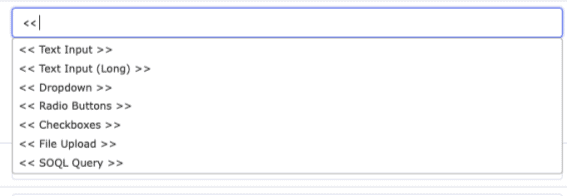
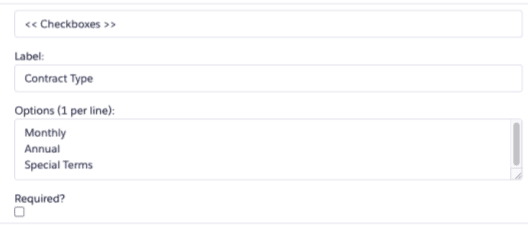
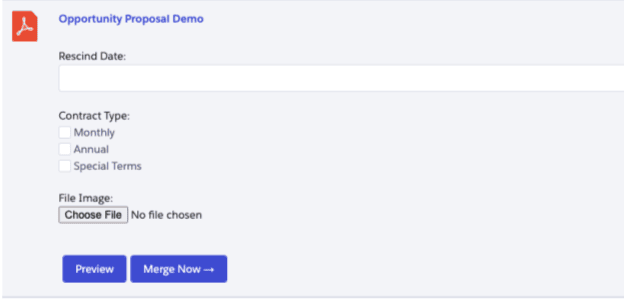
<<to add a text, long text, dropdown, radio, checkbox or file upload field that the person generating the document fills in at that moment, for example a contract term chosen per deal.
How Do You Generate Formstack Documents Automatically From Salesforce?
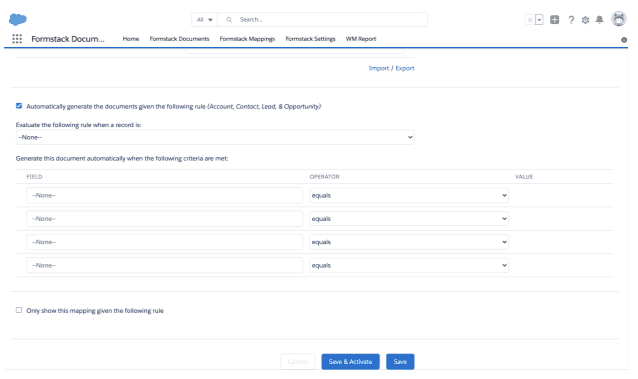
There are three supported ways to generate Formstack documents without a click: a simple rule on the mapping itself, a record-triggered Salesforce Flow that calls the Generate Document action, and High-Volume Generation for runs of thousands of records. Formstack's own setup guide calls Flow the more robust option.
| Method | How it works | Use it when |
|---|---|---|
| Mapping rule | Evaluate on create, on create and every edit, or on create and when an edit first meets the criteria; up to four criteria on the object or its parents | One document, one object, simple conditions |
| Record-triggered Flow | Add the "Generate Document" action; pass {!$Record.Id} and the mapping ID copied from the Formstack Mappings tab | Conditions span related records, or the document is one step in a larger automation |
| Flow with a collection | Get Records, use Transform to turn the records into a list of IDs, and pass the list to Generate Document | A batch of documents from a screen flow or another flow |
| High-Volume Generation | Checkbox under Optional Settings on the mapping; batch size 1 to 200 records, starting at 50 is recommended; cannot be combined with Batch Mode on the same mapping | Runs of thousands of records, such as statements, renewals or welcome letters |
Sources: Automatically Generate Documents with Flow and Formstack's High-Volume Generation announcement (September 2025), which states runs of 20,000+ records.
If your document automation still runs on Process Builder
Formstack still publishes an older guide for generating documents with Process Builder, and many orgs built it that way. Salesforce no longer supports Workflow Rules and Process Builder as of December 31, 2025. Existing processes keep running, but Salesforce no longer provides support or bug fixes for them. Rebuild document triggers as record-triggered flows using the Generate Document action, and test them in a sandbox first. Salesforce's Migrate to Flow tool converts record-triggered processes, though it has listed exceptions.
How Does Forms For Salesforce Capture Data Without Re-Keying?
Forms for Salesforce is a native form builder: submissions are processed and stored in your Salesforce org under Salesforce's security model, with no separate system to sync. To update data that already exists, it gives you two main methods, Upsert for blank public forms and Dynamic Prefill for personalised links, plus Advanced Prefill for programmatic lookups.
| Method | How it works | Best for |
|---|---|---|
| Upsert | Matches the submission to an existing record on a field you choose; updates it if found, creates a new one if not | Public website forms that should not show any Salesforce data |
| Dynamic Prefill | An encrypted link carries the org ID, primary record ID and form ID; the form loads live data from that record and related records | Profile updates, renewals, case updates and applications sent to a known person |
| Advanced Prefill | A programmatic search of Salesforce at runtime, using criteria you define, to find the record to prefill from | Cases where the record cannot be fixed in the link in advance |
Prefill links can be created by an automatic Apex trigger, emailed from the app, exported to CSV, generated in Flow, or built with custom Apex. Storing the link on the record lets your existing email or SMS automation send it. See Formstack's prefill overview and Dynamic Prefill guide for the setup.
What Breaks In Formstack Salesforce Workflows After Go-Live?
Formstack workflows rarely fail because a feature is missing. They fail when an org changes around them: a sandbox refresh, a package upgrade, a new user without permissions, or an automation platform reaching end of support. These are the issues we plan for on every build.
Where Does AI Fit In Formstack For Salesforce?
AI in Formstack today speeds up building, not running, a workflow. The AI form builder drafts a form from a written prompt, and the AI document builder drafts a template when you choose "Use AI Assist". Both produce a first draft that a person still has to review, connect to Salesforce and test.
According to Formstack's AI form creation article, the feature uses Anthropic's Claude in AWS Bedrock, an org admin has to enable it, and Formstack says it does not train AI on the forms you create. It cannot yet add show/hide logic, change field settings, update emails or set up integrations, so those steps stay manual. The AI document builder works the same way for templates.
Two newer AppExchange listings from Intellistack are worth watching: a Formstack Agentforce Extension for Forms for Salesforce, described as "formless" data collection through Agentforce agents, and Intellistack Streamline for Salesforce, a workflow and contract lifecycle product. Neither had any ratings when we checked in October 2026, so test them against your own requirements before you plan around them.
How Twopir Delivers Formstack Workflows On Salesforce
We implement, rescue, optimize, and integrate complex CRM and revenue systems. For Formstack, that means designing the process before configuring the tools: which object owns the data, which system starts each step, who approves, and what happens when a step stalls. Then we build it across Forms for Salesforce, Documents for Salesforce, Sign, Formstack Workflows and Salesforce Flow, with each piece doing the job it is best at.
We help growing and mid-market companies, as well as enterprise teams, with this work. Typical starting points:
- A new intake-to-signature process built end to end: our Formstack Salesforce integration service.
- Approvals and handoffs that currently live in email: our Formstack workflow automation service, which also decides what belongs in Flow instead.
- Templates and generation rules that nobody can safely edit: our Formstack document automation service.
- An existing Formstack estate with form sprawl, broken integrations or Process Builder triggers: a Formstack audit and optimization.
For a worked example, our document generation case study shows a manufacturing client whose receipts, agreements and payment records moved from manual creation to Salesforce field mapping and trigger-based Flow automation on WebMerge, the product now sold as Formstack Documents.
Map Your Formstack Workflow With A Salesforce Architect
In a 30-minute discovery call we walk through one process, from the first form to the signed document, and show you where it should run in Formstack Workflows, where it belongs in Salesforce Flow, and what to fix first.
Schedule a Discovery CallThe Bottom Line
Formstack gives a Salesforce team the parts of an intake-to-signature workflow: native forms, record-driven documents and e-signature, plus a workflow builder for handoffs between people. The result depends on decisions the products do not make for you, such as which system starts each step, how data moves between steps, and how the setup survives sandbox refreshes, package upgrades and the end of Process Builder.
- 1
Forms for Salesforce captures data natively, Documents for Salesforce turns records into documents, and Formstack Sign collects signatures; Formstack Workflows chains steps between people.
- 2
Let Salesforce Flow own record-triggered automation and Formstack Workflows own form-started handoffs, never both for the same event.
- 3
Move document triggers off Process Builder to the Flow Generate Document action, and use High-Volume Generation for large runs.
- 4
Put the External Client App migration, permission sets and sandbox steps on your release checklist.
Frequently Asked Questions
Forms for Salesforce is fully native: forms are built, and submissions processed and stored, inside your Salesforce org. Documents for Salesforce is a managed package that connects to your Formstack Documents account with an API key, where the templates live. Formstack Sign is a separate service that receives documents for signature.
Formstack Workflows chains form, document, approval and signature steps between people, and every workflow starts with a form. Salesforce Flow automates work when Salesforce records change and can call the Formstack Generate Document action. Use Flow for record-driven automation and Workflows for form-started handoffs.
Yes. A mapping can generate a document when up to four criteria are met, a record-triggered Flow can call the Generate Document action with the record ID and mapping ID, and High-Volume Generation processes large batches of records in configurable batch sizes.
The company rebranded from Formstack to Intellistack in June 2025 and launched a new platform, Intellistack Streamline. It stated that Formstack products continue to be sold and supported, and the Formstack apps on AppExchange are now listed under Intellistack as the provider.
Existing processes keep running, but Salesforce stopped supporting Workflow Rules and Process Builder on December 31, 2025, so they receive no support or bug fixes. Rebuild Formstack document triggers as record-triggered flows that use the Generate Document action.
Salesforce is moving third-party integrations to External Client Apps. Formstack asks Forms for Salesforce customers to upgrade to managed package version 4.162.1 or later from AppExchange and complete a one-time migration of the connection to an External Client App.
